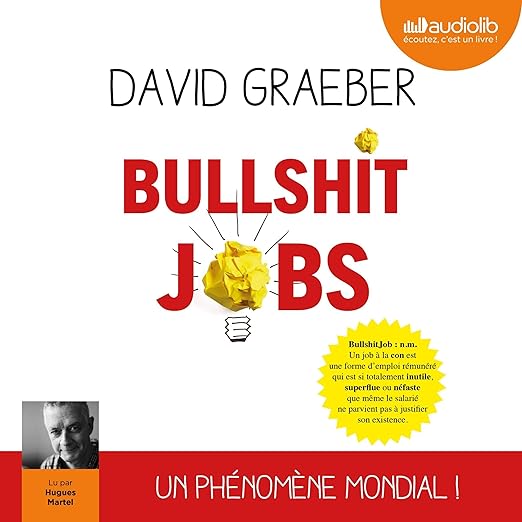
David Graeber's Bullshit Jobs arrives as one of those rare works of social criticism that names something so obvious it seems impossible nobody named it before. The audiobook version, narrated by Hugues Martel and running 13 hours and 41 minutes, is performed in French, which will immediately matter to some listeners and not at all to others. But the argument itself cuts across any language. Graeber, the late anthropologist and anarchist thinker best known for Debt: The First 5,000 Years, spent five years gathering testimony and theory to explain why a significant percentage of the global workforce is employed doing work that everyone involved privately knows serves no useful purpose. He called these positions bullshit jobs, and the concept went viral the moment he published a short essay on the subject in 2013. This full-length audiobook is the systematic, research-backed expansion of that original provocation.
Listener reviews are overwhelmingly enthusiastic. One describes it as "absolument génial" and praises the "écriture extrêmement fine, pleine d'humour pince sans rire." Another arrived expecting to disagree and came away converted. The book's reach across political identities is one of its genuine achievements: whether you lean toward labor organizing or personal accountability, Graeber's taxonomy of pointless work has an uncomfortable way of clarifying what you already suspected about your own professional life. The book carries a 4.4 rating from 432 listeners, a figure that understates how polarized reactions can be, since a handful of listeners gave one star primarily for discovering the French-language edition rather than the English one they intended to purchase.
From Flunkies to Goons Across 13 Hours
What makes Bullshit Jobs worth 13 hours of your attention is Graeber's insistence on taking the psychological consequences of meaningless work seriously rather than simply cataloguing its existence. The depression, the anxiety, the erosion of self-worth that comes from performing elaborate rituals of productivity that produce nothing real: these are the individual costs of a system that has somehow organized itself around keeping people occupied rather than useful. Graeber draws on philosophy, economics, and hundreds of firsthand testimonies to make the case that this is not accidental but structurally embedded in how power operates under modern capitalism. The book is funny in the bleak way that recognition of absurdity produces a kind of laughter, and then quickly sobering again when the structural analysis resumes.
Martel's narration is a good match for the material. His pacing is unhurried, his delivery measured without being stiff, and the slight irony Graeber deploys throughout translates well in a French-language performance. The book does make demands on the listener: this is not light listening. Graeber builds his argument methodically, which means the early chapters can feel like groundwork that pays off only later. Listeners who want the thesis fast and want out might prefer the original 2013 essay. But those willing to follow Graeber through his full categorization of job types, from flunkies and box tickers to taskmasters and goons, will find the intellectual payoff substantial.
Pointless Work as a Kind of Spiritual Violence
The audiobook format serves this material particularly well because Graeber's prose is built for voice: it has the rhythm of a careful speaker who has given these lectures many times and refined the phrasing. The 13-hour runtime allows for the full deployment of his comparative methodology, including how different cultures and historical periods have organized work around meaning rather than market logic. His call at the end for a reorientation of values, one that would put creative and caring work at the center of civilization rather than at its margins, lands with real weight because he has spent the preceding hours establishing precisely why the current arrangement produces such widespread private suffering.
For anyone who has ever sat in a meeting that existed only to justify having meetings, or processed paperwork that disappeared without effect, or managed reports that nobody read, this audiobook provides not just a framework but a kind of validation. Graeber is careful not to turn this into simple complaint. The structural analysis is genuinely sophisticated, even when he delivers it accessibly. That combination of academic rigor and readable argument is what made Bullshit Jobs a publishing event, and the audiobook preserves it intact. The section on the psychological effects of pointless work, what Graeber describes in terms of spiritual violence, is the most emotionally demanding portion and also the most important. Listeners who want to understand why so many people who are nominally successful report feeling empty at work will find Graeber's analysis the most precise account available.
A One-Star Review Over the Wrong Language
The most significant practical consideration here is the language: this is the French edition, and Martel's narration is entirely in French. The one-star review from a listener who didn't realize this before purchasing is a fair warning. If you are an English-only listener, you want the English-language edition. Set that aside, and the primary challenge is Graeber's density. He is not trying to be difficult, but he is trying to be thorough, and thorough arguments sometimes require sustained attention across multiple listening sessions. The section on the psychological effects of bullshit jobs, particularly the discussion of what he terms spiritual violence against workers, is the most emotionally demanding portion and also the most important. Do not skip it.
It is also worth noting that Graeber died in 2020, which lends the book a retrospective quality now that was not present at publication. His anger on behalf of workers who have been robbed of the possibility of meaningful contribution feels, if anything, more relevant in the years since. The book ends with a call to revolt, not necessarily in the streets but in our collective imagination of what work is for, what a society that valued actual contribution over the performance of busyness might look like, and why that vision is not utopian but achievable.
Important Social Criticism, Wherever You Access It
This audiobook is well suited for anyone in office work, management consulting, finance, or the administrative sectors of large organizations who has ever suspected that their job title describes something that would not be missed if it disappeared. It will also appeal to readers of Graeber's other work, to anyone interested in economic anthropology, and to listeners who found Matthew Crawford's Shop Class as Soulcraft or Rutger Bregman's Utopia for Realists worth their time. French-language listeners specifically will find Martel's narration a strong match for the material. English-only listeners should verify they are purchasing the correct edition before proceeding. The argument, wherever you access it, is one of the more important pieces of social criticism produced in the past two decades.
Key Details
- Voice: Hugues Martel delivers Graeber's dense sociological arguments in measured, dry French that suits the subject well, though English-only listeners should note the performance is entirely in French.
- Big ideas: Meaningless labor, late-stage capitalism, the politics of work and dignity
- Atmosphere: Sharp and indignant, occasionally darkly funny
- Worth it?: A genuinely important book about why so much modern work feels hollow, made more urgent by Graeber's gift for connecting individual misery to structural failure.
Is the audiobook of Bullshit Jobs narrated in French or English?
The version narrated by Hugues Martel is the French-language edition. If you need the English version, search specifically for the English audiobook edition to avoid purchasing the wrong one.
How long is the Bullshit Jobs audiobook and is it worth the full runtime?
The audiobook runs 13 hours and 41 minutes. Graeber uses that length methodically, and listeners who stay through the full categorization of job types will find the structural analysis pays off in the final chapters. Skimming is not well served by this book.
Does the audiobook include Graeber's five years of research and testimony, or is it an abridged version?
This is the full, unabridged edition covering Graeber's complete argument: the taxonomy of bullshit job types, the psychological costs to workers, the structural economic causes, and his concluding call for a reorientation of values around meaningful work.