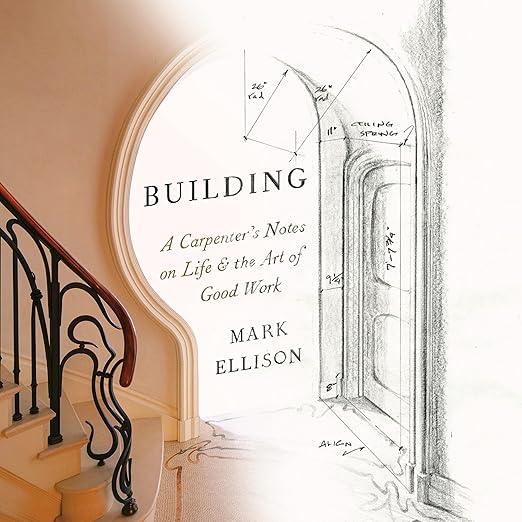
I started listening to Building on a Tuesday morning commute and finished the last hour sitting in my parked car outside the grocery store, unwilling to go in until it was done. That is not a reaction I predicted. A book about carpentry in New York luxury apartments does not sound like the kind of thing that stops you mid-errand. But Mark Ellison is doing something considerably stranger and more interesting than a trade memoir, and Paul Bellantoni's narration understands that from the first chapter.
Ellison has spent forty years building things that most people will never see, in apartments they will never visit, for clients whose names he cannot always legally mention. He built a staircase that Santiago Calatrava called a masterpiece. He constructed the sculpted core of the Sky House, which Interior Design named Apartment of the Decade. His clients have included David Bowie and Robin Williams. He is regarded by many as the best carpenter in New York. And the book he has written from inside that career is not primarily about any of those credentials.
Deceptive Minimalism Is Harder to Build Than It Looks
What Ellison is actually writing about is what it means to spend decades becoming exceptionally good at something most people overlook. The carpentry is the vehicle. The subject is mastery, the kind that accumulates slowly, that requires you to study your processes and invest yourself in the product of your labor in ways that go well beyond collecting a paycheck. One reviewer who came to the book through an NPR interview captured this perfectly, noting that Ellison's work ethos amounts to: if you make something, make it count, study your processes, work fast and smart, strive to master all aspects of your craft.
That sounds like self-help platitude when summarized. In Ellison's telling, it is not. He earns every insight through specific, often darkly funny stories about the gap between what clients want and what is actually buildable, about architects who design staircases that would be deadly as drawn, about minimalist aesthetics that are vastly more complicated to execute than their apparent simplicity suggests. The deceptive complexity of minimalist design is one of his recurring themes, and he handles it with the authority of someone who has spent years making the difficult look effortless while watching clients assume it was easy.
Escargot Snails and Wharton-Level Wealthy Clients
Because Ellison is genuinely funny about the ultra-wealthy in a way that never curdles into bitterness. One reviewer invoked Edith Wharton's portraits of shallow, cruel characters inhabiting New York's upper reaches, noting that Ellison's clients are no more evolved than Wharton's fictional ones. Ellison himself makes this observation more obliquely, through accumulated anecdote: the algae-eating snails boiled to escargot in a penthouse pond, the outlandish demands that characterize life in high-stakes luxury construction. He renders these people without contempt but without illusion either.
The book also works as a meditation on creative fulfillment that sits outside the usual self-improvement frameworks. Ellison did not become the best carpenter in New York by optimizing or hustling or building a personal brand. He became it by caring obsessively about the quality of his work over a very long time. There is something both obvious and genuinely radical about that argument, and Bellantoni's narration gives it room to land without overselling it.
Same Book, Different Title, No Disclosure
Ellison's musings on work and creativity sit alongside immersive storytelling, which means the book has a layered structure. The anecdotes about specific projects, some involving genuinely dangerous structural problems, alternate with more essayistic passages about what he has learned from four decades of building. Listeners who want the stories may find the philosophy occasionally slow; listeners drawn to the philosophy may want the stories to stop interrupting it. Most readers seem to find the balance works, but it is worth knowing going in that this is not a straightforward narrative.
There is also a note about the editions: a reviewer flags that this book was republished under a different title, How to Build Impossible Things, by a different imprint within the same publishing conglomerate, without disclosure. For audiobook listeners, this is not a practical concern, but it is worth knowing if you see both titles and wonder whether they are different books. They are not.
Bellantoni Gives the Trade Nine Full Hours
Anyone who has spent time in a skilled trade will find Ellison's observations resonant in ways that go beyond carpentry. Anyone who has ever worked for demanding clients in any field will recognize his portraits of people who confuse cost with quality. And anyone who has simply wondered what it feels like to commit to doing one thing very well for a very long time will find something here worth sitting with. The audiobook format, running just over nine hours, gives Bellantoni enough time to let the reflective passages breathe.
It is not for listeners who want a conventional memoir arc with a clear personal transformation narrative. Ellison resists that structure. He does not conclude that carpentry saved him or that luxury clients taught him the true meaning of something. He concludes, more modestly and more honestly, that doing good work over a long time is its own answer to a lot of questions people spend fortunes trying to resolve elsewhere.
Is Paul Bellantoni's narration well suited to Ellison's writing voice?
Reviewers who comment on the narration find it a good match. Bellantoni reads Ellison's blend of candid observation and dry wit without overplaying either quality, which suits a book that earns its insights through restraint.
How does Building compare to other craft-based memoirs like Shop Class as Soulcraft by Matthew Crawford?
Both books use skilled manual work as a lens for philosophical reflection, but Ellison's book is more anecdote-driven and less polemical than Crawford's. Building is warmer and funnier; Shop Class as Soulcraft is denser and more argumentative. They complement each other well for listeners interested in the subject.