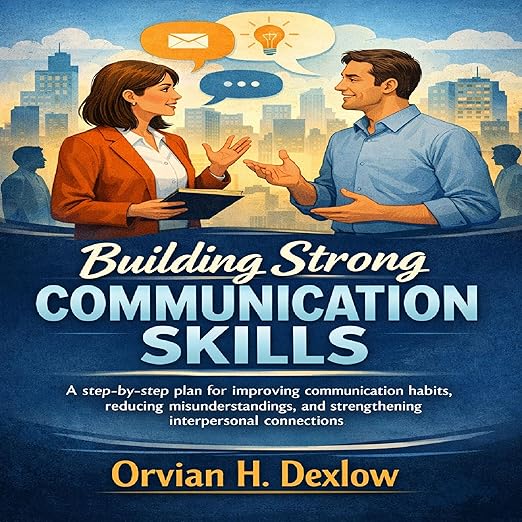
Orvian H. Dexlow opens Building Strong Communication Skills by dismantling one of the most persistent myths in professional development: that effective communication is a natural talent possessed by a fortunate few. It is, Dexlow argues, a learnable skill, and this audiobook is structured entirely around that premise. The approach is practical and deliberately non-academic, aimed at listeners who want to improve how they express themselves, listen to others, and connect in ways that hold across both personal and professional contexts. The promise is tools you can apply immediately, and the book takes that promise seriously in its architecture.
At three hours and twenty-six minutes, this is a lean production. Dexlow does not spend significant time on foundational theory before moving to application; the ratio of framework to practice leans toward the latter, which is appropriate for an audiobook in this category. Communication skills training that stays primarily theoretical loses credibility with the audience it most needs to reach, the people who already know they want to improve but have not yet found a structure for doing so. Dexlow is aware of this tension and stays close to the concrete throughout.
The book's core proposition is structured in three interconnected domains: how you express yourself, how you listen, and how you connect. Treating these as distinct skills that interact, rather than as a single undifferentiated capacity called communication, is a useful organizational move. Many people who struggle with communication have one of these areas significantly weaker than the others - someone who expresses themselves clearly but listens poorly, or someone who listens with care but cannot organize their expression effectively. By separating the components, Dexlow allows listeners to locate their own specific gaps rather than working through the entire curriculum as if every element is equally new.
The active listening sections are among the stronger parts of the book. Listening is chronically undertreated in communication training, which tends to focus on the output side of the exchange, on speaking clearly, on structuring arguments, on managing tone. Dexlow gives listening genuine attention as a skill with its own disciplines and failure modes, and the practical suggestions here, for what to do with your attention, your body, and your responses during a conversation when the other person is speaking - are specific enough to be immediately applicable rather than generically encouraging.
Leonard Jr.'s Narration Is Precisely Calibrated
Eddie Leonard Jr.'s narration is a competent match for the material. The instructional register of the content benefits from a clean, direct delivery that does not call attention to itself, and Leonard Jr. provides exactly that. His pacing gives the listener time to absorb each point before moving on, which matters for a book asking its audience to not just follow an argument but to internalize and apply frameworks. There are no dramatic flourishes that would feel out of place in an educational production, and no flat monotony that would make sustained listening difficult. It is precisely calibrated narration for the material's needs.
For listeners who want to strengthen their communication at work, the book is particularly useful in the sections addressing professional interactions, managing difficult conversations, and building confidence in contexts where the stakes feel high. Dexlow is practical and non-condescending in how he addresses anxiety around communication, framing confidence not as something you have or lack but as something that builds with repeated, structured practice. That framing will land well for listeners who have tried motivational approaches to communication improvement and found them insufficient.
Working With the Confidence You Already Have
The book's brevity means some topics receive coverage that a longer treatment would deepen. Workplace-specific scenarios, for example, are addressed but not comprehensively enough to replace more specialized resources on negotiation or difficult conversations in hierarchical settings. Listeners who have very specific professional communication challenges, such as presenting to senior leadership, managing cross-cultural teams, or navigating conflict in highly politicized environments, will find this useful as an orientation but will need to supplement it with more targeted resources.
The lack of reviews at the time of this writing makes it difficult to triangulate how the book performs for different types of learners. Audio-only learners sometimes find that communication skills training benefits from visual frameworks, diagrams, or worksheets that reinforce the listening experience. Dexlow does not appear to have companion materials, and listeners who typically use audio as a supplement to reading rather than as a primary learning mode should factor that in.
One element of Dexlow's approach that distinguishes this book from comparable titles is its treatment of confidence not as a prerequisite for communication but as a byproduct of practice. Much communication training implicitly assumes a baseline social ease that it does not address directly; Dexlow confronts the anxiety variable head-on, treating nervousness and self-consciousness as normal states to work with rather than deficiencies to overcome before the real learning can begin. This framing is practically useful because it removes the gatekeeping assumption that confident communication is something you either have or are working toward from scratch. You are working with what you have, and the tools Dexlow provides are designed for that starting point.
Designed as a Foundation for Early Careers
This audiobook serves best as a practical starting point for listeners who know they want to improve their communication but have not yet found a framework that makes the work systematic. It is particularly well suited to early-career professionals, people navigating significant life transitions that require new communication demands, and anyone who has received feedback about their communication style and wants structured tools for addressing it. Experienced communicators looking for advanced material will find it covers familiar ground; the book is explicitly designed as a foundation rather than a refinement. For the right listener at the right stage, it is a well-constructed entry point.
At a Glance
- Narrator: Eddie Leonard Jr. delivers a clean, professional reading that suits the instructional register of the material without adding unnecessary theatrical weight.
- Subjects: Practical communication frameworks, active listening as a learnable skill, confidence in professional and personal expression
- Tone: Focused and actionable, brisk without being rushed
- Bottom line: A functional communication skills primer for listeners who want structured tools they can apply immediately rather than theory to absorb gradually.