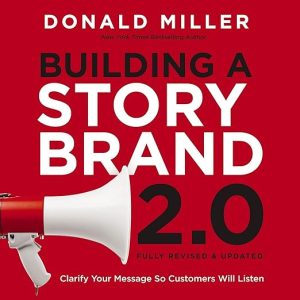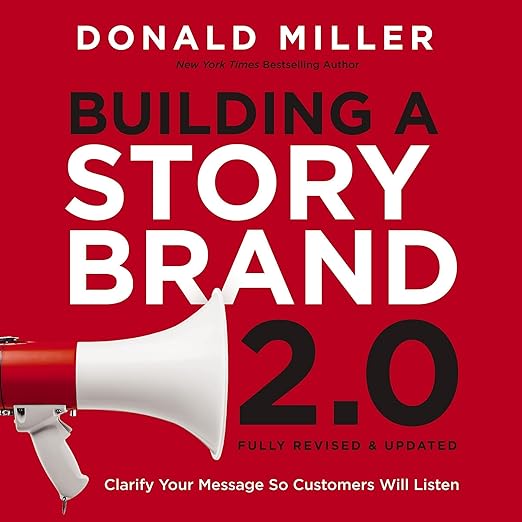
One million business leaders already bought into Donald Miller's original StoryBrand framework, which means this 2.0 audiobook has to justify itself against its own runaway success rather than against some other author's competing idea. It mostly does. Miller's core claim, that most companies talk about themselves when they should be positioning the customer as the hero and the brand as the guide, isn't new information by now to anyone who follows marketing books, but this revised seven-element framework is sharper and more usable than the original, and Miller narrates the audiobook himself with the polish of someone who has pitched this exact material from a stage hundreds of times.
Closer to Screenwriting Logic Than Marketing Jargon
The seven universal story elements borrow directly from classic narrative structure, a character with a problem meets a guide who offers a plan, calls them to action, and helps them avoid failure and reach success, applied wholesale to how a business talks about its own product. It's a genuinely clean piece of applied storytelling theory, closer to screenwriting logic than to typical marketing-department jargon, and that's part of why the framework has stuck with so many readers since the original release.
This isn't a light repackaging. The synopsis is explicit that Miller 'deepens his teaching' on the seven elements and adds new tools aimed at brand-messaging efficacy, and the content bears that out: this reads like a genuine second pass by someone who has spent years watching where the original framework succeeded and where clients got stuck applying it.
The Guide Never Becomes the Story's Hero
The book's own framing pushes hard on universality, insisting the framework applies as much to a multibillion-dollar marketing director as to a small business owner, a politician, or a touring musician, and that range mostly holds up because the underlying structure is about clarity of message, not about any one industry's specific tactics.
The seven-element framework sits inside a much older tradition of extracting a repeatable structure from how stories actually work, the kind of analysis that has shaped decades of writing about narrative form, and then applying that structure somewhere outside fiction entirely. What makes Miller's specific version useful rather than academic is how relentlessly he translates each story beat into a business action: not an abstract claim that a guide reassures the hero, but the specific words a company's homepage should use to reassure a confused, half-convinced customer scrolling past on their phone.
The 'guide' role in Miller's framework draws on the same archetype that shows up across decades of popular storytelling, the wise outside figure, a Yoda or an Obi-Wan type, who never becomes the story's hero but makes the hero's success possible. Miller's insight is straightforward but genuinely useful once applied: most companies instinctively write their own marketing as if they're the hero of the story, when the position that actually sells is the guide's, standing just off to the side of the customer's own journey.
Miller Performs This the Way It Was Designed
Miller narrates in what is essentially his native professional register. This is stage material he has delivered as a speaker and consultant for years, which means self-narration here isn't a novelty, it's closer to hearing the material performed the way it was originally designed to be heard.
Listener reaction leans heavily on repeat engagement: one reviewer who has followed Miller's work for years and taken a related course said the 2.0 material still left them 'blown away' by how much value it delivered. Another called the information 'crisp' with enough real business examples to make the framework concrete rather than abstract, and a third specifically praised how well it works for anyone building their own brand or personal story.
Narrated by the Person Who Developed It
At six and a half hours, the runtime is tight enough to finish quickly while still giving each of the seven story elements room to land with its own examples, rather than rushing through the framework as a bullet-point list.
Miller leans on real, recognizable companies throughout as worked examples rather than hypothetical case studies, which gives listeners something concrete to hold onto as each of the seven elements gets introduced one at a time. Hearing those examples narrated by the person who developed the framework himself, rather than read cold by someone encountering the material for the first time, keeps the pacing tight through what could otherwise feel like a long string of disconnected case studies.
BrandScript Only Comes Alive With the PDF
The audiobook comes with a companion PDF of story maps, charts, and tools for building your own BrandScript, and this is genuinely necessary if you want to apply the framework, not just understand it intellectually. Audio alone will teach you the seven elements clearly; actually mapping your own brand onto them requires the visual worksheet.
Despite the claimed universal applicability, the framework is built through a marketing and messaging lens first. Listeners in roles with little direct customer-facing communication may need to do real translation work to find the practical use case for their specific job.
The seven elements arrive briskly, one chapter each, which keeps the six-and-a-half-hour runtime tight but also means listeners without a pen and the companion PDF handy may find the concepts start to blur together by the fifth or sixth element without pausing to apply each one to their own business before moving forward.
Because this is Miller's own voice describing his own framework, listeners should expect an inherently promotional undertone at points, particularly when the book references Miller's own consulting services and courses directly; the core teaching stands on its own merits, but it arrives inside a broader business ecosystem Miller is also actively selling alongside it.
Donor Communication Gets the Same Hero Logic
This is built for marketers, founders, and anyone responsible for how their offering gets described to customers, along with readers who enjoy narrative-structure thinking applied outside of fiction. It works equally well for complete newcomers and for people who read the original StoryBrand, since this is a full revision rather than an addendum.
Consultants and agencies that work with client messaging will find this doubles as a genuine diagnostic tool, a fast way to identify why a client's existing marketing isn't landing with its audience, which extends its usefulness well past a single listen-through and into ongoing client work.
Nonprofit leaders and mission-driven organizations will find the framework translates cleanly beyond pure commercial selling, since the same customer-as-hero logic applies just as well to donor communication and volunteer recruitment as it does to a traditional sales funnel.
Skip this if you want granular execution tactics like ad copy or funnel mechanics rather than a higher-level messaging framework, or if the hero's-journey-as-marketing-metaphor idea itself doesn't appeal to you; that conceit is the entire spine of the book.