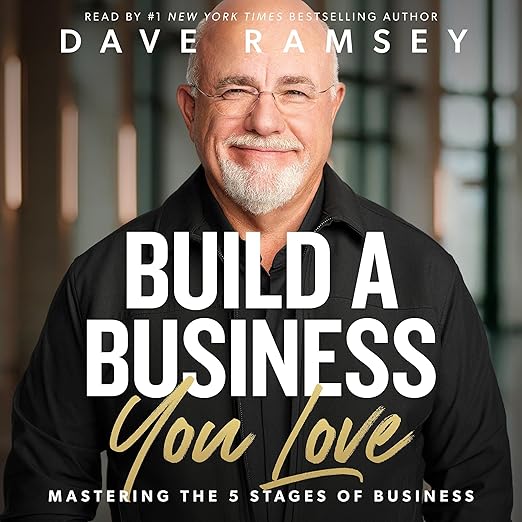
Quick Take
- Voice: Dave Ramsey narrates with the practiced conviction of three decades running his own company.
- Big ideas: business scaling, leadership stages, entrepreneurship
- Atmosphere: Direct and motivational
- Worth it?: A practical framework for owners ready to grow past the founder-does-everything stage, delivered in Ramsey's signature style.
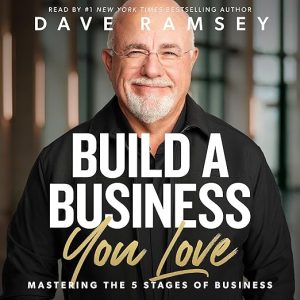
A card table in Dave Ramsey's living room was the entire operation once, and this audiobook of Build a Business You Love traces the thirty-year climb from that card table to Ramsey Solutions, a company with more than a thousand team members and roughly 250 million dollars in revenue. Ramsey doesn't pretend the path was clean; he's upfront across this audiobook's four hours and fifty-six minutes about plenty of wrong turns alongside the right ones, and that honesty about his own mistakes is what keeps the framework from feeling like simple success-story bragging. The title's phrasing is deliberate: a business you love, rather than simply a successful business, signals Ramsey's actual argument, that scaling a company without losing your own passion for it is a distinct challenge from scaling revenue alone, and plenty of founders manage the second while quietly losing the first somewhere around stage two or three of his framework.
Five Stages, Each With Its Own Failure Mode
The EntreLeadership System Ramsey lays out organizes business growth into five distinct stages: Treadmill Operator, Pathfinder, Trailblazer, Peak Performer, and Legacy Builder, each with its own specific challenges around hiring, budgeting, and strategic planning. Reviewer W. RTP describes the practical value plainly: the five-stage framework 'helps you quickly identify where your business is and what to focus on next,' with advice that's 'practical, motivating, and based on real experience, not theory.' That last distinction matters, since Ramsey isn't drawing on secondhand case studies or academic research; every stage in this framework comes from decisions he personally made, right or wrong, while actually running Ramsey Solutions through each phase of its own growth. Each of the five stages gets its own specific failure mode in Ramsey's telling: Treadmill Operators burn out doing everything themselves, Pathfinders struggle to build their first real systems, and Trailblazers face the growing pains of an actual management structure, and so on through Peak Performer and Legacy Builder. Naming the specific trap at each stage, rather than offering generic growth advice, is what gives the framework its practical bite for listeners trying to self-diagnose exactly where their own business currently sits.
The book includes a companion PDF alongside the audio, a detail worth knowing before you start given how reference-heavy a five-stage framework can get. Reviewer Robert's reaction was immediate and strong: 'from the very first page, I was hooked,' he writes, describing the book as transforming 'the way I think about business' by the final chapter, evidence of the framework's motivational pull for founders early in their own growth.
Ramsey's Radio Cadence Carries His Own Framework
Ramsey narrates with the practiced, direct conviction of someone who has spent decades explaining this exact material on his own radio and media platforms, and that conviction reads as earned here rather than performed, since the stages he's describing are drawn from his own company's real history rather than borrowed theory. His delivery carries what listeners familiar with his broader media presence will recognize as a preacher's cadence, confident, rhythmic, built for emphasis, which some listeners will find energizing and others may find a bit much depending on their prior relationship with his style. Either way, it's an authentic match for material this personal to him. Ramsey's radio background is directly relevant to how this audiobook is structured: decades of taking live caller questions on air have sharpened his instinct for anticipating exactly where a business owner will get stuck, and that caller-tested clarity carries through into how cleanly each stage's challenges are explained here without excessive hedging or academic qualification. The four-hour-fifty-six-minute runtime also reflects a deliberate editorial choice: rather than padding the audiobook with extended personal anecdotes disconnected from the framework itself, Ramsey keeps most of the material directly tied to actionable stages and decisions, which is part of why it moves as briskly as it does for a book covering three full decades of company history. Listeners already familiar with Ramsey's broader personal-finance work, built around debt payoff and household budgeting, will notice this book applies a similar no-nonsense, stage-based clarity to business growth instead, extending a communication style he's refined across decades of media work into a genuinely different subject.
Reviewer Aimee Hemmer's short, direct praise, 'so much good info for learning to be more business minded,' reflects the book's core utility well: this is dense with specific, applicable guidance rather than motivational filler. For business owners looking for concrete next steps tied to their current growth stage, that density is exactly the point of a framework structured this clearly. Growing from a single founder to more than a thousand team members and roughly 250 million dollars in annual revenue over thirty years is a genuinely unusual trajectory to have documented this specifically, and the book's willingness to attach real numbers to each stage of that growth, rather than speaking only in generalities about scaling, gives listeners concrete benchmarks to measure their own progress against. This book also sits within a much larger EntreLeadership ecosystem Ramsey has built over more than a decade, including a long-running podcast and summit events, which means listeners who connect with the framework here have a considerably deeper well of related material to draw on afterward.
A Public Persona Some Listeners Already Judge
Ramsey's public radio and media persona precedes him for most listeners, and some will already have a strong opinion of his voice and brand before pressing play; that's worth naming plainly as a real factor in how this specific listening experience lands, separate from any assessment of the business content itself. At under five hours for a system meant to cover three decades of company growth, the book is necessarily a condensed framework rather than an exhaustive operating manual, which makes the included PDF companion more important here than in most business audiobooks. Download it before starting rather than after.
The five-stage structure is clean and easy to follow by ear, but listeners running businesses that don't map neatly onto Ramsey's own trajectory, highly technical startups, for instance, may need to adapt some specifics rather than applying the framework directly. The underlying principles travel further than the specific examples do.
Best Fit for Founders Who Know Their Stage
Small business owners scaling past the stage where they personally handle everything, fans of the broader EntreLeadership brand and podcast, and listeners who respond well to direct, no-nonsense coaching voices will get real value from this audiobook. It's especially useful for founders who can point to exactly which of the five stages they're currently stuck in.
Skip it if Ramsey's radio-host delivery style doesn't suit your taste in narrators, or if you're looking for a rigorously academic business-strategy text grounded in broad research rather than one company's specific lived experience. Listeners wanting case studies from multiple different companies rather than one founder's own journey should look elsewhere.
Common Questions
Does the Build a Business You Love audiobook include the companion PDF?
Yes, a PDF is included alongside the audio, which is especially useful given how reference-heavy the five-stage framework can get.
Is Build a Business You Love based on Dave Ramsey's own company, Ramsey Solutions?
Yes, every stage in the framework is drawn from Ramsey's own thirty-year experience growing Ramsey Solutions from a card table to a 250 million dollar company.
How does Dave Ramsey's narration style come through in this audiobook?
With the direct, rhythmic conviction of his broader radio and media career, an authentic match for material this personal, though not every listener responds the same way to that style.
Do I need to have read Dave Ramsey's other books before this audiobook?
No. Build a Business You Love stands on its own, though it draws on the same EntreLeadership brand and philosophy familiar to longtime followers of his work.