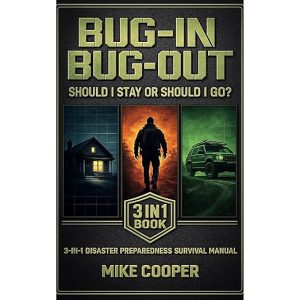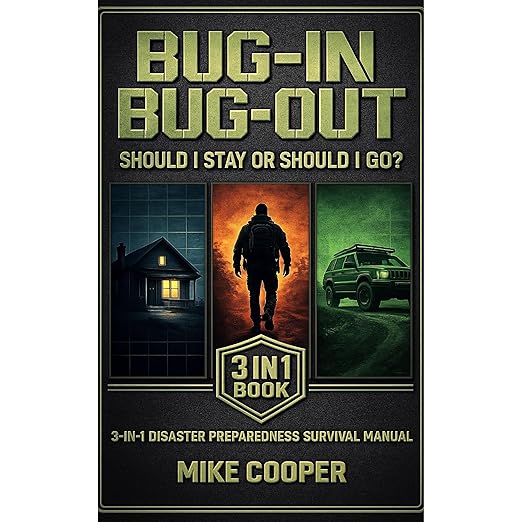
Bug In Bug Out: Should I Stay or Should I Go? earns its question-mark title by actually answering it, across 500 pages covering three distinct emergency scenarios with enough specificity to be genuinely useful. Mike Cooper frames this audiobook explicitly against the fear-driven prepper genre, and that contrast is the book's real selling point. At thirteen hours and thirty-one minutes, this is a substantial listen, and the Virtual Voice narration does its job of keeping a dense reference work navigable, even if the AI delivery occasionally sounds more like a well-organized presentation than a person who has lived through the situations being described.
Home, Bag, and Foot Plans Share One Order
The book's architecture is its strongest argument. Most emergency preparedness guides specialize: either they tell you to fortify your home, or they tell you to build a bug-out bag. Cooper's work does both, and adds a third category for on-foot evacuation when vehicles are not viable, then sequences them in what he argues is the actual decision order you would encounter in a real emergency. That structural clarity is something that multiple reviewers noted specifically. The room-by-room home defense section is particularly practical, addressing not just supply stockpiling but entry-point hardening and the specifics of managing power outages, home invasions, and supply chain disruptions from within an ordinary suburban house.
Cooper's self-description as a regular guy who has figured this stuff out over decades, rather than a tactical professional, is either a limitation or an asset depending on what you are looking for. He does not have the credentialing authority of a military or law enforcement background, but he also does not carry the operational swagger that makes some prepper content feel addressed to a different kind of person than most of us actually are. Reviewer Frederic Audebrand described the book as calm and genuinely confidence-boosting, and that tone is entirely deliberate. Cooper is trying to make preparedness feel like a rational, accessible thing that regular people do, not a subculture or an ideology requiring special commitment.
Horses Join Cars on the Evacuation List
The vehicle section is the part of this audiobook that most preparedness guides either skip or handle superficially, and it is where Cooper's comprehensiveness pays off most clearly. He addresses cars, trucks, SUVs, motorcycles, RVs, boats, and even horses as potential evacuation vehicles, covering fuel management, route planning, and the specific problems of each platform. The practical detail is notably level-headed: rather than assuming you need a fully kitted tactical vehicle, he works with whatever you own and focuses on making it more reliable and better-stocked than it currently is.
More Prepared and Less Anxious on Foot
The foot evacuation section, which Cooper acknowledges as the scenario nobody wants to plan for, is handled with similar seriousness. Load management for multi-day travel, navigation without GPS, maintaining group cohesion when morale is low under real duress conditions. These are not scenarios that most suburban preparedness guides take seriously. Cooper treats them as worth planning for not because disaster is imminent but because the cost of being unprepared, if the situation ever arises, is not recoverable. That logic runs consistently throughout the book and gives the whole project a persuasiveness that the more sensationalized end of the genre lacks.
Reviewer J S described coming away feeling noticeably more prepared and a lot less anxious after listening, which is exactly the emotional destination Cooper is aiming for. That combination, increased readiness without increased anxiety, is genuinely difficult to achieve in content about emergency scenarios, and the fact that multiple reviewers independently describe the same effect suggests Cooper has calibrated the tone with real care.
Thirteen Hours of AI Delivery, No Emphasis
Virtual Voice narration at thirteen hours is a commitment, and listeners who are sensitive to synthetic delivery will notice it. The AI narration is competent for a structured guide format like this, keeping the section headings and transitions clear, but it does not have the capacity to vary emphasis in response to what the content is doing rhetorically. When Cooper's prose makes a point that benefits from underscoring, the narrator delivers it at the same level as everything else. A human narrator would have given the more urgent passages more urgency.
The book is also explicitly comprehensive rather than selective, which means some sections will be more relevant to your specific circumstances than others. Listeners who live in urban apartments and do not own a vehicle will find the vehicle section less immediately applicable. Cooper acknowledges this kind of variability but does not tailor the book for specific contexts, so the breadth comes at the cost of targeted relevance in individual sections.
Hurricane and Wildfire Households Need One Book
Listeners who have thought about emergency preparedness but been put off by the genre's tendency toward either anxiety or tactical machismo will find this audiobook a more approachable entry point. Cooper's tone is consistent with someone who has done the thinking, wants to share what he learned, and does not need you to share his worldview to benefit from the information. Households in areas with hurricane, wildfire, or major storm risk, where the decision between sheltering in place and evacuating is a real annual question, will find the core framework directly applicable. This audiobook is also well-suited to listeners who want a single comprehensive reference rather than multiple specialized guides.
Before You Press Play
- Voice: Virtual Voice narration keeps the material accessible and clearly organized across a dense thirteen-hour runtime, though the synthesized delivery lacks the urgency this subject sometimes calls for.
- Big ideas: emergency preparedness, decision-making under crisis, home and vehicle survival planning
- Atmosphere: Practical and confidence-building, with a deliberate absence of fear-mongering
- Worth it?: Bug In Bug Out covers the full preparedness spectrum from home defense to foot evacuation with unusual evenhandedness, making it the most comprehensive single-volume treatment most listeners will find.
Does Virtual Voice narration work for a thirteen-hour reference audiobook like this one?
It works for the material's structure. The section-based format gives the narration clear signposts, and the AI delivery is consistent and clear. The limitation shows up in passages that would benefit from varied emphasis or rhetorical urgency, where a human narrator would differentiate more effectively. For a dense practical guide, it is functional rather than ideal.
Is this audiobook's advice practical for ordinary households, or is it aimed at dedicated preppers?
Cooper explicitly positions the book against dedicated prepper culture. He describes himself as a regular person rather than a tactical professional, and the advice is calibrated for people who need to make their existing homes and vehicles more resilient, not for people building off-grid compounds. Multiple reviewers specifically noted the absence of fear-driven or extreme-scenario bias.
Is Bug In Bug Out: Should I Stay or Should I Go? too long at thirteen hours for a preparedness audiobook?
For the scope it attempts, the length is justified. Most listeners will not consume this in a single session but will return to specific sections as reference material. At thirteen hours, the audiobook covers ground that most competing titles split across multiple volumes, so the commitment is proportional to what you receive in return.