Before You Press Play
- Read by: Jonathan Waters gives equal, steady weight to both British and Zulu perspectives across a large cast.
- At its heart: colonial war and manufactured justification, courage under manipulated circumstances, the runup to Isandlwana
- Vibe: Tense and politically clear-eyed
- Short version: A strong series opener for military history listeners willing to start at the beginning rather than jump ahead.
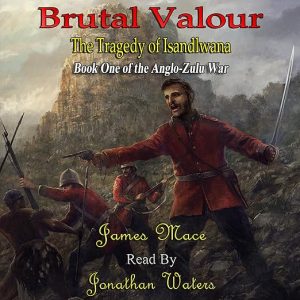
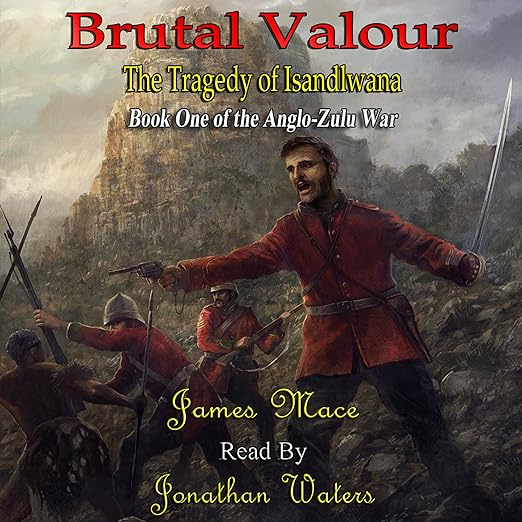
Sir Henry Bartle-Frere's ultimatum lands on Zulu king Cetshwayo's desk in December 1878, and this audiobook opens at exactly that impossible fork: disband the armies, pay reparations Zululand cannot afford, or fight a war Cetshwayo never sought. James Mace builds Brutal Valour, the first entry in his Anglo-Zulu War series, around that manufactured crisis, following the British invasion force under Lord Chelmsford alongside two newly arrived privates, Arthur Wilkinson and Richard Lowe, whose eagerness for adventure sets up the book's title with grim precision. What does courage mean when the war itself was engineered as a pretext rather than a necessity? Mace spends fifteen and a half hours answering that question from both sides of the coming battle.
Mace Breathes Life Into Both Armies
Mace has spent a career, seventeen books by reviewer Blimprider's count, writing across different historical periods, and that experience shows in how confidently Brutal Valour handles a large, dual-sided cast. Reviewer Bob Jarvis writes that what Mace does is 'breathe life into the combatants, both European & Zulu,' rather than treating the Zulu side as a faceless opposing force, which is a meaningful choice given how often nineteenth-century colonial conflicts get told from a single perspective. The politics behind Bartle-Frere's ultimatum, an invented justification for a war of conquest, get real attention rather than being waved past on the way to the battle scenes.
The novelistic technique of following named privates through the ranks, rather than only tracking generals and commissioners, gives the political maneuvering somewhere to land emotionally. Reviewer Bob Jarvis confirms the historical detail holds up: 'the location, strategies & manouvres described are exactly as they took place at the time,' which matters for a book blending documented history with the texture of individual soldiers' experience. Wilkinson and Lowe function as an entry point into an otherwise sprawling, multi-figure history, giving listeners someone specific to track through the ten days between the ultimatum's expiration and the battle itself.
Two Privates' Friendship Outweighs Talk of Empire
Calling the book Brutal Valour rather than something more triumphant is itself a small editorial signal. Valour under a manufactured pretext for war reads differently than valour in clear self-defense, and Mace's title seems to acknowledge that complexity upfront rather than smoothing the story into a more conventional adventure-story framing a less careful historian might have reached for.
The synopsis specifically frames Wilkinson and Lowe's motivation as duty 'both for the empire and for their friends,' and that small phrase captures something the book returns to often: soldiers rarely fight primarily for abstractions like empire once they are actually in the field. Mace uses the two privates' friendship as the emotional throughline running underneath the larger political story, giving listeners a reason to care about the outcome that has nothing to do with whether Frere's ultimatum was justified.
Waters Voices Both Sides Evenhandedly
Jonathan Waters narrates the full Anglo-Zulu War series, and that continuity is a genuine asset even on this first entry. He handles the British and Zulu material with equal steadiness, resisting the temptation to voice one side as heroic underdogs and the other as a faceless threat. For a conflict this politically loaded, an ultimatum designed to be rejected, an invasion justified after the fact, that evenness in performance matters as much as any technical narration skill. His register favors clarity over dramatic flourish, which suits a large-cast military history where confusing two characters costs a listener real comprehension.
Reviewer Bruce Roeder, whose interest in the Zulu War dates back to watching the classic war films that first popularized the conflict for a wider audience, cites Donald Morris's The Washing of the Spears and the work of historians Ian Knight and Ian Castle as his other reference points, and still rates Mace's telling among his most enjoyable engagements with the material. That is a meaningful endorsement from a reader already deep in the subject, not someone encountering Isandlwana for the first time through this book alone.
Listeners new to the Anglo-Zulu War get a real advantage from Mace's dual-perspective approach: rather than needing a separate, later corrective account to hear the Zulu side of the story, that fuller picture is built into the narrative from its first entry, which is not always true of older popular histories of this specific conflict.
This Volume Ends Before the Battle Itself
At fifteen hours and thirty-six minutes, this is a substantial listen, and it is explicitly Book One of a longer series, meaning the ultimate battle and its full aftermath extend beyond this single entry. Listeners expecting a self-contained account of Isandlwana from ultimatum through resolution should know the story continues past this volume's closing pages, ending instead at the moment the two armies are about to meet.
The blend of documented history and novelistic technique, invented dialogue and interiority for real historical units, sits in a space between straight nonfiction and historical fiction. Listeners who want a purely academic account with no dramatized scenes should know Mace is working in a more narrative register, prioritizing character experience alongside documented fact rather than keeping strictly to verifiable primary-source detail throughout.
The crossing of the uMzinyathi River at Rorke's Drift into Zululand functions as the book's real structural hinge, the literal and symbolic point of no return once Frere's ultimatum expires. Mace spends real time on the days immediately surrounding that crossing, giving listeners a clear sense of the invasion's actual mechanics, supply lines, river fords, marching order, rather than jumping straight from political buildup to battle.
Chelmsford and Frere Gambled on a Quick War
Listeners already familiar with the broader Anglo-Zulu War through film or other popular accounts should know Mace's version moves at a more deliberate pace than a two-hour dramatization can afford, spending real time on regimental logistics and the specific chain of command among British officers like Captain Younghusband before the fighting itself begins. That pacing rewards patience with military bureaucracy and organizational detail as much as it rewards interest in the eventual battle.
The book also gestures toward consequences beyond the battlefield itself: Chelmsford and Frere both gambled on a quick, contained war going unquestioned back in London, and Mace lets that political calculation sit visibly in the background throughout the invasion buildup. Listeners interested in how colonial wars got authorized and later justified, or excused, from thousands of miles away will find that undercurrent as engaging as the more immediate soldier's-eye material.
Series Starters Belong at Book One
This audiobook suits listeners drawn to military history that treats both sides of a colonial conflict as fully realized rather than defaulting to one perspective, and anyone who wants to start the Anglo-Zulu War series from its actual beginning rather than jumping into a later volume. It rewards patience with political buildup as much as interest in the coming battle itself.
Skip it if you want the Battle of Isandlwana itself covered start to finish in one sitting, since this volume closes just as the armies converge, or if strictly document-based history without dramatized scenes is a hard requirement.
Do I need to start the Anglo-Zulu War series with the Brutal Valour audiobook?
Yes, this is the first entry, and Jonathan Waters narrates the series continuously, so starting here gives listeners the full arc of both the political buildup and the narrator's developing command of the material.
How does Jonathan Waters's narration handle both British and Zulu perspectives in the audiobook?
With consistent, even steadiness. Waters resists voicing one side as clearly heroic and the other as a faceless threat, which matters for a conflict built around a manufactured justification for war.
Does the Brutal Valour audiobook cover the actual Battle of Isandlwana or just the lead-up to it?
This volume closes as the two armies are about to meet at Isandlwana, covering the political buildup and invasion in full detail, with the battle and its aftermath continuing into the series' next entries.