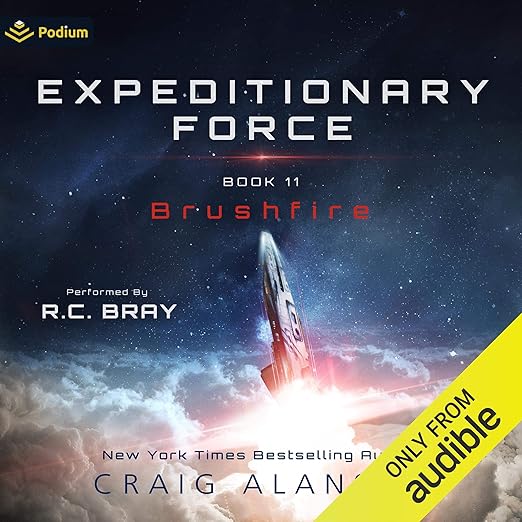
Brushfire is the eleventh entry in Craig Alanson's Expeditionary Force series, and the audiobook arrives with nineteen hours and eighteen minutes of new material for a readership that has been following Joe Bishop and Skippy the Magnificent since the very first contact with alien civilizations back in book one. The series has generated a devoted audience precisely because it does something unusual in military science fiction: it allows the central premise to evolve across installments rather than recycling the same threat structure. Brushfire takes the logical next step after the events that preceded it, asking what happens when a battle-hardened crew tries to function in a peacetime that has not fully arrived.
First, the Big Picture
The synopsis is intentionally minimal, which is standard practice for later entries in a series where spoiler management for earlier volumes is a legitimate concern. The broad strokes are this: the Merry Band of Pirates is attempting to adjust to post-conflict life, and the universe is not cooperating. Aliens who did not receive the ceasefire memo remain a problem. The gap between what peacetime is supposed to feel like and what the people who fought for it are actually experiencing forms the book's central tension.
For a series that has always balanced action with character comedy, this premise offers interesting territory. The Merry Band has been defined by their cohesion under pressure, their shared humor in impossible situations, and the particular dynamic between Joe's human instinct and Skippy's superintelligent alien condescension. Asking what those relationships look like when the pressure reduces, at least officially, is the kind of evolution that keeps a long-running series from becoming formulaic. Alanson has demonstrated the ability to generate this material at volume and sustain quality across installments, which reviewers across the series consistently note as something they cannot quite explain.
One reviewer describes Brushfire as hitting the ground running with new twists and plenty of banter. Another offers the more measured assessment that the middle section loses momentum before recovering. Both readings are consistent with what series veterans have come to expect from the longer entries: Alanson writes long, and the middle acts of his longer books sometimes need reader patience that the opening and closing acts reward. The final act recovery reviewers describe is meaningful for a nineteen-hour audiobook. You are committing significant time, and knowing the landing sticks matters.
The Best Parts of Brushfire
R.C. Bray has narrated every Expeditionary Force entry and his performances are the reason the audiobook format is the series' dominant consumption mode. His Joe Bishop is a specific vocal creation: the everyman inflection, the slightly exhausted pragmatism, the undercurrent of actual tactical competence beneath the self-deprecating surface. His Skippy is where the comedic chemistry comes from: the condescension, the verbal flourishes, the genuine alien quality beneath the comedy. After eleven books, Bray's command of the ensemble extends to dozens of recurring characters, and the distinction between those voices is one of the listening pleasures that purely text-based reading cannot replicate. Series listeners who have followed in audio from the beginning will find the narration as secure and satisfying as ever.
The nineteen-hour runtime places Brushfire at the longer end of the series' installments, and first-time listeners should know that this kind of military science fiction demands sustained engagement rather than casual background listening. The banter between characters is fast and relies on established context. The action sequences are kinetic and benefit from attention. This is active listening territory, not ambient entertainment.
A Few Reservations
Alanson's productivity across this series is itself a notable feature of the landscape. The Expeditionary Force books arrive at a pace that few military science fiction authors match, and the consistency of quality reviewers note across installments is genuinely unusual at this volume. The concern, which occasional reviews raise, is that the middle sections of the longer books can feel padded in a way that suggests writing to a length target rather than to a story arc. Whether that is the experience in Brushfire depends partly on what you find compelling about the series: if it is the Joe-Skippy banter, the book delivers it throughout; if it is the macro-strategic military plotting, the middle section may test patience.
As the eleventh book in a continuous series, Brushfire has no utility as an entry point. The premise, the characters, the galactic political situation, the history of the Merry Band, and the specific emotional stakes of the peacetime adjustment arc all require knowledge of the preceding ten books to land properly. Alanson does not provide the kind of extended recap that would orient a new listener, which is the correct authorial choice for a book eleven but a practical consideration for anyone who has not already committed to the earlier volumes.
The middle-act pacing concern raised by one reviewer is worth flagging for new series members who have binged the earlier books quickly. Books that slow in the middle before recovering are a fair description of some Alanson titles in this series, and nineteen hours means the middle is a substantial period. Series veterans who have developed trust in his endings will navigate this without concern; readers encountering the pattern for the first time may need the reassurance that the recovery comes.
Who Should Listen to Brushfire
Existing Expeditionary Force series listeners who have completed books one through ten should proceed directly to Brushfire. R.C. Bray's narration is as accomplished as ever, Alanson's ability to sustain the Joe-and-Skippy dynamic across a long installment remains intact, and the premise of post-conflict adjustment opens narrative space that the series has not previously explored. New listeners should start at book one of the Expeditionary Force series and work forward; the payoff in Brushfire depends entirely on the investment made in the preceding volumes.
Can I start the Expeditionary Force series with Brushfire, or do I need to listen to the earlier audiobooks first?
You need the earlier books first. Brushfire is book eleven in a continuous series and makes no concession to new listeners. Start with the first Expeditionary Force audiobook and work forward. The payoff accumulates across the series.
Is R.C. Bray's narration consistent with his performance in the earlier Expeditionary Force audiobooks?
Yes. Bray has narrated every entry in the series and his characterizations of Joe Bishop, Skippy, and the ensemble remain as distinctive and well-differentiated as they were in the earlier volumes. This is one of the most stable long-running audio-narrator partnerships in military science fiction.
Does the peacetime premise in Brushfire significantly change the tone compared to the combat-heavy earlier entries?
Partially. The book opens with the adjustment tensions the synopsis describes, but the premise that aliens did not receive the ceasefire memo means action sequences are present throughout. The tone shifts toward examining what the Merry Band is like under reduced official pressure rather than abandoning the series' action-comedy balance.
How does Brushfire handle the length compared to other entries in the Expeditionary Force audiobook series?
At nineteen hours and eighteen minutes, it sits at the longer end of the series. Reviewers note a middle section that loses momentum before the final act recovers. This pattern appears in some other long Alanson entries and is worth knowing if you plan to listen in long sessions.