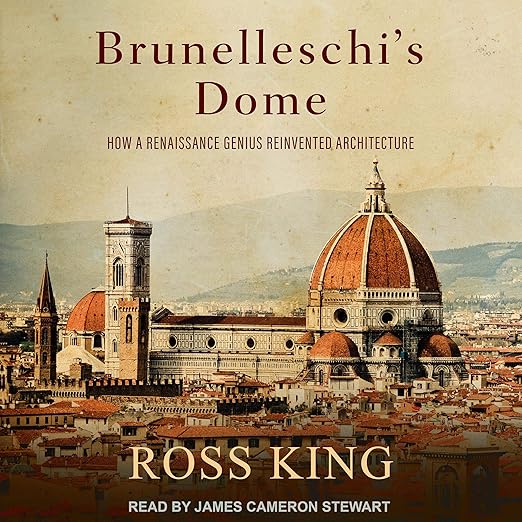
Can a goldsmith and clockmaker with no formal architectural training design and build the largest dome in the world, without scaffolding, without flying buttresses, and without any precedent for how to vault a span of 143 feet? That is the question at the center of Brunelleschi's Dome, Ross King's celebrated account of how Filippo Brunelleschi transformed Renaissance Florence and, in the process, reinvented the field of architecture. The audiobook, narrated by James Cameron Stewart, covers one of the most extraordinary engineering achievements in human history across six hours and thirty-six minutes of dense, vivid storytelling. It is, however, worth noting upfront: several listeners have encountered a different product under the same or similar title, a photo collection with no narrative content. If you are looking for Ross King's historical account, confirm before purchasing that you are buying the narrated audiobook version of the full text.
The story of the Florence cathedral dome, the cupola of Santa Maria del Fiore, visible from virtually every corner of the city, is extraordinary on its own terms. The cathedral had been under construction for more than a century when, in 1418, city officials announced a competition for anyone who could solve the problem of vaulting the main dome. The design had been set for generations: no flying buttresses, an octagonal shape, a diameter that made conventional centering (the wooden scaffold that normally supported masonry during construction) economically and perhaps physically impossible. The competition that Brunelleschi won was not just a professional triumph; it was the beginning of twenty-eight years of continuous invention that produced not only the dome but an entirely new way of thinking about what architecture could be.
Only One Man Died During Decades of Construction
King's account works as well as it does because he understands that engineering history is human history. The technical challenges Brunelleschi faced, how to lift an estimated 70 million pounds of material hundreds of feet into the air, how to lay herringbone brick patterns that allowed the dome to support itself as it rose, how to design the hoisting machines that moved materials without the cranes and powered equipment we now take for granted, are described with enough detail to be comprehensible to non-specialists without becoming dry. But the book is equally attentive to the political dimension: the guild rivalries, the professional jealousy of Lorenzo Ghiberti (who was assigned as co-superintendent of the project and whom Brunelleschi repeatedly outmaneuvered), and the personal obstacles that threatened to derail the work at multiple points.
The detail that one man died during decades of construction, despite a workforce numbering in the hundreds, working at dangerous heights with primitive equipment, says something remarkable about Brunelleschi's insistence on worker safety that King highlights with appropriate wonder. It is the kind of specific historical fact that reframes everything around it and that only close archival research can produce. King draws on contemporary documents, workshop records, and the accounts of Brunelleschi's near-contemporaries to build a portrait of a man who was, by turns, secretive, paranoid, brilliant, and entirely focused on a problem that anyone who looked at it honestly could see might be impossible to solve.
Stewart's Pacing Rewards Florence Visitors Most
James Cameron Stewart's narration is a measured, engaged performance that suits the material well. He does not dramatize in ways that would feel inappropriate for historical nonfiction, but he communicates genuine interest in the engineering puzzles King describes, which keeps the more technical passages from becoming lectures. The six-and-a-half-hour runtime is compact for the amount of history covered, King is writing a focused account rather than an exhaustive one, and Stewart keeps the pacing brisk without sacrificing the weight that the story deserves.
For listeners who have visited Florence and stood inside or beneath the dome, this audiobook is a particularly rich experience. The structure that Brunelleschi built remains the largest masonry dome ever constructed, and hearing King's account of how it was achieved, the specific brick patterns, the dual-shell construction, the lantern that crowns it, transforms the experience of looking at it. For listeners who have not been to Florence, the book may inspire the trip.
One Building, One Man, Twenty-Eight Years
The book's focus is narrow by design. King is not writing a general history of the Renaissance, nor a comprehensive biography of Brunelleschi, who had a career and an influence that extended well beyond the dome project. Listeners who want more context on Brunelleschi's role in developing linear perspective, his other architectural commissions in Florence, or the broader political history of the city during the early fifteenth century will need to supplement this account with other reading. What King delivers is a masterclass in the single-project deep-dive: one building, one man, twenty-eight years, and the cultural and technical revolution that resulted.
The chapter on the competition itself, the 1418 announcement, the various proposals submitted, and the audacious way Brunelleschi ultimately secured the commission, is particularly compelling listening. He refused to reveal the details of his plan until he was guaranteed the work, which his rivals dismissed as madness and which history validated as strategy. The character that emerges from these pages is as interesting as the engineering he produced, and King balances the two with the skill of a writer who knows that the best history makes individuals as vivid as the forces they navigate.
Verify This Is the Narrated Full-Text Edition
Listeners interested in Renaissance history, architectural history, the history of engineering, or the kind of deeply researched popular history that uses a single object as a lens on an entire era will find this audiobook essential. The narrative is accessible to anyone with a general historical curiosity, and Stewart's narration makes the technical content manageable. Those seeking a comprehensive Brunelleschi biography or a broader history of the Italian Renaissance should know this book is deliberately focused; its depth comes precisely from its narrowness. Before purchasing, verify that you are acquiring the narrated full-text audiobook rather than any photo collection sold under the same or similar title, the reviews on some platforms reflect genuine confusion between two different products.
Is the audiobook of Brunelleschi's Dome the full Ross King text, or is it a photo collection that some reviewers describe?
Ross King's Brunelleschi's Dome is a full narrative history narrated by James Cameron Stewart. However, some listings under the same or similar title appear to be photo collections with no narrative content. Verify before purchasing that you are buying the narrated full-text audiobook.
How much technical detail does this audiobook include about the dome's construction?
King covers the engineering, the herringbone brick patterns, the dual-shell construction, the hoisting machines Brunelleschi invented, in enough detail to be comprehensible to non-specialists. The technical content is embedded in narrative rather than presented as a technical manual, so listeners without engineering backgrounds will follow it comfortably.
Does this audiobook require any prior knowledge of Renaissance history or architecture to be enjoyable?
No. King writes for general readers and provides the historical context needed to follow the story. Listeners who have visited Florence or have some prior interest in Italian Renaissance history will find additional resonance, but neither is required.
At six and a half hours, does this audiobook cover Brunelleschi's full career or just the dome project?
The book focuses specifically on the dome project, the twenty-eight years Brunelleschi dedicated to it from the 1418 competition through its completion. His broader career and other architectural commissions in Florence are mentioned but not the primary focus. Listeners wanting a complete biography should supplement this with other sources.