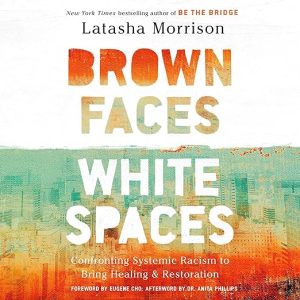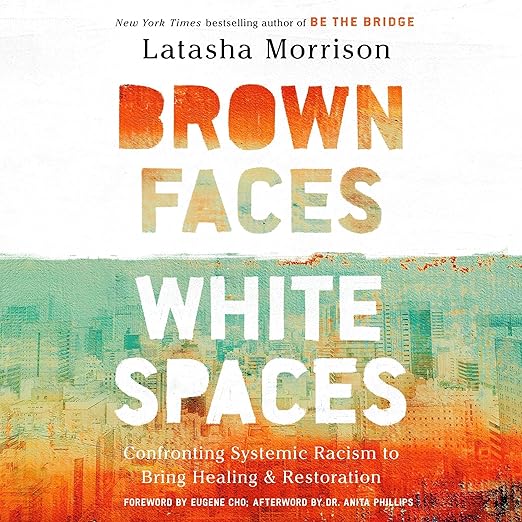
I started Brown Faces, White Spaces on an evening walk and finished it over three more days of commutes and lunch breaks. Morrison's voice has a quality that makes it easy to keep going even when the subject matter is heavy, and the subject matter here is often very heavy. This is a book about the gap between what American institutions promise and what they actually deliver to Black and Brown citizens, and Morrison traces that gap across nine distinct domains , education, healthcare, property ownership, the justice system, entertainment, and the church, among others.
Morrison is the New York Times bestselling author of Be the Bridge, and Brown Faces, White Spaces grows naturally out of that earlier work's concerns. Where Be the Bridge focused on the practice of racial reconciliation within Christian communities, this book zooms out to examine the structural conditions that make that reconciliation necessary. The framing is explicitly Christian throughout, but the research underneath it is sociological and historical in a way that should be accessible to readers who do not share Morrison's faith commitments.
The book's organizing framework is a three-stage progression Morrison calls preparation, dedication, and liberation , recognizing inequity, committing to change, and working toward genuine freedom. It is a tidy structure, and Morrison is careful not to let it become reductive. Each of the nine chapters works through historical background, personal narrative, and present-day data before arriving at something like a call to action. The result is a book that manages to be simultaneously a history lesson, a lament, and a practical guide.
What distinguishes Morrison's approach from the crowded field of American anti-racism writing is the faith dimension. She is not interested in secular allyship as an end in itself. Her argument is theological as well as sociological: that the church has both a particular responsibility to confront racial inequity and a particular set of resources , community, accountability, moral imagination , for doing so. Whether or not you share that framework, it gives the book a specific quality of urgency that purely academic treatments sometimes lack.
Morrison's Own Delivery Bridges Data and Story
The self-narration is the right choice for this material. Morrison's voice carries authority without condescension, and she knows how to move between the analytical and the personal in a way that feels organic rather than calculated. When she shares stories from her own family's experience or from friends whose lives were shaped by the systems she is describing, the transition from data to humanity is seamless. One listener noted that hearing the author read her own work added significantly to the experience, and I agree.
The research is serious. Multiple reviewers mentioned the extensive endnotes, and the book reflects genuine engagement with the sociology and history it cites. Morrison is not overstating her case or relying on anecdote where data exists. At the same time, this is not a dry academic text , the personal stories that thread through each chapter keep the material grounded in actual human experience.
Seven and a Half Hours, Built for Groups
The book covers a lot of ground in seven and a half hours. Some chapters are necessarily more compressed than others, and a reader looking for deep dives into any single system , housing discrimination or the school-to-prison pipeline, say , will find the survey format slightly frustrating. Morrison's focus is breadth and integration rather than exhaustive depth on any single topic. The trade-off is worth it for most listeners, but worth acknowledging.
The book also includes discussion questions for group settings at the end of each chapter, which makes it particularly well-suited for church groups, book clubs, or classroom use. Several reviewers mentioned using it in exactly that context, and the structure supports communal reading thoughtfully.
Essential for Christians, Useful Well Beyond Church
This is essential listening for Christians who want a structured, historically honest engagement with race in America that does not separate faith from action. It works equally well for anyone interested in how systemic inequity persists across nine key domains of American life, regardless of religious background.
Listeners looking for a policy-focused analysis without the theological framework may find the faith scaffolding more prominent than they prefer. And anyone expecting quick optimism will find instead something more durable , a hope that takes the weight of history seriously before offering a way forward.
- Narration: Latasha Morrison reads her own work with a preacher's cadence and a journalist's precision , the self-narration is a significant asset.
- Themes: Systemic racism, Christian faith and racial reconciliation, historical accountability
- Mood: Earnest, historically grounded, and cautiously hopeful
- Verdict: A careful, research-backed survey of nine systems where racial inequity persists, delivered with conviction by an author who genuinely believes change is possible.
How does this audiobook compare to Morrison's earlier Be the Bridge?
Be the Bridge focused more narrowly on racial reconciliation within church communities. Brown Faces, White Spaces is broader in scope, examining nine systems where racial inequity persists, and relies more heavily on historical and sociological research.
Does Latasha Morrison narrate her own audiobook, and does it add to the experience?
Yes, she reads the full audiobook herself. The self-narration is widely praised by listeners, with several noting that her delivery adds depth and authenticity to both the personal stories and the research-driven sections.