
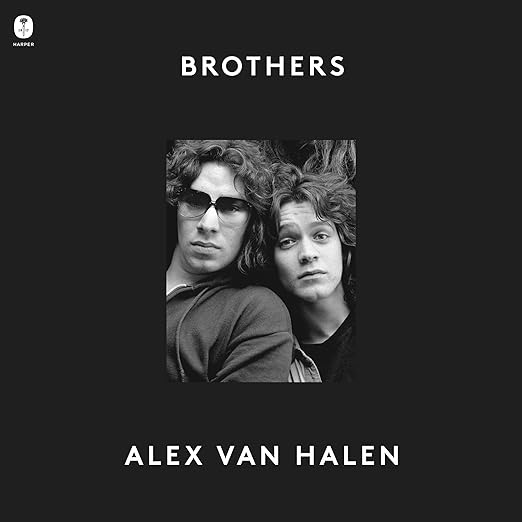
Six hours and nine minutes is short for a rock memoir, and this audiobook spends almost none of that time on the band. Alex Van Halen is seventy, a drummer, and the surviving half of a pair who shared a record player, an eight-hundred-square-foot house, a set of parents and, later, the back of a tour bus and a drinking problem. He wrote it while still mourning his younger brother, and the compression reads as a decision rather than as an omission. The memoir knows precisely what it is refusing to be.
Maybe Ed, Never Eddie, the Copy Insists
Ariel Levy's name appears once in the description and nowhere on the byline. The copy says the book was told with the New Yorker writer, which is the standard formula for a collaboration that shaped the prose, and it matters here because the manner is unusually controlled for the genre. Anyone deciding whether to spend an evening on it should know a professional was in the room. The byline itself lists only the drummer, in a lowercase spelling the copy never once uses.
Edward is the subject, and the book is careful about him in ways that read as insistence. Maybe Ed, the copy specifies, but never Eddie. The childhood runs from the Netherlands to working-class Pasadena, with an itinerant musician for a father and an Indonesian-born mother who told her sons to always wear a suit no matter how famous they became, and who was relaxed enough about all of it to take a doggie bag home from a star-studded dinner.
Chris in Providence R.I. gave it five stars on November 4 and put the appeal into one admission: still unable to accept that Edward is gone, and discovering on reading that neither can Alex. That is an accurate account of the book's emotional position. This is not a settled retrospective composed at a safe distance. It is an argument with a fact, conducted by a man who states outright that no accurate account of the brothers or the band has existed before now.
A Phrase About Voice That Turns Literal Here
Alex Van Halen reads it himself, and the description hands you a strange sentence about that in advance. It praises the rough yet sweet voice in which he recounts the childhood, a phrase written about prose that turns literal the moment a self-narrated recording exists. In an audio context it looks like a comment on the performance, and it is not. What it does convey is the register the publisher believes the book has, and a seventy-year-old drummer reading his own mourning is unlikely to sound polished.
Quotations open every chapter, and William P Long, five stars on November 18, noticed the pattern and then matched it, beginning a review with Einstein and closing on the remarkable coincidences the book itself ends with. Structural habits of that kind survive the move to audio better than most things do, because an epigraph read aloud works as a change of gear. It also tells you the book was assembled rather than dictated, which is useful to know going in.
Music is the element a printed page cannot deliver and a recording might. The description promises an exclusive piece never heard before, the last thing the brothers wrote together, and presents it as a headline feature of the release. What the page never states is whether the recording carries the music, or whether the audio edition contains only the prose about it. For a listener choosing between formats that is the entire decision, and the answer is not published.
Three Votes Cannot Add Up to 4.5
Four stars in January 2025 is the only mark here below the top, and the response behind it is the most argumentative of the five. It credits the brothers as innovators who got folded into a genre they never belonged to, describes the founding lineup in blunt shorthand, and insists the band was not a metal act at all. That is a fan making a case rather than a reader lodging a complaint, and the two are worth separating when a lower grade appears.
Three ratings are reported, and three whole-star votes cannot produce a 4.5. At that count the arithmetic reaches 4.3 or 4.7 and nothing between them, so the displayed figure is coming from somewhere other than three integer clicks. Five people have written verdicts against a counter of three, which points the same way: separate editions pooled under one entry, with the average inherited from a population larger than the one you can actually read.
An additional caution concerns the pool itself. Two of the five responses come from outside the United States, and one of those consists of a single approving character with no text whatsoever. Another is not in English and amounts to a declaration of loyalty to the band rather than an assessment of the book. Of five visible verdicts, three carry an argument, which is a thin evidence base for deciding how to spend an evening.
One Sitting or Two Difficult Evenings
Van Halen listeners who want the family story rather than the band story are the right audience, and they should know the proportions before buying. The Netherlands, Pasadena, the parents, the shared room and the shared habits take up the bulk of the running time. Musical politics and bad behavior are present but subordinate throughout. The book assumes you already know who these people are, and it never once pauses to introduce the band to somebody who does not.
You can pass on this if you came for the discography. Nobody is going to walk you through the records in order, and the studio years are handled as biography rather than as craft. It is equally the wrong purchase if unmediated grief is not something you want in your ears for two evenings, because the book does not resolve, does not step back, and does not pretend to have finished with its subject.
Grief is the register, and a recording is where that register belongs. A brother reading his own sentences about a brother he cannot accept is losing produces something a printed page holds at arm's length by design. Six hours is one sitting for a determined listener and two evenings for everybody else, and the book asks to be taken roughly that way. Anyone who ever cared about this band will find the last stretch difficult in a useful way.
Before You Listen
Does the Brothers audiobook include the exclusive piece of music the description promises?
The page does not say. The copy presents a never-before-heard composition, the last the brothers wrote together, as a headline feature of the release, but nothing confirms whether it appears in the recording or is only described in the prose. If that track is your reason for buying, confirm it on the product page first.
Why do five people have written reviews when the audiobook shows only three ratings?
Pooled editions, almost certainly. The counter and the visible record disagree, and the displayed 4.5 cannot be produced by three whole-star votes at all, since that count reaches only 4.3 or 4.7. The average is inherited from a larger population than the five verdicts you can actually read.







