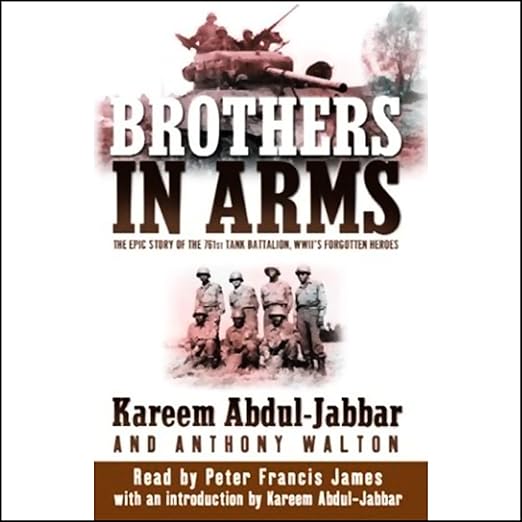
The 761st Tank Battalion fought six straight months of combat under Patton's Third Army, an unusually long stretch given the standard one- or two-week front-line rotation most units received, and did so as the first all-Black armored unit the U.S. Army ever sent into battle. This audiobook's catalog listing credits WWII historian James Holland as the author, but the synopsis text names the real writers directly: Kareem Abdul-Jabbar, working with acclaimed writer Anthony Walton, drawing on interviews with surviving battalion veterans including family friend Leonard 'Smitty' Smith. That's a byline worth correcting before evaluating anything else, since Holland's own substantial WWII catalog, built from entirely different research and sources, has nothing to do with this specific book.
Abdul-Jabbar's Real Byline Behind Patton's Battalion
What the book documents is a historical injustice compounding a genuine act of valor. The battalion was organized largely, per the synopsis, as a public relations gesture meant to placate Black community support for the war rather than to actually fight, and General Patton is described as having opposed their deployment outright, doubting Black soldiers could operate tanks quickly enough under real combat conditions. That resistance only gave way when the Allies ran short of trained tank crews following heavy casualties in France during the summer of 1944. What followed was a casualty rate approaching fifty percent sustained across more than six months at the front, contributing directly to the liberation of roughly thirty towns and villages along with several branch concentration camps.
USA Today called it 'more than a combat story... it's also the story of how black soldiers had to fight (literally and figuratively) for the right to fight the Germans,' and that double meaning runs through the entire book. Abdul-Jabbar's own connection came through Leonard 'Smitty' Smith, a family friend and battalion veteran, which grounds the research in a real personal relationship rather than distant archival curiosity alone. Reviewer Fíal, who reads extensively on WWII including German-language survivor accounts, describes encountering testimony from Holocaust survivors liberated by Black American soldiers without knowing which specific unit those soldiers belonged to; this book supplies exactly that missing context, connecting oral history from both sides of the same story.
The book also traces what happened after the war, when the same men who'd fought with distinction under Patton returned home to a country still enforcing segregation, a whiplash the synopsis gestures toward directly in noting 'the prejudice they faced upon their return home.' That postwar section is where the book's title, Brothers in Arms, arguably earns its full double meaning: the bonds forged in combat had to sustain these veterans through a homecoming that offered little of the recognition their service should have guaranteed, and the friendships among battalion members became, in a real sense, a substitute for the national gratitude that didn't materialize.
James's Unhurried Gravity for a Shorter Runtime
Peter Francis James narrates with the kind of unhurried gravity this material demands. Combat sequences move at a controlled pace rather than a breathless one, which suits a story built on sustained endurance across six months rather than a single dramatic set piece, and his delivery of veterans' firsthand recollections carries genuine weight without tipping into melodrama. None of the three attached reviews comment specifically on narration technique, so this assessment rests on the performance itself rather than a listener's direct quote, but the serious, measured register fits a battalion history built around dignity sustained under relentless pressure.
At four hours and fifty-six minutes, this runs notably shorter than most full-scope WWII unit histories, which typically run eight to twelve hours once training, combat chronology, and postwar reckoning all get covered in full. That compressed runtime is worth knowing going in, since it suggests either a tightly edited narrative or possibly an abridged or young-readers edition, and listeners wanting the most exhaustive treatment of the 761st's story should confirm which specific edition they're purchasing before buying. What the shorter format buys in exchange is real momentum. A. J. Ross, a lifelong WWII enthusiast with two uncles who served, still found substantial value here despite the compact runtime.
The book's title carries a second meaning worth drawing out for prospective listeners: 'in arms' evokes both the armored vehicles the battalion crewed and the literal camaraderie of wartime brotherhood among men who had every institutional reason to distrust the army that trained and then doubted them, a tension the narration handles by letting quieter, more reflective passages breathe rather than rushing toward the next combat sequence.
Searching by Author Name Risks Missing This Book
Because the byline mismatch is real, it's worth being specific about what to search for. If you already enjoy James Holland's WWII writing, primarily large-scale campaign histories built from archival and firsthand British and American sources, this is not one of his titles despite what the catalog claims, and searching under his name risks missing this book entirely or, worse, mistakenly buying something else of his instead. Search under Abdul-Jabbar and Walton's names directly, and double-check the edition length before purchasing, since a full unabridged print edition runs considerably longer than this shorter audio production.
The material does not soften the racism the battalion faced, both during deployment and after returning home, and listeners should expect that discomfort as a deliberate, necessary part of the account rather than an incidental aside tucked into the margins. Alex Mack's brief, enthusiastic review, simply calling it 'amazing' and noting it 'worked out very well in ALL SORTS of WAYS,' suggests the emotional impact lands even for listeners without deep prior WWII knowledge, though the book still assumes basic familiarity with the war's European timeline rather than explaining troop movements and campaign geography from scratch for total newcomers.
Oral Testimony Over a Historian's Removed Voice
This is a strong pick for listeners interested in WWII history that centers the specific, under-told experience of Black servicemen, for readers of other 761st-adjacent or Black military history titles, and for anyone drawn to research shaped by real personal connection, in this case Abdul-Jabbar's relationship with veteran Smitty. Fíal's review suggests it works especially well for listeners who already engage seriously with WWII scholarship and want a piece connecting disparate historical threads, German civilian and survivor memory on one side, an American armored unit's combat record on the other.
This also works well for listeners generally interested in oral-history-driven military nonfiction, since so much of the book's texture comes from firsthand veteran testimony rather than a historian's removed narrative voice, giving it an immediacy that more conventionally academic WWII histories sometimes lack.
Listeners specifically hunting for a James Holland title should look elsewhere despite what this catalog page claims, and anyone wanting the most exhaustive possible unit history rather than a tighter four-to-five-hour treatment should verify the edition length before buying. If concise, character-driven military history isn't your preference and you'd rather have a sprawling, multi-volume campaign history with extensive tactical detail, this compact format will likely leave you wanting considerably more than it delivers.
Frequently Asked Questions
Why does this audiobook's byline say James Holland when the story is Kareem Abdul-Jabbar's?
That appears to be a catalog error. The synopsis names Abdul-Jabbar, working with Anthony Walton, as the actual writers, while Holland is a separate, well-known WWII historian whose own books are unrelated to this one.
Is this audiobook the full book or a shorter, abridged edition?
At four hours and fifty-six minutes it runs notably shorter than most full-scope WWII unit histories, so listeners wanting the most exhaustive treatment should confirm the edition length before buying.