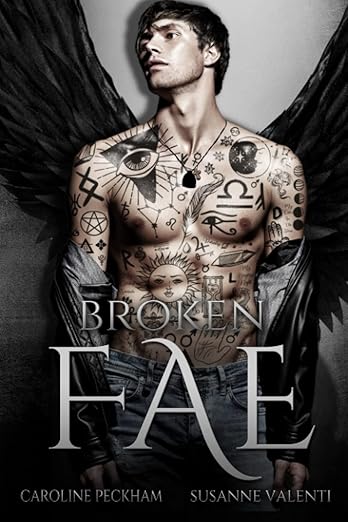
I have been tracking Caroline Peckham and Susanne Valenti's work, writing together as the Twisted Sisters, for a while now, watching their readership develop into something genuinely devoted. Broken Fae is book two in their Ruthless Boys of the Zodiac series, and while I do not have the first book behind me, the reader responses to this one tell a consistent story: this is the kind of serialized fantasy that creates the particular pull described by one reviewer as being "sucked in, chewed up, and never wanting it to spit you out." That kind of response is not manufactured by clever marketing. It comes from a combination of character investment and plot velocity that is harder to achieve than it looks.
The setup is mythologically dense. The protagonist navigates a world where the "wheel of destiny" and the "will of the stars" are active forces rather than metaphors, shaping and disrupting the relationships she is forming with her kings. Felix Oscura haunts the city of Alestria with a bloodthirsty agenda, claiming power over a clan he was never fated to rule, while an entity known as the illusive King moves toward citywide control. The brother's death mystery unravels slowly alongside the political threat, layering a personal grief plot over the external conflict in a way that keeps the book from becoming purely action-driven.
The Twisted Sisters' world-building is consistently praised as their strongest quality, and this book reflects that. The magic system, the clan politics, the fate mechanics, and the specific rules of power in Alestria are developed with enough internal consistency that the twists feel earned rather than arbitrary. One reviewer specifically noted being given new angles on the mystery of Garrett, a character whose role in the first book apparently left readers wanting more, and that the new angle adds genuine complexity rather than merely adding complication.
The character who drew the most attention from reviewers is Gabriel, described as someone who has lived his entire life in solitude and is now working, imperfectly, to extend himself toward connection and understanding. One reviewer described his arc in this book as having "redemption in my view" after his treatment in the previous installment, which suggests Peckham and Valenti have executed a difficult narrative maneuver: making a reader who was frustrated with a character believe his growth by the end of the next book.
Why It Works in Audio
Twenty hours and fifty-eight minutes is a serious audio commitment, and the quality of narration matters proportionally more for an immersive fantasy series than for a shorter standalone. Troy Duran handles an ensemble cast with the differentiation required for a book where multiple kings, a villain with political ambition, and the protagonist's internal voice all need to be distinguishable without becoming caricature. The emotional range required for a book moving between action sequences, political confrontation, and romance is significant, and Duran navigates it without the kind of flat monotony that can undermine long fantasy audiobooks.
Readers of the Twisted Sisters' work will already know whether this narration style suits them from previous entries. For new listeners, the recommendation is to start with the first book and assess from the beginning rather than joining at book two.
Weak Spots in Broken Fae
This is book two of a series and functions as a middle installment in all the ways that implies. Major threads are advanced but not resolved. New complications are introduced. The relationship dynamics between the protagonist and her kings shift but do not settle. If you need narrative closure at the end of an audiobook, this format will frustrate you. If you are comfortable with the ongoing-arc structure of serialized fantasy, the book delivers on its promises within those terms.
The reverse harem romance structure means multiple significant relationships are developing in parallel, which requires readers to be comfortable with that premise before investing. This is not a book that will convert skeptics of the subgenre; it is a book that executes its subgenre premises with considerable craft for readers who are already interested in what the Twisted Sisters are doing.
Who Will Get the Most From It
Start with the first book in the Ruthless Boys of the Zodiac series. Broken Fae is built on established character and world dynamics that have real payoff only in the context of what came before. The intense reader devotion the series generates, reviewers talking about chokehold, about not being able to close the book, about immediately opening the next installment, reflects accumulated investment that you cannot access by entering at book two.
Readers who enjoy Caroline Peckham and Susanne Valenti's Zodiac Academy series will find this in a related register: similarly dense world-building, similarly complex ensemble dynamics, similarly serialized structure. The audience overlap is significant, and if Zodiac Academy worked for you, this series is likely to as well.