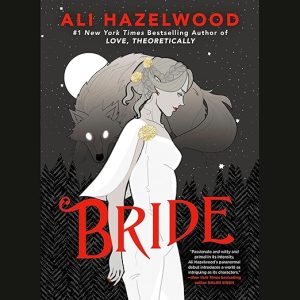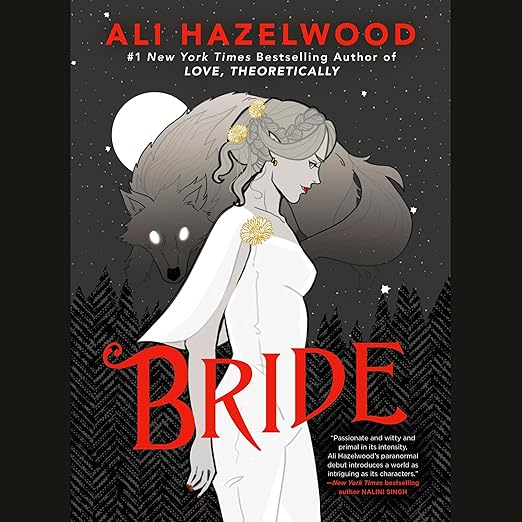
At a Glance
- Read by: Therese Plummer handles Misery Lark's dry wit and emotional guardedness with a dry precision that suits the character's peculiar mix of competence and vulnerability.
- At its heart: political marriage and genuine connection, interspecies coexistence as allegory, outsider identity
- Vibe: Slow-burn and sardonic, with a humor that softens the paranormal edges
- Short version: Ali Hazelwood at her most imaginative, transplanting her signature slow-burn dynamic into a vampire-werewolf world that actually uses its premise for something.
I had come to Ali Hazelwood through her STEM romance novels, Love Theoretically and The Love Hypothesis, where her signature move is pairing an academically brilliant, socially awkward protagonist with an equally brilliant romantic lead and generating friction through professional context. Bride takes that instinct into entirely different territory, and what surprised me was how well the paranormal setting actually serves her strengths. The tension between Misery Lark and Alpha Lowe Moreland is recognizable Hazelwood territory: slow-burn, charged with mutual suspicion, and built on a foundation of two people who have very specific reasons not to trust each other. What the vampire-werewolf setting adds is not genre decoration but genuine stakes.
Misery is the only daughter of the most powerful Vampyre councilman in the Southwest, and she has spent most of her life as an outcast within her own community. When she is surrendered to the Were pack as part of a historic peacekeeping alliance, the arrangement looks, from the outside, like a political transaction. But Misery has her own agenda: there is something she needs from this arrangement, something that has nothing to do with politics, and she will protect that secret at significant personal cost. Lowe Moreland watches her with the careful attention of a man who has learned not to trust, and the dynamic between two characters who are both deeply competent and deeply guarded is what drives the novel.
Is Bride Worth Your Time?
Several reviewers who came to Bride skeptically, doubting the vampire-werewolf premise, describe it as the book that changed their mind. One French reader articulated clearly what Hazelwood is doing beneath the paranormal surface: the novel is about tolerance of differences, about discovering that the people your community defines as enemies are recognizable human, or close enough. The Vampyre-Were hostility functions as allegory, and Hazelwood does not let the allegory sit as mere backdrop. It inflects how Misery and Lowe think about each other, what concessions each makes, what prejudices each has to actively dismantle.
Misery's voice is one of Hazelwood's funniest and most distinctive: dry, self-aware, quick with observations that undercut the romance genre's tendency toward melodrama. One reviewer mentioned laughing out loud repeatedly, and that quality is real. Hazelwood's particular gift is for characters who are emotionally guarded but inwardly expressive, and the gap between what Misery shows and what she feels generates most of the novel's pleasure.
The Best Parts of Bride
Therese Plummer is a good fit for Hazelwood's voice. The dry delivery required for Misery's narration sits naturally with Plummer's performance style, and she handles both the comedic timing and the more emotionally exposed moments without losing the character's essential guardedness. At twelve hours and forty-seven minutes, the pacing reflects a common Hazelwood characteristic: the first half establishing the dynamic and the world, the second half accelerating toward the emotional payoff. One reviewer noted that the last quarter of the book elevated their rating substantially, and the audiobook format suits that construction because the momentum builds naturally over consecutive listening sessions.
Before You Commit to Bride
Readers coming from the ACOTAR world of Sarah J. Maas or Jennifer Armentrout's highly descriptive romantasy may find Hazelwood's prose more interior and less environmental. She builds world and character primarily through her protagonist's voice rather than through extended description, and the Were world is evoked through implication and interaction more than explicit worldbuilding. For some readers this is a strength; for others, particularly those who want a richly realized paranormal setting, it may feel thin. The book is, at its core, a character study and a romance with paranormal scaffolding rather than a world-building exercise.
Should You Listen to Bride?
Hazelwood readers who have stayed with her contemporary romances should find this a natural expansion of her strengths into new territory. Paranormal romance listeners who want something lighter in tone and more character-driven than the typical alpha-werewolf or dark vampire novel will find Misery and Lowe a welcome change. Romance listeners who need heavy world-building to stay engaged should manage their expectations. Those who love slow-burn dynamics, dry wit, and protagonists with secrets they are actively protecting will be well served.
Good to Know
Is Bride connected to Ali Hazelwood's STEM romance novels like Love Theoretically?
No. Bride is a standalone paranormal romance set in an entirely different world. The characters and setting share nothing with her contemporary romance novels, though the signature slow-burn dynamic and dry protagonist voice are recognizable Hazelwood qualities.
Does Therese Plummer's narration work for Misery Lark's particular voice?
Yes. Plummer's delivery captures the dryness and guardedness of Misery's character well. The humor lands because Plummer does not oversell it, and the more emotionally open moments in the second half benefit from the restraint established earlier.
Is Bride the start of a series or a complete standalone story?
Bride functions as a complete standalone. The central relationship between Misery and Lowe reaches a full conclusion. Hazelwood has indicated interest in continuing in this world, but the book does not end on a cliffhanger requiring a sequel.