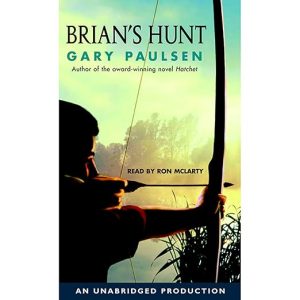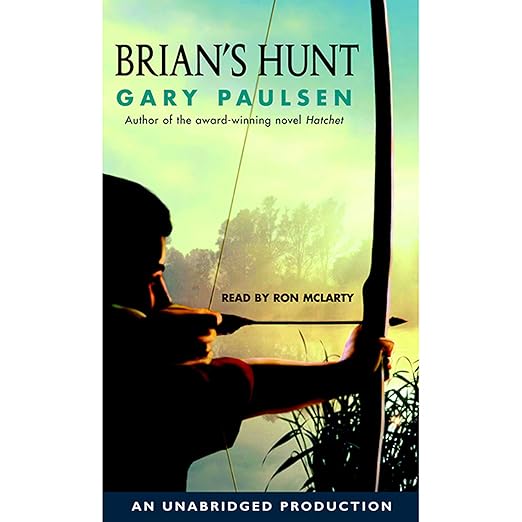
- Performance: Ron McLarty takes a novel that is mostly one person, one dog, and no conversation, which is work a single voice can do properly.
- What it covers: Wilderness competence, the bond between a person and an animal, a series drifting from survival toward choice.
- Feel: Quiet, watchful, finished quickly.
- Our call: A strong short entry for listeners already inside the saga, sitting beneath a rating field that has visibly broken.
Ron McLarty gets two hours and twenty-three minutes to deliver a Gary Paulsen novel, which is brief even by the standards of a series written for readers who resist long books. That compression is the first thing worth knowing about this audiobook. The second is that the star rating attached to this listing cannot possibly be true. Brian Robeson, camping alone on a lake in the woods, finds a wounded and whimpering dog, decides that whatever did it is worth heading north about, and the story proceeds from there. Listening Library put the recording out in May 2011.
Our Take on Brian's Hunt
Brian's Hunt is the fifth entry in Brian's Saga according to the series field, and it assumes a great deal. Hatchet, The River, Brian's Winter, and Brian's Return all appear in the copy as what came before, and the premise leans hard on a listener already understanding why this boy is competent alone in the North Woods and why his Cree friends are worth a hard journey. The description supplies none of that background. It supplies a wounded animal, a set of instincts, and a direction.
Two hours and twenty-three minutes covers the entire recording, and the material fits inside it. This is a book with very little dialogue: one person, one dog, a canoe, and a decision. A single credited reader is not a compromise here in the way it would be in an ensemble novel, but close to correct staffing. Whether McLarty was the right single reader is a question this page cannot help with, since Listening Library provides no sample and nothing at all describing how the session was made. The audience note is missing too: this listing carries no tag whatsoever, not a reading level, not an age band, which is unusual for a title pitched at school-age listeners.
VOYA and Kirkus Reviews are both quoted in the description, and both are praising a printed book. The VOYA line commends spare prose that seems ideally suited to the setting and plot. The Kirkus line calls this a well-written sequel that will be gobbled up by the author's legions of fans. Neither offers a buyer of an audio edition anything to act on, and prose described as spare behaves differently in the ear than on the page, where a reader sets the pace and can slow down at will.
Why Listen to Brian's Hunt
Survival is the franchise, and tmNT2105 registers the most interesting objection on the page: by this point in the sequence, the survival has largely drained out of it. Brian goes into the woods because he enjoys it, not because a plane came down, and that reviewer is unsure whether a book about escaping modern living teaches the right lesson, before the response breaks off in the middle of the thought. Four stars delivered with reservations, and the only entry here that argues with the book instead of recommending it. It is also the one response written by somebody outside the country the series is set beside, reading American books at a distance and weighing what they teach.
Josh's review is the one a parent will actually use. A son who had never been a fan of reading, who had resisted graphic novels and sports stories, got through this one and then worked onward through the remaining volumes. The list of things that had failed before it includes audiobooks, which is worth pausing over on a listing selling one. cryteria reports a husband buying the series for reading and comprehension tutoring and says students enjoy them, particularly boys. Two accounts of the same use, from October and November 2025. Amazon Customer supplies a fourth data point in four words, filing the purchase under Birthday Gift and calling it perfect for the book loving kid.
What to Watch For in Brian's Hunt
Five written responses sit in this column while the counter beside the stars insists on two ratings. Both cannot be right, and the score makes it worse: 4.8 cannot be assembled from two whole-star votes under any rounding convention in use anywhere. Something in the aggregation has broken, most plausibly a merge across formats or editions, and the practical consequence is that the headline figure carries no information whatsoever. Read the five responses and disregard the number above them.
Newbery is spelled two ways on this listing. The publisher's copy calls Gary Paulsen a three-time Newbery Honor-winning author. gt surber, in the longest review here, writes that Hatchet is one of three Newberry Awards that Paulsen has earned. An Honor and an Award are not the same distinction, and the spellings differ by a letter. That same review calls the series The Brain Sagas in one line and Brian Sage books in the next, refers to this volume as The Hunt, and names an epilogue, Guts, that appears nowhere in the publisher's list.
Four titles are printed under the heading Read all the Hatchet Adventures: Brian's Winter, The River, Brian's Return, and Brian's Hunt. The same page numbers the volume five. gt surber counts five books plus the epilogue and puts Hatchet first in the sequence, which reconciles the arithmetic if Hatchet is the volume the publisher's own list omits. The listing never confirms that. A buyer working out where to begin is being asked to reconstruct the reading order from a customer review.
Who Should Listen to Brian's Hunt
Reluctant readers are the audience two separate responses identify without prompting from each other, and the short running time is why it works: a whole novel inside one car journey, with no moment at which a listener has to decide whether to carry on. At this length a household can test the format without committing to anything, since a failed experiment costs one evening. It also suits anyone who met Brian years ago through Hatchet and wants to know how the sequence closes. The wilderness detail is the draw, and the dog supplies an emotional center that a lone-survival premise does not automatically provide.
Listeners who want the original Hatchet situation, a boy dropped into the wilderness with nothing, are buying the wrong volume, because this Brian chooses the woods and arrives equipped. Anyone who needs a rating to mean something will have to find their signal elsewhere on the page, since that field has plainly failed here. Give this one to a young listener who has already met Brian, and it should do what the two households in the review column say it did for them.
Common Questions
Why does the rating on this audiobook look wrong?
Because it is wrong. The page shows 4.8 beside a counter reading two ratings, and no rounding convention turns two whole-star votes into that figure. Five written responses are visible, which is already more than the counter allows for. The likeliest cause is an aggregation merging entries across editions, so ignore the number.
Can this audiobook be followed without the earlier Brian books?
The plot can, since it opens on a camping trip and a wounded animal and explains itself as it goes. The emotional weight cannot. Everything that makes this competence remarkable happened in earlier volumes, and the description takes that knowledge for granted. Beginning here works as a sample and badly undersells the book.
How many books come before this one in the sequence?
The page cannot decide. Its series field calls this the fifth, while the publisher's own list under Read all the Hatchet Adventures prints only four titles. The longest review counts five plus an epilogue called Guts and puts Hatchet first of all, which would square the numbers if Hatchet were simply missing from that list.
Is two hours and twenty-three minutes really the complete text?
Nothing on the listing suggests otherwise, and no abridgement notice appears anywhere on it. The length is genuinely short for a novel, although this is a compact book with very little dialogue and one point of view throughout. Listening Library provides neither a sample nor a chapter breakdown for checking that.