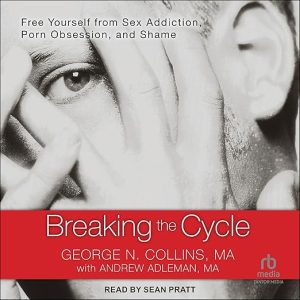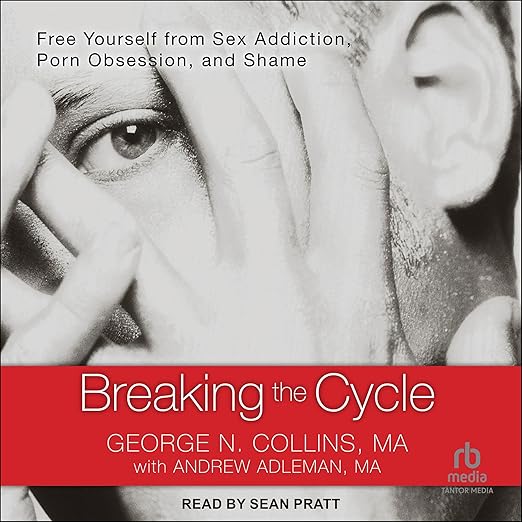
Sexual addiction is one of those topics that attracts a remarkable amount of bad literature from every direction, both from people who deny its clinical legitimacy as a genuine psychological pattern and from those who address it with more moral urgency than psychological rigor. George Collins has written something that belongs to neither category and that is considerably more useful as a result. Breaking the Cycle is a clinical resource from someone who has spent his career working directly with people struggling with sexual compulsivity, and the audiobook version carries the texture of that accumulated professional experience in ways that more theoretically grounded treatments of the subject consistently fail to replicate. The combination of clinical framework and direct practitioner knowledge is what distinguishes this from the more common alternatives in this specific corner of the self-help and psychology audiobook space.
I listened to Breaking the Cycle over several evenings with a particular listener in mind, a friend who had been asking me for resources in this area on behalf of someone close to them. What I found was a book that is genuinely useful in the specific and demanding way that the best clinical resources are useful: it is specific about what it is treating, organized around a coherent framework, and honest about the limitations of what it offers without undercutting the substantial value of what it does provide. Collins is not selling a cure or a simple protocol that works for everyone. He is offering a map of a territory that is genuinely difficult to navigate, along with a set of practices that his clinical experience strongly suggests are useful for making meaningful progress through it.
How Breaking the Cycle Holds Up
Before Collins gets to the practical content, he spends real and necessary time establishing precisely what he means by the term he is using and why the clinical framework he has developed is justified by the pattern he observes in his clients. This definitional groundwork is genuinely important. The question of whether sexual addiction is a legitimate clinical category remains actively contested in some professional circles, and Collins addresses that controversy honestly and directly without becoming defensive about his own clinical position. His definition centers on the compulsive, self-reinforcing quality of the behavior pattern and its documented consequences for the person's life, relationships, and capacity to function rather than on moral categories of appropriate versus inappropriate sexual desire or expression. That framing is both clinically coherent and significantly more useful for listeners trying to understand their own behavior without the additional burden of shame-based frameworks that conflate compulsion with moral failure.
Why Breaking the Cycle Works as an Audiobook
The practical sections of Breaking the Cycle are organized around a recovery framework that draws explicitly on Collins' clinical experience with what actually works for his specific client population rather than on theoretical models derived from addiction research in other domains. He is honest throughout that different approaches work for different people and that the framework he offers is a rigorous starting point rather than a guaranteed solution that applies uniformly. The exercises and practices he recommends are concrete enough to apply in daily life, and he provides enough clinical context for each recommendation that listeners can understand why it is being suggested and how it fits into the larger framework, rather than simply following instructions without comprehending their purpose. This approach treats the listener as an intelligent adult capable of engaging with and understanding their own recovery process rather than demanding compliant rule-following.
Weak Spots in Breaking the Cycle
The clinical subject matter requires a narration that achieves a specific and difficult calibration: neither so clinically distanced that it creates emotional barriers between the listener and the material, nor so empathetically intense that it tips the content into the melodrama that would undermine its usefulness as a serious resource. The narrator here finds the right register throughout the audiobook and maintains it consistently. The delivery is clear and informative in the expository sections explaining the clinical framework, and appropriately subdued in the sections addressing the emotional dimensions of recovery and the consequences of compulsive behavior for relationships and self-image. The case material, which Collins uses strategically to ground his clinical framework in recognizable human experience, is handled with genuine discretion throughout the production.
The Right Listener for Breaking the Cycle
Breaking the Cycle will be most useful for three distinct audiences, each of which will approach the material with different needs and different prior knowledge. First, people dealing directly with sexual compulsivity who are looking for a clinically grounded framework that does not begin from a shame-based position or require religious commitment as part of the recovery process. Second, partners and family members of people with these behavior patterns who want to understand the clinical landscape and their own complicated role within the recovery process rather than simply reacting to the behavior. Third, therapists, counselors, and coaches who work adjacent to these issues and want a practically organized resource to recommend to clients or draw on in their own practice. For all three audiences, Collins has produced an honest, serious, and clinically grounded resource that this subject area genuinely needs. Collins has spent his career working directly with the people this book is written for, and that direct clinical experience gives the framework an authority that purely theoretical treatments of the subject cannot replicate regardless of their academic credentials or their theoretical sophistication. The audiobook carries that authority throughout.
Common Questions
Is this audiobook useful for partners and family members of people with sexual compulsivity?
Yes, Collins explicitly addresses the impact on relationships and includes material aimed at partners. The clinical framing is accessible to non-specialists.
How does Collins address the contested question of whether sexual addiction is a legitimate clinical category?
Directly and without defensiveness. He acknowledges the clinical debate while explaining the behavioral and psychological criteria he uses to define the pattern he is treating. The definitional groundwork is solid.