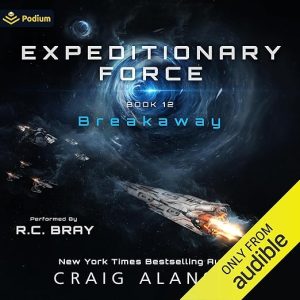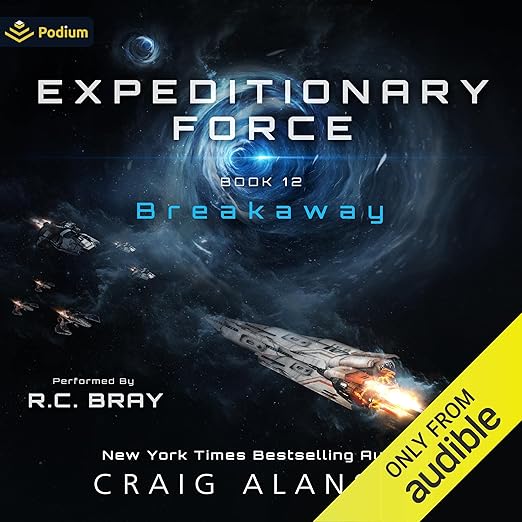
Expeditionary Force Book 12, Breakaway, is the kind of audiobook that rewards long loyalty to Craig Alanson's series more than almost any entry since the earliest Joe-and-Skippy exchanges. R.C. Bray has been the series' constant across all preceding volumes, and his performance here, nearly 20 hours of the familiar dynamics between Joe Bishop and the magnificently insufferable Skippy the Magnificent, reminds veteran listeners exactly why they've committed this many collective hours to a saga about reluctant galactic peacekeeping and AI condescension as a survival mechanism.
The setup is vintage ExFor: the Pirates offered the alien factions a ceasefire, nobody took it seriously, and now everyone is racing around the galaxy managing the consequences of their own failed diplomacy. Alanson runs multiple simultaneous threads: the Merry Band of Pirates cleaning up the ceasefire fallout, the infant UN Navy working with the Alien Legion on building actual diplomatic alliances for humanity, and the Ethics and Compliance Office facing the awkward necessity of doing something ethical, or at least finding a convincing workaround. That last thread is where the comedy operates at its most pointed, applying institutional absurdity to civilizational-scale stakes in a way that feels like the series' natural register rather than a tonal deviation.
What We Made of It
Bray's performance is what sustained ExFor listeners come for, and Breakaway doesn't disappoint on that dimension. One reviewer noted that his voice immediately makes them identify the characters speaking, which understates how technically difficult that consistency is across 19-plus hours of complex, multi-character science fiction with a large recurring cast. The Skippy voice in particular demands precise comedic timing; Alanson's dialogue for the AI's condescension and Joe's exasperated responses is only as funny as the reader makes it, and Bray's timing remains exceptional at this point in the series' run.
Alanson's plotting in Breakaway manages multiple simultaneous threads without losing the character stakes that make the series' humor function. The UN Navy and Alien Legion thread introduces enough new diplomatic complexity to feel like genuine forward momentum rather than series maintenance, which is the ongoing challenge for any franchise operating at Book 12. One reviewer captured the appeal precisely: the book is full of fun, sarcasm, and a whole lot of Skippy, and you can't have Skippy without Joe. That formula remains the load-bearing structure of everything else Alanson builds around it.
Why Listen to Breakaway
The ExFor series has sustained the audiobook format better than most long-running science fiction franchises because Alanson's prose voice and Bray's performance voice have converged over twelve volumes into something coherent and reliable. Listeners who have stayed with the series know exactly what to expect in terms of humor style, action pacing, and the specific texture of the central dynamic. Breakaway delivers on those expectations without merely repeating what earlier volumes have already accomplished, which is the meaningful challenge at this stage of the run.
The galactic scale of the plotting is managed without losing individual character stakes, which is a genuine craft challenge at this point in a series this long. New factions, new ethical dilemmas, and a continued expansion of what humanity's position in the galaxy actually means are all present without overwhelming the interpersonal dynamics that make listeners care about the outcome. At 19-plus hours, the listen is a substantial commitment even for dedicated ExFor fans, but Alanson earns the runtime consistently across the volume.
What Might Not Land
Long-running series humor faces an inherent challenge: familiarity can tip into formula. One reviewer described the comedy at certain points as a little forced, offering the memorable comparison that it would be chain restaurant level at those moments if it were food. That's a fair observation for a series running this long. The Skippy-Joe dynamic is well-established enough that it doesn't always generate the same friction it did when the pairing was newer, and some of the banter runs on its own inertia rather than genuine comedic discovery. For most ExFor fans, this is an acceptable trade-off rather than a serious flaw, but it's worth noting honestly.
The Ethics and Compliance Office thread will likely generate divided reactions among the ExFor fanbase. Listeners who appreciate Alanson's willingness to find comedy in institutional logic will find it one of the more inventive elements of Breakaway. Those primarily invested in action plotting and the Pirates' primary mission thread may find it a slower burn that tests patience before the payoff arrives.
The Right Listener for Breakaway
This audiobook is specifically for readers who have completed Expeditionary Force Books 1 through 11 and want to continue following the series. Breakaway follows directly from Brushfire, Book 11, and that continuity is tight enough that jumping in here without the preceding context would be a disorienting experience. The internal series consistency makes Bray's performance exceptionally rewarding for listeners who have the established context to appreciate every callback and character development.
New listeners to the ExFor series should start with Book 1 and commit to the full run. The series rewards that investment with one of the most consistent long-form narrator performances in science fiction audiobooks, and Breakaway demonstrates that at Book 12, Bray and Alanson have not yet exhausted what this premise and this central pairing can deliver together.
For committed ExFor listeners, Breakaway also represents a useful benchmark for where the series sits at the end of its second decade of storytelling. Alanson has kept the core premise generative by continuing to expand the galactic stage without abandoning the interpersonal dynamics that make listeners care about the strategic outcome. Whether that balance holds across future volumes remains to be seen, but at Book 12, the creative health of the series is in better shape than most comparable long-running science fiction franchises can claim at the same point in their run.