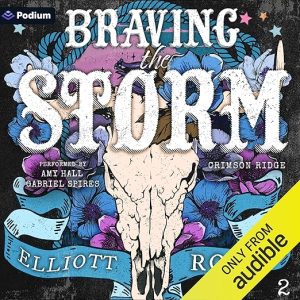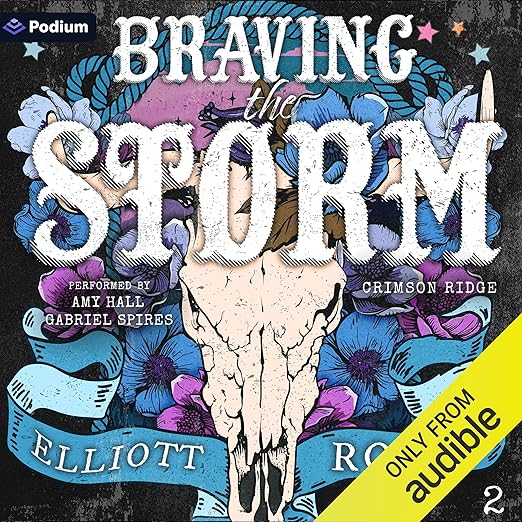
Braving the Storm requires a certain kind of listener honesty. It is doing what it says on the cover: a forbidden romance between a woman fleeing her family and an ex-bull rider who turns out to be her father's adopted brother, marooned together in a mountain cabin in Crimson Ridge during a winter that shows no interest in cooperating. If that premise troubles you on principle, nothing Elliott Rose does on the execution side is going to change that. But if you are the kind of listener who has a shelf of taboo romances and a nuanced understanding of why the genre exists, this second installment in the Crimson Ridge series is working at a higher emotional register than most of its contemporaries.
I finished most of it in a single evening, the kind of evening where you tell yourself you are just going to see how the next chapter develops and then look up to find it is two hours later. The cabin setting is doing real work throughout. Rose understands forced proximity as a pressure cooker rather than a convenience, and the physical constraint of the mountain location, snowbound, isolated, the outside world reduced to a signal on a satellite phone, gives the growing attraction between Briar and Stormand a specific temperature that slower-paced romance rarely achieves.
Where This One Lands
The taboo element here is the adopted-uncle dynamic, Stormand Lane is not a blood relation to Briar, something the narrative establishes clearly and returns to several times. Reviews suggest readers appreciated that Rose does not use this as a loophole she ignores but as a genuine source of tension. Both characters know what the relationship would look like from the outside. They know the social stakes. The push and pull of that awareness against their physical and emotional pull toward each other is where the book lives, and Rose handles it with more psychological seriousness than the premise might suggest. The emotional baggage Briar arrives with, years of being treated as a chess piece in her father's business dealings, a soul-crushing LA existence she upended on the strength of a secret found in a jacket pocket, is given real weight and development.
What Makes Braving the Storm Worth Hearing
This is the second book in the Crimson Ridge series, but Rose has structured it as an interconnected standalone. Familiarity with the first book, Chasing the Wild, enriches some of the secondary character appearances, previous protagonists make a brief return, but Braving the Storm is entirely coherent without that context. Gabriel Spires's narration suits the moody, tension-heavy register of the material. He does not overplay the forbidden-desire moments, which is exactly right: Rose writes that chemistry through accumulation of small charged exchanges rather than operatic declarations, and Spires respects that architecture. The result is a performance that lets the writing do its job rather than competing with it.
What Gives Us Pause
The explicit content is significant and escalates as the book progresses. Rose positions this as adult fiction and the content warnings on her website are thorough, worth consulting before listening. A small contingent of reviewers found the sexual content density eventually tiresome at the expense of emotional development, and that is a fair note. The romantic resolution arrives on the quicker side relative to the depth of the complications Rose has set up, and some of the plot mechanics surrounding Briar's family, the dirty secret, the business empire threads, are left more loosely tied than the cabin story itself. But the central emotional arc between Briar and Storm is handled with genuine care, and the healing-from-family-trauma element is more substantive than it typically is in books of this genre.
Should You Listen to Braving the Storm?
This is for listeners who are comfortable with taboo romance premises and explicit adult content, who prefer their forbidden romance emotionally grounded rather than purely sensation-driven. Fans of the first Crimson Ridge book have been vocal in their enthusiasm. Readers who came to the book specifically for the bull-rider cowboy energy will find Stormand delivers, the ex-rodeo backstory is rendered with specificity. Those who are new to the author and the series can start here without issue.
Quick Take
- Voice: Gabriel Spires handles the mountain isolation and the charged dialogue between Storm and Briar with appropriate restraint, not the flashiest performance but a solid match for the material's moody register.
- Big ideas: forbidden attraction, healing from family trauma, isolation as both danger and refuge
- Atmosphere: Tense and slow-burning, with a claustrophobic mountain-cabin pressure that suits the taboo premise
- Worth it?: Readers who go in knowing exactly what this is, a taboo forced-proximity romance with genuine emotional stakes, will find Elliott Rose has delivered the book she promised.
Questions Listeners Ask
Can I listen to Braving the Storm without reading the first Crimson Ridge book?
Yes. Rose has written this as an interconnected standalone, meaning you will encounter characters from Chasing the Wild but you do not need their backstory to follow Briar and Storm's arc. That said, readers who have finished book one will get more from the secondary character appearances.
Is the taboo element, the adopted uncle relationship, handled carefully, or is it treated as pure shock value?
Multiple reviewers note that Rose takes the complicated dynamic seriously. Both characters are explicitly aware of the social weight of what they are feeling, and that awareness is a sustained tension in the narrative rather than something the book glosses over to get to the romance.
How does Gabriel Spires handle the male lead character Stormand, is it a convincing performance?
Spires plays Storm as quieter and more contained than you might expect from a former bull rider, which turns out to be a good instinct. The character is defined by restraint as much as intensity, and Spires builds the tension through controlled delivery rather than performed roughness.
Does the Crimson Ridge series have a consistent tone across books?
Based on available reviews of both books, yes, the series maintains a consistent mountain-west setting with forbidden-romance premises and explicit adult content. Readers who enjoyed the first book's tone and heat level should find this installment familiar and satisfying.