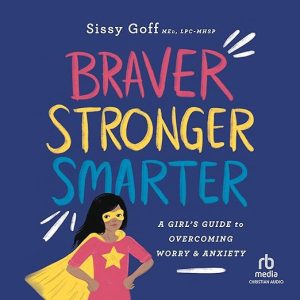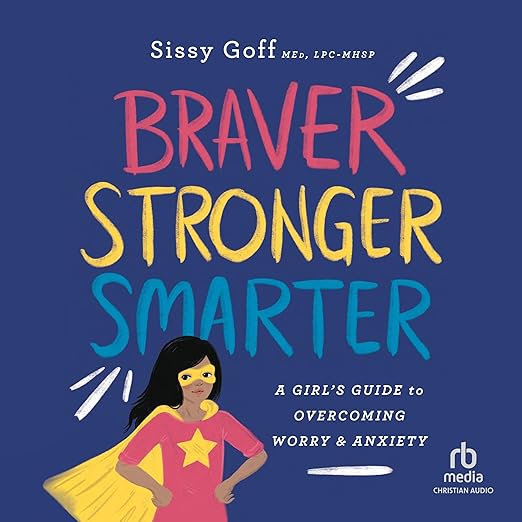
Six to eleven is the exact window Sissy Goff targets in Braver, Stronger, Smarter, the stretch of elementary school when anxiety in girls tends to surface for the first time, and this two-hour, self-narrated audiobook is built to meet that moment directly rather than waiting for it to become a bigger problem later. Goff, a licensed counselor who has spent her career working specifically with girls and anxiety, frames the book around a simple faith-based idea: a child who trusts that she is loved by a God bigger than her fears has a real foothold against worry, not just a coping trick to memorize.
Answering Yes to Almost Every Worry-Question
What sets this apart from a typical parenting guide is who is actually being spoken to. Goff writes and narrates directly to the child listener, not to the parent reading over her shoulder, which reviewer Amazon Customer captures well in describing how her nine-year-old daughter answered 'yes' to almost every worry-question during the introduction alone. That kind of immediate, uncomfortable recognition is exactly what a book like this needs to work, and it depends on Goff's ability to speak to a specific young girl rather than lecture an audience of parents about her.
Reviewer Shauna extends the book's reach further than its stated six-to-eleven age range, noting that the coping techniques inside proved genuinely useful for godly women in their twenties and thirties working through their own anxiety, not just for the elementary-aged girls the book is written for. That kind of crossover appeal is a real signal about the underlying quality of Goff's actual therapeutic content, since techniques robust enough to help an adult manage worry are unusually well built for a children's format specifically.
Goff has built a body of published work specifically around girls and anxiety, this title sits alongside her other books addressing worry, confidence, and emotional resilience in young girls, which matters for a listener deciding whether to start here or with one of her other titles. Braver, Stronger, Smarter functions as the version aimed most directly at the child herself rather than at the parent, distinguishing it within her broader catalog by audience rather than subject matter.
Hundreds of These Exact Conversations Before This One
Goff's self-narration is the single biggest reason this audiobook works as well as it does. As the counselor who actually developed these techniques through real sessions with real anxious girls, her voice carries an authority no outside narrator could borrow convincingly, the specific, practiced warmth of someone who has had this exact conversation hundreds of times before and knows precisely where a young listener tends to tense up or tune out. A professional narrator reading Goff's words from a script would deliver information; Goff herself delivers something closer to a session.
That intimacy matters especially given the book's format: short, easy-to-listen stories paired with writing and drawing prompts, meant to feel like a conversation rather than a lecture. Hearing Goff address the listener directly, as if speaking to one specific child rather than performing for an audience, reinforces the book's central promise that a young girl is not alone with her worries. For a genre that can easily tip into either clinical distance or saccharine over-reassurance, Goff's matter-of-fact warmth threads that needle unusually well.
The title's three adjectives, braver, stronger, smarter, are not interchangeable synonyms for confidence; each maps to a distinct piece of Goff's actual framework, courage in the face of fear, resilience under repeated difficulty, and the practical wisdom to recognize an anxious thought for what it is rather than automatic truth. Structuring the book around three distinct, nameable qualities rather than one vaguer idea of feeling better gives a young listener specific, memorable language to reach for later, a meaningfully different design choice than a more generic reassurance-focused children's book would make.
Built to Be Revisited in Short Doses
At two hours and eight minutes, this is a genuinely short listen relative to most audiobooks, and that runtime should be understood as a feature rather than a shortfall: this is meant to be revisited in short doses over time, not consumed once and shelved. Parents expecting a comprehensive, single-sitting resource on childhood anxiety broadly should know this is narrower and more targeted than that, built around Goff's specific brave-strong-smart framework rather than a survey of anxiety treatment approaches generally.
The writing and drawing prompts built into the print companion cannot be completed through audio alone, which matters more for this title than for most nonfiction, since actively working through a prompt is central to how the book's coping techniques are meant to stick. Families planning to use this as a full program, not just a bedtime listen, should pair the audiobook with the physical book or workbook pages rather than treating the audio edition as a complete standalone resource. The spoken stories and explanations still carry real value on their own, but the full program depends on both formats working together.
Being a Working Counselor Is What Makes This Credible
Faith-integrated children's mental health resources occupy a fairly specific niche, distinct both from secular clinical anxiety workbooks and from purely devotional children's content, and Goff's specific credential, a working counselor rather than a general Christian children's author, is what makes this particular blend credible rather than a purely inspirational add-on to clinical technique. Parents comparing this against secular options should know the clinical content itself, naming anxious thoughts, building coping tools, is legitimate and well-grounded, with the faith framing woven through rather than replacing it.
A rating of 4.8 across 768 reviews is an unusually strong showing for a children's resource this specific in both age range and faith framing, suggesting Goff's material connects reliably across a wide range of families rather than appealing narrowly. That consistency matters for parents weighing an unfamiliar counselor's book against better-known children's anxiety resources, since strong, high-volume ratings for a niche title are harder to earn than for a more broadly marketed one.
Choosing a Practiced Voice Over Polished Delivery
This audiobook is built for parents of anxious elementary-aged daughters, particularly in households where a faith-centered framing of courage and reassurance already resonates, looking for a short, warm, immediately usable resource rather than a lengthy parenting manual. It also works well as a listen the parent and child share together, given how directly Goff addresses the young listener throughout. Anyone drawn to a counselor's real, practiced voice over a professional narrator's polished but secondhand delivery will find real value in the self-narration specifically.
Families outside a Christian faith framework, or those looking for a secular, clinically framed anxiety resource, should know the God-centered language is not incidental here, it runs through the entire book's core argument. Parents hoping for a comprehensive, single-source anxiety program covering older children or a wider range of approaches will also find the narrow age range and short runtime limiting relative to that goal.