At a Glance
- Performance: Andrew McCarthy narrating his own memoir is the right call - his measured, slightly guarded delivery mirrors the emotional territory he is covering, and there is real intimacy in hearing him reckon with his own mythology.
- What it covers: Coming of age in public, addiction and conflicted ambition, the cost of sudden fame
- Feel: Reflective and candid, with the specific melancholy of someone revisiting a time that defined them against their will
- Our call: McCarthy's self-narrated memoir earns its running time through genuine introspection rather than nostalgia-mining, and the audiobook format makes his measured candor land with particular force.
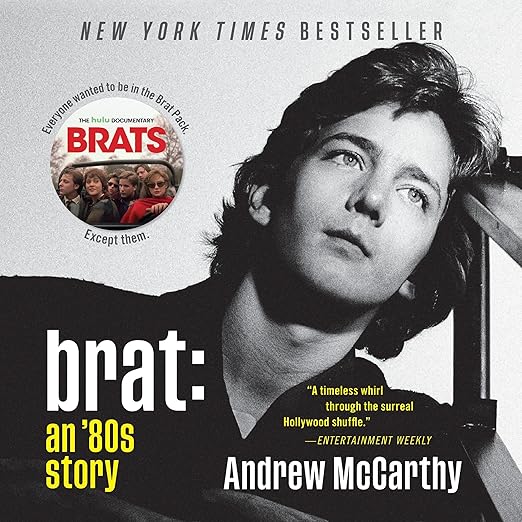
Andrew McCarthy's memoir Brat arrives with an interesting credibility problem: everyone thinks they know who he is. The Pretty in Pink outsider, the St. Elmo's Fire lost boy, the Weekend at Bernie's comic relief - the Brat Pack mythology has spent four decades calcifying around him into something he never quite agreed to. The audiobook, narrated by McCarthy himself, is his attempt to occupy that story on his own terms rather than the ones the cultural record assigned. It is a 4-hour and 55-minute listen that earns its most honest moments by refusing to make the mythology more glamorous than it actually was.
Washington Square Park, Before the Fame
McCarthy focuses the memoir specifically on that singular Brat Pack moment rather than attempting a comprehensive career retrospective, which is the right editorial decision. The specificity gives the book its texture. The 1980s New York City he describes - scoring loose joints in Washington Square Park, skipping school for the revival houses of the Village, discovering the films that would redirect his life - has the granular detail of genuine memory rather than performed nostalgia. He is not celebrating that time so much as excavating it, tracing the line from that particular adolescence to the particular kind of actor, and person, he became.
The sections dealing with conflicted ambition are the memoir's strongest. McCarthy was famously ambivalent about his own success, a trait that read as aloofness to some observers and authentic artistic discomfort to others. Brat does not resolve that ambivalence neatly - it holds it up and examines it, looking at how an outsider identity that felt genuine in Washington Square Park became complicated by sudden immersion in John Hughes films and Hollywood celebrity. His reflections on masculinity and addiction are handled with care, present as forces that shaped his trajectory without being dramatized into recovery narrative beats.
Drawing on Notebooks, Not Reconstituted Memory
The memoir's New York City sections are its most fully realized. McCarthy writes the city's 1980s geography - the dark revival houses of the Village, Washington Square Park as a social ecosystem, the particular quality of cultural ambition that flourished in those pre-gentrification neighborhoods - with an intimacy that suggests he is drawing on notebooks rather than reconstituted impressions. For readers whose relationship with that era and that city is personal, these passages carry a specific kind of resonance. For younger readers, they serve as social history grounded in one young man's experience of it, which is more compelling than any survey of the period could be.
McCarthy Writes Like He Acts, for Himself
McCarthy reading his own work is the format this memoir needed. A reviewer noted that he writes like he acts, for himself - which is meant as mild criticism but reads as accurate description of something that works in his favor in audio. There is a particular quality to self-narrated memoirs when the author is reckoning with a version of themselves they are not entirely comfortable with: the guardedness that might feel like withholding in a celebrity profile becomes precision in audio. McCarthy's slightly measured delivery mirrors the emotional territory he is covering, and the result is a listening experience that feels intimate without being confessional in a way that would ring false.
The Brat Pack's roster - Rob Lowe, Molly Ringwald, Emilio Estevez, Demi Moore - appears as backdrop rather than subject, which is another good editorial call. McCarthy is not telling their stories, and the memoir is better for that restraint. One reviewer who grew up in the 80s described not being able to put the book down, finding in it the comfort that those films and their world were a shared experience rather than a personal one. That response points to what the memoir does best: it makes the specific feel universal without flattening it into generality.
More Interior Than Anecdotal
Readers who come to this memoir wanting comprehensive behind-the-scenes accounts of the Brat Pack films will find less of that than they might expect. McCarthy's interest is interior rather than anecdotal - he is more drawn to what fame felt like from inside than to the stories about what happened on set. The cultural context of the era is vividly present, but this is a book about a young man's inner life during an extraordinary external moment, not a Hollywood oral history. The inspiration for the Hulu documentary, Brat is worth encountering in audio form before or alongside the visual version - the memoir's interiority translates differently in McCarthy's own voice than it does through documentary framing.
At just under five hours, the memoir does not overstay its scope. McCarthy writes with economy that some readers experience as restraint and others as reticence - the honest answer is probably that both are true and that the book is better as a result. Listeners looking for the kind of expansive, anecdote-rich celebrity memoir that spends extended time on set stories and industry gossip should look elsewhere. What McCarthy is doing here is quieter and ultimately more durable than that.
More Reckoning Than Celebration
Listeners who have a genuine relationship with the films and cultural moment McCarthy describes - Pretty in Pink, St. Elmo's Fire, the Brat Pack era broadly - will find the memoir rewarding rather than nostalgic in the hollow sense. People who are drawn to memoirs that resist easy self-congratulation will appreciate McCarthy's refusal to mythologize his own success. Fans of Patti Smith's Just Kids or Rob Lowe's Stories I Only Tell My Friends, the two comparisons the publisher invokes, should note that McCarthy's approach is quieter than either - more reckoning than celebration. Those seeking extensive Hollywood gossip or a comprehensive career account should calibrate expectations accordingly.
A Few Questions About Brat
Does Andrew McCarthy narrating this audiobook add something that a professional narrator could not?
Yes, meaningfully so. The memoir is about the gap between the person McCarthy was and the person the Brat Pack mythology made him, and his self-narration's slightly guarded quality mirrors that gap in a way a professional narrator replicating his voice could not.
Does this audiobook tell the stories of other Brat Pack members like Rob Lowe or Molly Ringwald?
No - the memoir stays focused on McCarthy's own experience. Other Brat Pack members appear as context rather than subjects, which is a deliberate and effective choice.
How does this audiobook compare in tone to other celebrity memoirs?
Quieter and more inward than most. McCarthy is interested in excavating his own ambivalence rather than celebrating his career, which makes the audiobook more reflective than triumphant.