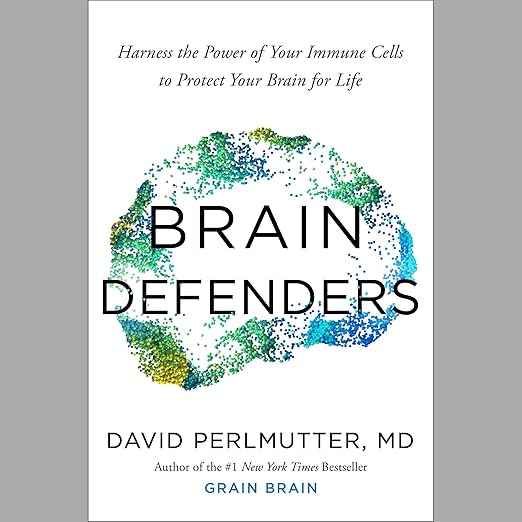
At a Glance
- What it covers: Microglial immunity, chronic inflammation, metabolic health, cognitive decline.
- Feel: Urgent, clinical, faintly evangelical.
- Our call: A current and serious argument about brain immunity, sold with more certainty than a blank credit line and an empty response column can support.
Microglia are the cells this audiobook is built around, and if you have never met them before, that is precisely the point of the exercise. Brain Defenders arrived from Penguin Audio on August 18, 2026, runs a round nine hours, and carries David Perlmutter M.D. on the byline. The listing attached to it has no narrator credit, no star rating, and not a single written response. Nine hours of neurology, and the only material available for judging it in advance is the publisher's own description, which is doing what publisher descriptions do.
Metabolically Hijacked Microglia Turn Against the Brain
David Perlmutter M.D. is presented here as a neurologist and a number one New York Times bestselling author, and the argument on offer is one clean reversal. Medicine has spent decades aiming its weapons at symptoms, memory loss, tremors, headaches, lethargy, while the roots of Alzheimer's, Parkinson's, and major depression went unaddressed. The named culprit is an immune cell that lives inside the brain. Metabolically hijacked microglia stop protecting neurons and begin attacking them, and whether they act as protectors or destroyers depends, the description says, largely on how we live. The reversal is offered as a correction to an entire field rather than as a hypothesis under test, and that rhetorical setting shapes how everything after it lands.
Immunometabolism is the technical spine of the book, and the copy does not hide the word or soften it. The promise is the science of how cellular energy and immune function interact, the overlooked role of inflammation in conditions running from dementia to long COVID, and the case that the immune system is simultaneously the brain's greatest threat and its greatest hope. That is a coherent thesis. It is also a live research area rather than settled ground, which is worth knowing before nine hours of sustained confidence.
Blank Narrator Field Hides the Reading Voice
Nothing in this record tells you who reads it. The narrator field is blank, which for a Penguin Audio release from an author with this publishing history is unusual enough to stop on. It might mean the credit was never entered. It might mean the author takes the microphone, which is common for clinician-written health titles. It might mean a hired reader whose name has not reached the listing yet. What it definitely means is that you cannot audition the voice you would spend nine hours with by reading this page.
Nine Hours Even Suggests an Early Listing
Penguin Audio is the imprint, and that round nine-hour runtime has the shape of an estimate rather than a measured file, since finished audio almost always lands on an odd count of minutes. On its own that is trivia. Sitting beside a blank narrator field and an empty response column, it suggests a listing assembled ahead of the recording rather than from it, and it is a useful reminder that a product page can be published before a product is finished.
Metformin and Lion's Mane Get One Volume
Nine hours is generous for a health book written at a general reader, and the shape implied by the description accounts for it: immunometabolism and cellular energy, inflammation and dementia, how daily life decides the fate of your microglia, the link between metabolic health and neural resilience, and then the interventions. Fasting, sleep, oxygen therapy, metformin, lion's mane mushroom. Those last items are not the same category of claim as the first two, and a listener should be hearing them differently as they arrive.
Metformin and lion's mane sitting in one list alongside sleep is the moment to keep your judgment switched on. Sleep and physical activity carry a weight of evidence that a mushroom extract does not, and audio quietly flattens that distinction, because everything reaches you at the same volume, at the same pace, in the same measured register. On a page you can see a hedge sitting in a subordinate clause and weigh it. Read aloud, a hedge sounds like nothing more than a pause.
Empty Ratings Meet an August Release Date
Empty is the accurate word for the evidence column here. No star average is displayed, no vote count sits beside it, and no written responses exist at all. For a title from a major imprint by an author with a long back catalog, that combination almost always means the page went up at or before publication and nobody has returned to it since. It is not a verdict on the book. It is the absence of one, and the two should never be confused.
The listing dates publication to August 18, 2026, which means anyone reading about this title in its first season is working from exactly the materials this piece is: a description, a byline, a runtime, an imprint. That deserves saying plainly, because health writing is the genre where a confident third-party summary most easily passes for corroboration when it is really just a paraphrase of the jacket. Nobody has yet reported back on what nine hours of this actually feels like.
Neither the description nor any other field mentions a supplementary document, and that omission carries more weight here than it would elsewhere. Books about metabolic and cognitive protocols normally arrive with food lists, charts, or dosing guidance, and several of the interventions named in the copy imply specific numbers. Whether those numbers exist as a downloadable file, get read out in full, or simply never appear in the audio edition is a question this listing leaves entirely open.
Caregivers and Metabolic-Health Readers Fit This Best
Curious listeners who already follow the metabolic-health conversation, and who want the immune-cell case laid out at length by a practicing clinician, are the natural audience. So is anyone caring for a parent in early cognitive decline who wants to understand what inflammation has to do with any of it. The microglia framing is a genuine shift in how a decade of research is being read, and hearing it argued at length is a reasonable use of nine hours. The method will be familiar to anyone who has read in this territory before: pick one mechanism, follow it everywhere it leads, and keep the caveats brief. Followed carefully, it produces real insight. Followed uncritically, it produces a shopping list.
Hold off if you want to hear a voice before committing to a long nonfiction listen, because this page will not tell you whose it is. Hold off as well if you prefer independent corroboration before spending money on a health protocol, since the response column is bare and is likely to stay that way for some months. Anyone who wants the science with the sales language stripped out will have to do the stripping themselves. Wait for the first written responses if you can, and keep your skepticism switched on through the intervention chapters.
Who narrates the Brain Defenders audiobook?
The listing does not say. The narrator field sits empty, which is unusual for a release on this imprint and means the voice cannot be sampled from the product page in advance. Clinician-written health books are often read by their authors, but nothing on file here confirms that arrangement one way or the other.
Does the audiobook come with charts, food lists, or a downloadable file?
Nothing in the record mentions one. Given that the copy names specific interventions including fasting protocols, metformin, and oxygen therapy, some numerical guidance is likely in the text. How that survives being read aloud, and whether a companion document exists at all, remains unanswered on this page.