The Short Version
- Read by: Megan Tusing handles Freida McFadden's darkly witty thriller voice with the timing that the author's dark humor requires, maintaining the tonal balance between genuine suspense and the sardonic register that McFadden's work consistently deploys.
- At its heart: Memory and identity after trauma, the gap between a perfect life's surface and its reality, survival as investigation
- Vibe: Tense with flashes of dark humor, like a psychological thriller written by someone who genuinely enjoys genre mechanics
- Short version: McFadden's Brain Damage does exactly what a Freida McFadden thriller is supposed to do, assembling an amnesiac protagonist in a race against her would-be killer with structural confidence and enough sardonic wit to keep nine hours from feeling punishing.
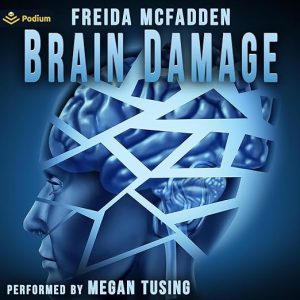
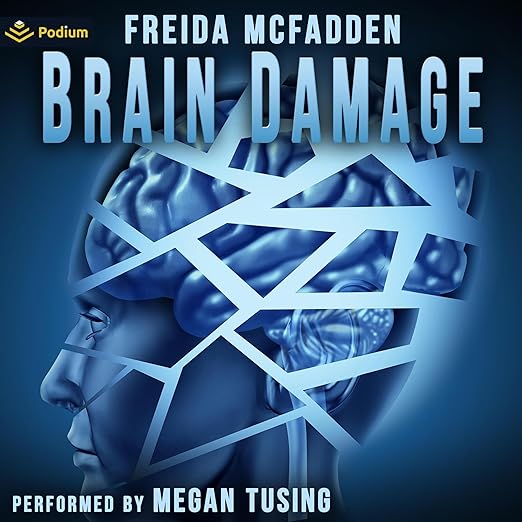
Freida McFadden's Brain Damage audiobook continues her specific trajectory: each novel adds another permutation to the unreliable-protagonist psychological thriller, and this entry makes the protagonist's unreliability neurological rather than psychological. Dr. Charly McKenna has everything the checklist specifies: the career, the Central Park apartment, the handsome lawyer husband. Then a bullet takes the right side of her skull and she loses all of it. The novel that follows, narrated by Megan Tusing across nine hours and fifteen minutes, is about Charly assembling the jigsaw pieces of that night while the person who fired the shot is still at large. This audiobook deploys McFadden's signature structure with practiced efficiency.
Reviewer Shellsimm81 describes the book as their favorite read of the year with a 4.5 rating, praising the "engaging characters, humor, suspense, and not too much drama or intensity." That calibration is precise and useful. McFadden writes psychological thrillers that do not take themselves entirely seriously, which is a tonal choice that divides reader responses but sustains nine hours more comfortably than unrelenting grimness would. The humor is not comedic relief in the conventional sense; it emerges from Charly's perspective as she navigates both the confusion of her brain injury and the social performances required of someone trying to appear more recovered than she is while investigating who tried to kill her.
The brain injury framing is the novel's most interesting structural choice. Charly knows that the events of the night she was shot are trapped in the damaged right side of her brain, physically inaccessible rather than simply forgotten or suppressed. That neurological specificity is more interesting than the standard amnesia trope because it gives the protagonist's investigation a definite architecture: she is not trying to remember but trying to reconstruct from external evidence what her own memory cannot supply. Reviewer Joseph J. Truncale notes that as someone who has been a voracious reader for more than seven decades, he was genuinely surprised to find the book compelling, which suggests the genre mechanics land even for readers not predisposed to psychological thrillers.
Megan Tusing's narration captures the tonal split that McFadden's fiction requires. Charly's observations about her own situation carry a dark wit that would tip into camp without controlled delivery, and Tusing calibrates the performance to maintain the tension between genuine stakes and sardonic self-awareness. Nine hours is a long time to sustain that balance, and Tusing does not let the delivery drift into either pure comedy or unrelieved intensity. Her handling of the recovery sequences, where Charly gains function gradually while simultaneously assembling the picture of who wanted her dead, keeps the dual arc moving without either strand overwhelming the other.
Tusing's Voice Tracks a Healing Brain
McFadden's work has found a substantial audio audience because her novels are paced for sustained forward momentum rather than rereading. The plot mechanics of Brain Damage, specifically the question of which person in Charly's apparently perfect life wanted her dead and why, unravel in a sequence that rewards continuous listening. Pausing for extended periods between sessions allows the plot strands to go slack in a way that hurts the eventual reveal. At nine hours, this is a long-weekend audiobook rather than a daily-commute project.
The setup, the protagonist who has "it all" before everything is violently stripped away, is common in the genre, but McFadden's specific twist of making the loss neurological rather than purely circumstantial gives the rebuilding narrative a different texture. Charly's recovery from brain injury runs alongside her investigation, and the two arcs interact: as her brain heals, her ability to pursue the investigation improves, which creates a physical as well as psychological arc. Shellsimm81's description of riding "along as she evolves, gains strength, insight, coordination and healing" captures that double-track development accurately. The audiobook format suits this dual-arc structure particularly well because Tusing's voice can register the incremental changes in Charly's capability and confidence in a way that readers processing prose have to infer rather than hear.
Craft over Revelation, by Design
McFadden's plotting is designed for entertainment rather than literary depth, and readers who want psychological or emotional complexity beyond the genre conventions will find Brain Damage delivers craft rather than revelation. The novel is very good at what it is trying to do, but what it is trying to do is construct an efficient and enjoyable psychological thriller with a memorable protagonist conceit. Reviewer Shellsimm81's "entertaining and fun" framing is accurate and is not a diminishment; an audiobook that delivers precisely what it aims for across nine hours is doing something specific and worthwhile.
Listeners who are new to McFadden's work should know that her novels share a structural DNA: the protagonist's apparently stable life conceals a threat from within rather than from outside, and the reveals are designed to reframe earlier scenes rather than introduce entirely new information. Brain Damage follows this pattern. Experienced McFadden readers will likely spot the structural moves earlier, but the execution remains satisfying. The Central Park apartment and the handsome lawyer husband are not just backdrop; they are the components of the perfect life that the bullet dismantled, and McFadden makes the demolition methodical rather than gratuitous.
Housemaid and Coworker Fans Will Feel at Home
Psychological thriller fans who appreciate dark humor alongside genuine suspense will find McFadden's tonal balance in this audiobook very much to their taste. Listeners who have enjoyed The Housemaid or The Coworker and want another novel with a similar structural DNA and a protagonist navigating hidden threats within an apparently perfect life will find Brain Damage immediately accessible. Megan Tusing's narration is an asset for listeners who have responded well to her work on other McFadden titles.
Readers who find dark humor tonally inappropriate in thriller fiction will be less comfortable with McFadden's register here. Listeners who want their psychological thrillers to be primarily devastating rather than entertaining should approach with adjusted expectations, as Brain Damage is genuinely committed to reader enjoyment rather than emotional devastation as its primary goal. The nine-hour runtime is most rewarding for listeners who can commit to a sustained listening block rather than fragmenting the audiobook across many short sessions.