At a Glance
- Read by: Natalie Holloway narrates her own founder story, and hearing the real person behind the numbers adds genuine stakes.
- At its heart: bootstrapped entrepreneurship, brand building, pitching and financing a startup
- Vibe: Energetic and mentor-like, more conversation than lecture
- Short version: A specific, credible playbook for physical-product founders, less directly useful for service or software businesses.
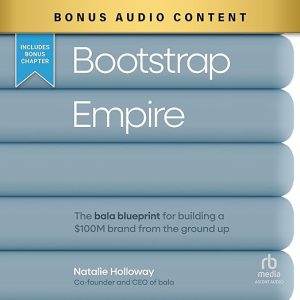
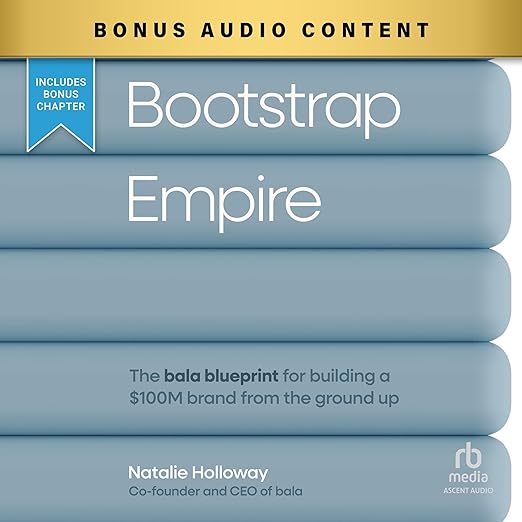
Natalie Holloway turned a five-thousand-dollar initial investment into a fitness equipment company doing thirty million dollars a year in sales, then watched five different Shark Tank investors compete to fund it. The Bootstrap Empire audiobook is her attempt to reverse-engineer that trajectory into something repeatable for anyone else starting from nothing, walking through the mindset shifts, the mistakes, and the specific tactical tools, pitching, budgeting, financing, hiring, that got Bala from a garage idea to a genuine juggernaut.
Real Numbers Instead of Vague Success-Story Gesturing
Holloway builds the book as a practical roadmap rather than a memoir with occasional advice mixed in, and the synopsis's own list of what's inside reads like a syllabus: a comprehensive growth roadmap, hands-on bootstrapping techniques with or without outside funding, and specific guidance on early marketing, hiring timing, and pitching. Reviewer Caity Eng captures the tone well, describing the book as feeling 'like an older friend/mentor having a conversation with me' rather than a lecture, which tracks with how personally Holloway frames even the tactical sections.
What separates this from a generic entrepreneurship book is how specific Holloway gets about her own numbers and decisions: the five-thousand-dollar starting investment, the climb to thirty million in annual sales, the five-way bidding war on Shark Tank, all real, checkable details rather than vague success-story gesturing. Reviewer NG, in the process of trying to start a brand from scratch, says the book was 'written so well and was clear and easy to read' and that she 'truly did not want to put it down,' a genuine endorsement from exactly the reader this book is aimed at.
The book's tactical chapters get specific in ways general entrepreneurship guides often don't: when exactly to make a first hire versus staying lean longer, how to structure an early pitch deck for a product category investors don't yet understand, and how to budget marketing spend before meaningful revenue exists to draw from. Holloway frames each of these as a real decision she had to make under uncertainty, with real consequences either way, rather than as abstract advice detached from actual stakes.
Moments of Doubt Get as Much Room as Wins
That mentor-not-lecturer register reviewer Caity Eng picks up on runs through the whole book's structure; Holloway frames chapters around specific moments of doubt or near-failure rather than presenting her success as a smooth, inevitable climb, which makes the tactical advice land as earned rather than assumed.
Holloway is also candid, per the synopsis, about the mistakes that came with the climb, not just the wins, framing failure as load-bearing material for the book's advice rather than an embarrassing footnote to skip past quickly.
Holloway's Own Voice Replaces a Hired Performance
Holloway narrates her own book, and for a founder-memoir-meets-playbook like this one, that authenticity is a real asset: listeners hear the actual person who lived through the pitch meetings and the early cash-flow scares describing them, rather than a hired voice performing enthusiasm secondhand. The audiobook also includes a bonus afterword not found in the print edition, a genuine content advantage for anyone deciding between formats rather than just a nice-to-have.
Reviewer Jill Paulin's praise for the physical hardcover is a reminder that this book has real crossover appeal as a reference object, something to flip back through for the pitch-deck checklist or the hiring-timeline advice, but the audio edition's advantage is Holloway's own voice carrying the emotional stakes of decisions that, in print, might read as just another bullet point. Six hours and forty-two minutes is enough time for both the tactical content and the harder emotional beats, near-failure moments, self-doubt, to get proper room.
Shoe Dog Is the Genre's Best-Known Comparison
Bootstrap Empire sits in a small but growing shelf of founder-narrated business books, Phil Knight's Shoe Dog is the genre's best-known example, that trade the distance of a business-school case study for the specific, occasionally messy texture of one person's actual decisions. Holloway's version is more compressed and more explicitly instructional than Knight's memoir-first approach, but the underlying appeal, hearing an actual founder narrate their own uncertainty in real time, is the same.
Six hours and forty-two minutes also leaves room for Holloway to walk through specific numbers, initial unit costs, early marketing budgets, hiring timelines, in more granular detail than a shorter business audiobook could manage, without the pacing ever feeling padded.
Three Full-Text Reviews Against a Perfect Average
Bootstrap Empire is built entirely around one company's specific trajectory, a physical fitness-equipment product that found a very particular kind of retail and Shark Tank-fueled momentum, and listeners running a service business, a software company, or anything without a tangible product to pitch on television should expect to do real translation work to make Holloway's specific tactics apply. The book is also, by nature of the genre, a survivorship-bias story: it explains what worked for Bala without much space for the far larger number of similarly bootstrapped companies that didn't make it.
Only three full-text reviews are attached despite a perfect 5.0 average across 28 ratings, all of them enthusiastic and none offering much critical distance on where the book's advice might fall short. That's a thin sample to fully judge consistency across the whole runtime, and listeners should treat the uniformly positive tone of the available reviews as encouraging but not the same as broad, independently verified consensus.
Bala's rise also rode a specific tailwind, at-home fitness equipment demand accelerating sharply in the early 2020s, that won't repeat identically for every product category, so listeners in a fundamentally different market climate should weigh how much of the growth curve Holloway describes was strategy versus timing.
Listeners should also know Bala operates in a category, home fitness equipment, that benefits enormously from visual product demonstration; some of Holloway's marketing-strategy examples reference visual content specifically, video, product photography, that naturally translates less directly to an audio-only format than her financing or hiring advice does.
Bootstrap or Raise, Holloway Names the Tradeoff
First-time founders building a physical product or consumer brand from limited capital are the direct audience, and anyone specifically preparing for a pitch, whether to investors, a bank, or a show like Shark Tank, will find the pitching and financing chapters especially practical.
Aspiring founders specifically weighing whether to bootstrap versus raise outside investment early will find Holloway's own reasoning on that exact tradeoff, and the flexibility bootstrapping preserved for Bala, one of the more concretely useful decision frameworks in the book.
Founders in software, services, or any business without a tangible product will need to do more translating than direct application, and anyone hoping for a warts-and-all account of what didn't work, not just what did, may find the book's relentlessly upbeat framing a little one-sided.
Before You Listen
Does the Bootstrap Empire audiobook include content not found in the print edition?
Yes, the audiobook includes a bonus afterword not included in the print edition.
How long is the Bootstrap Empire audiobook?
Six hours and forty-two minutes.
Does the Bootstrap Empire audiobook explain how Natalie Holloway's company ended up on Shark Tank?
Yes, she describes the five-way bidding war her company, Bala, generated on the show as part of the larger growth story.