Key Details
- Narration: Henry Winkler narrates his own story with an authenticity no professional voice actor could fake.
- Themes: dyslexia, stage fright, classroom belonging
- Mood: Warm and reassuring
- Verdict: A short, big-hearted listen for early readers, especially those who feel like their brains freeze under pressure.
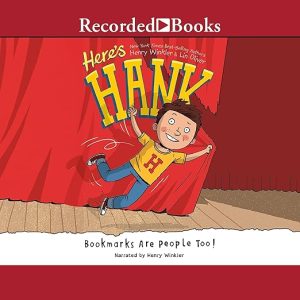
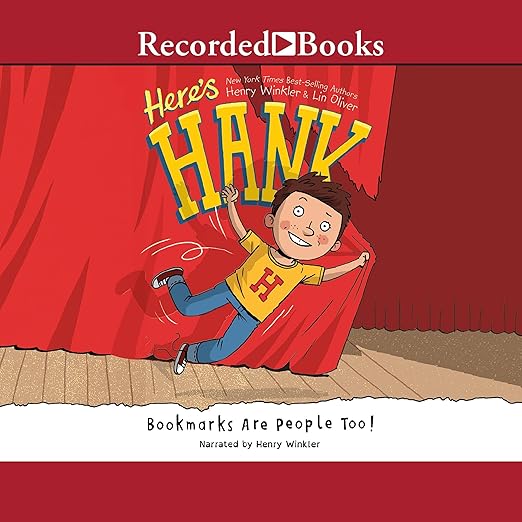
Hank calls his own brain a popsicle that freezes solid every time he tries to read out loud, and that single image tells you almost everything about why this audiobook works as well as it does. Bookmarks Are People Too! opens the Here's Hank series with its narrator-hero facing a class play he desperately doesn't want to be part of: spelling is already his worst subject, reading and math aren't far behind, and now his teacher wants him to perform lines in front of everyone. Henry Winkler builds fifty-seven minutes of genuine warmth around that specific, ordinary classroom fear.
Hank is funny without trying to be, which is a hard trick for a children's book to pull off convincingly, and the humor never comes at the expense of how real his struggle feels. He tries hard, genuinely hard, at spelling, math, and reading, and the story treats that effort seriously rather than as a punchline. Reviewer AKgirl 85, listening with her six and eight year old daughters, breaks down exactly what lands: 'the main character was bullied and not the best in school but used humor and confidence to diffuse both situations,' a description that captures the book's real balance between comedy and genuine emotional stakes for young listeners.
Henry Winkler has spoken publicly for years about his own dyslexia, and that lived experience clearly informs Hank's popsicle-brain moments in a way that reads as authentic rather than performed. This isn't a celebrity author borrowing a struggle for material; it's someone writing from direct memory of exactly what it feels like when letters refuse to cooperate in front of a room full of classmates. Winkler's advocacy around dyslexia extends well beyond this specific series; he has spoken at length in interviews about not being diagnosed until his thirties, after years of being told by teachers and even his own parents that he simply wasn't trying hard enough. That history matters for understanding why Hank's specific brand of humor, deflecting shame through charm before anyone else can call it out first, reads as so carefully observed rather than invented for the plot.
Winkler's Unpolished Narration Reads as Authentic
Winkler narrates his own story, and the performance isn't studio-polished in the way a professional voice actor's would be, but that imperfection reads as a genuine asset here rather than a limitation. You can hear an author who has lived the material rather than an actor performing empathy from the outside, and for a book specifically about the gap between how smart a kid feels internally and how they perform under classroom pressure, that authenticity matters more than technical polish. Reviewer Beverly W. Kile calls Hank 'well loved by his classmates' with 'such a positive attitude,' and Winkler's own warmth carries that characterization through the narration. Illustrated chapter books like this one always lose something in translation to audio-only format, though the prose itself carries enough concrete classroom detail, the specific play, the specific spelling test, that the narration rarely feels like it's missing something a picture would have provided.
This audiobook also extends Winkler's longer literary partnership writing about a dyslexic kid navigating school, building on the ground he covered in his earlier Hank Zipzer series for slightly older readers. Here's Hank recalibrates that same core premise for a younger audience, and this first entry sets up Hank's voice, his classroom, and his specific anxieties efficiently within a very tight runtime. The Hank Zipzer series that preceded Here's Hank ran for years, aimed at readers a bit older than this spinoff's target audience, which means Bookmarks Are People Too! represents Winkler revisiting and recalibrating material he'd already spent time refining for a slightly younger, earlier-elementary reader. That accumulated experience shows in how efficiently the fifty-seven minutes establish Hank's central conflict without wasted setup.
Music and Performing Arts Undersells This Reading Story
At fifty-seven minutes, this is squarely a single-sitting listen rather than a long commute companion, and that scope should be set correctly before pressing play: it's a short, focused chapter-book experience built for early readers, not a sprawling middle-grade adventure. Reviewer Amazon Customer, who read it aloud to a five-year-old, notes it's 'one of the only books we got to the end of,' which is a meaningful data point about how well the length and pacing suit genuinely young or reluctant listeners specifically. The book's brevity also mirrors its subject honestly: a longer, denser format would work against a story specifically about a reader who struggles with exactly that kind of density, and keeping the runtime tight is itself a subtle formal choice that respects the audience it's written for rather than a limitation imposed by the material. Winkler has now spent more than a decade returning to this same core character concept, a kid whose cleverness and specific challenges with reading don't line up with how the adults around him initially size him up, refining the approach book by book rather than treating it as a one-off passion project. That sustained commitment is itself a kind of evidence: a single well-intentioned celebrity title rarely gets a true, ongoing series built around it the way this character has, which suggests genuine audience demand rather than a one-time publishing experiment.
The genre tag on this listing, Music & Performing Arts, only loosely fits; the class-play plot touches performance, but this isn't really about music or theater craft. Don't expect performing-arts instructional content here, just a school-play backdrop for a story that's really about reading anxiety and self-acceptance. Teachers and reading specialists working with dyslexic or reading-anxious students have a specific, practical use case for a book like this beyond pure entertainment: hearing a character voice the exact same brain-freeze sensation a struggling reader might feel silently themselves can be genuinely validating in a way a worksheet or a pep talk from an adult often isn't. Hank does eventually find his way into the class play, though not without real anxiety along the way, and the resolution avoids the easy fix of simply overcoming his struggles entirely, landing instead on something more honest: finding an approach that works with his specific strengths rather than around them.
Readers Six to Nine Who Know Hank's Struggle
Early readers roughly six to nine years old, kids with their own reading struggles or dyslexia who'd benefit from seeing themselves in Hank specifically, and parents looking for a warm bedtime listen will all get real value here. It's also a good pick for classroom read-alouds given how directly it addresses performance anxiety around reading.
Skip it if you're looking for a longer single sitting or content for older, teen listeners, since this is squarely early-elementary material both in length and in emotional complexity. Older siblings may enjoy it as a quick nostalgic listen, but it isn't built for that audience primarily.
Good to Know
How long is the Bookmarks Are People Too! audiobook?
Fifty-seven minutes, built as a single-sitting chapter-book listen rather than a longer middle-grade audiobook.
Does Henry Winkler's own dyslexia inform the Bookmarks Are People Too! audiobook?
Yes. Winkler has spoken publicly about his dyslexia for years, and that lived experience shapes Hank's reading-anxiety moments authentically.