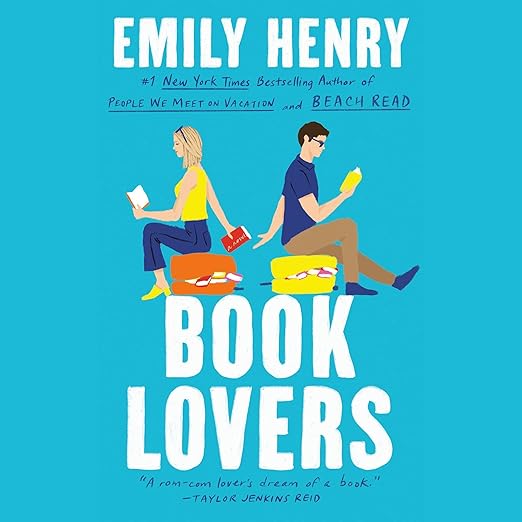
I listened to Book Lovers on a solo road trip through upstate New York, which in retrospect was almost too apt. Here I was, alone in a car with nothing but a strong signal and a bag of gas station snacks, listening to a literary agent who refuses to be the kind of woman who transforms in a small town. The irony was not lost on me. Julia Whelan's voice filled the car the way a good novel fills an afternoon: completely, generously, without leaving room for whatever you thought you were going to be anxious about instead.
Emily Henry has built a reputation on romantic comedies that are smarter about the genre's conventions than most readers expect, but Book Lovers is the most formally self-aware thing she has written. Nora Stephens is, as one reviewer put it perfectly, the woman who would be the ex left behind while the lead goes to a small town and falls in love. She knows this about herself. She has been that ex more than once. When her sister Libby engineers a month-long trip to Sunshine Falls, North Carolina, Nora is braced for the transformation arc to start, and then keeps failing to perform it correctly.
What We Made of It
What Henry does with this premise is genuinely interesting. The book is not satirizing small-town romance so much as examining what the genre costs the women who don't fit its templates. Nora is described by reviewer Lillian at Mom with a Reading Problem as a woman hardened to love by loss, she became her sister's primary caretaker early, she drives herself professionally in ways that make other characters uncomfortable, and she has internalized the cultural message that her kind of ambition is unfeminine. Charlie Lastra, the brooding city editor she keeps encountering in Sunshine Falls, has his own version of this problem. They are both people who decided they were nobody's hero, as the synopsis puts it, and the novel's project is to dismantle that self-story from the inside.
The banter between Nora and Charlie is exactly as good as Henry's reputation for dialogue suggests, and Whelan handles it with the precision it requires. Comic timing in audio is a specific skill, the beat before a punchline, the way a line reading can signal that a character is trying not to laugh, and Whelan has it. But she is equally good at the quieter scenes, the ones where Nora's sister is present and the book's emotional center shifts from romance to grief and family obligation. Those sequences are where Book Lovers earns its length.
What Makes Book Lovers Worth Hearing
The audiobook case for Book Lovers rests primarily on Whelan's specific gifts. Henry writes dialogue that benefits from a single, consistent voice shaping both speakers, and Whelan differentiates the ensemble cast, Libby, Charlie, the various Sunshine Falls locals, without breaking the intimacy of Nora's first-person narration. The novel has a layered emotional architecture: witty surface, genuine ache underneath, and a third layer below that concerning what women give up to take care of everyone around them. Whelan reaches all three without announcing the transitions.
Reviewer Sowmya quoted a passage about love built on compromises that don't force two people into shapes they don't fit in, and that quote captures the book's thesis. It is a romantic novel that argues against the kind of transformation narrative it superficially resembles, and the audio experience is particularly good for a premise that depends on a character's interior voice carrying more truth than her visible behavior.
A Few Reservations
Henry's novels tend to front-load their charm and earn their emotion in the final third. Book Lovers follows this pattern more deliberately than her earlier work. The middle section in Sunshine Falls can feel repetitive, Nora and Charlie keep meeting, keep sparring, keep almost connecting, and listeners who want faster romantic progression may find the slow burn frustrating around the midpoint. The small-town setting is also used somewhat ambivalently; Henry is critiquing the genre's dependence on rural transformation while clearly enjoying the atmosphere, and that tension is not always fully resolved.
The Right Listener for Book Lovers
Henry readers who have worked through Beach Read and People We Meet on Vacation will find Book Lovers the most intellectually satisfying entry in her catalog. It rewards the meta-awareness of the genre that builds across her work. Listeners new to Emily Henry can start here without difficulty. Readers who want their romances to deliver consistent forward momentum without structural self-examination may prefer one of her other novels. Those who enjoy literary fiction that takes genre conventions seriously, think Curtis Sittenfeld's Romantic Comedy as a spiritual neighbor, will find Book Lovers operates at a similar register.
Before You Listen
Is Book Lovers better as an audiobook than as a print read, given that other Emily Henry novels work in both formats?
The critical and reader consensus is unusually strong that the audiobook is the optimal format for Book Lovers specifically. Nora's sardonic internal voice translates particularly well to Whelan's delivery, and the comedic pacing of the banter scenes benefits from the audio timing in ways that are harder to replicate on the page.
Does Book Lovers spoil or require knowledge of the small-town romance tropes it references?
No prior genre knowledge is required, but the novel is richer if you have encountered the tropes it deconstructs, the big-city woman who transforms through small-town living, the antagonist-to-lover arc, the woman who gives up her ambitions for love. Henry signals these patterns clearly enough that genre newcomers will follow the subversion without having experienced the originals.
Julia Whelan narrates several of Emily Henry's novels, is her performance consistent across the catalog?
Whelan has narrated Henry's major titles and is considered definitive for the author's voice by most listeners. Her work on Book Lovers is regarded as among her best Henry performances, particularly the emotional range required for Nora's character arc in the final third.