In Brief
- Read by: Gary L Willprecht carries a large cast of quoted astronauts and engineers across thirteen hours without a multi-voice production.
- At its heart: Space shuttle program history, the Challenger disaster, firsthand astronaut and engineer testimony
- Vibe: Reverent, detailed, oral-history in structure
- Short version: A strong pick for spaceflight history readers, built from firsthand testimony rather than secondhand narration.
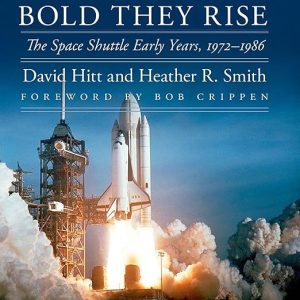
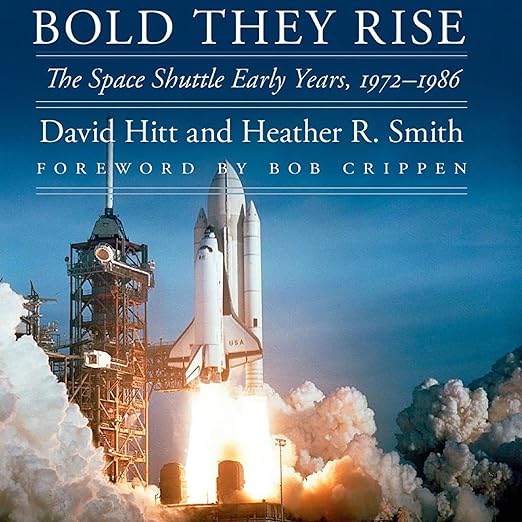
Launched like a rocket, landed like a glider, and arguably the most complex machine ever built: that’s the space shuttle as Bold They Rise frames it, and David Hitt’s audiobook spends thirteen hours and fifteen minutes tracing the program from its earliest design sketches through the Challenger disaster.
Part of the Outward Odyssey: A People’s History of Spaceflight series, this volume covers how the shuttle was conceived and built, through its significant first flights, drawing on the testimony of the astronauts, engineers, and scientists who actually lived it. That structure, oral history rather than a single authorial voice retelling events secondhand, is the book’s defining choice.
Oral History Over NASA's Official Narrative
The “guided tour” framing in the synopsis is accurate: this moves through research and design, the shuttle’s actual capabilities as the world’s first reusable spacecraft, and the day-to-day reality of testing and flying an entirely new kind of vehicle, all the way to its most tragic outcome. What distinguishes it from a dry engineering history is the access to firsthand accounts: what it felt like to float freely in the vacuum of space as what the synopsis calls “a one-man satellite,” and what it meant to witness a friend’s death in the program’s worst moment.
One reviewer, a self-described voracious spaceflight reader with “hundreds and hundreds of volumes” already on the shelf, still sought this one out despite knowing “spaceflight history and technology like the back of my hand.” That’s a meaningful endorsement from someone with genuine comparison points across the genre, not a casual reader encountering the subject for the first time.
The series title itself, Outward Odyssey: A People’s History of Spaceflight, is a deliberate historiographical choice, echoing the bottom-up, testimony-driven approach associated with people’s history as a genre, prioritizing the accounts of those who did the work over an official, top-down NASA institutional narrative. That framing matters for how Bold They Rise actually reads: less like an agency’s authorized history and more like oral history gathered directly from the people who built, flew, and studied the program at every stage, mistakes and triumphs both. It’s a meaningfully different reading experience than the glossier, more triumphalist space histories aimed at a general audience, and it earns that difference through genuine access to firsthand testimony. Gary Schroeder’s review situates this specifically as the technical-conception half of a two-book arc, useful context for anyone deciding where to start.
Willprecht Carries Dozens of Named Voices
This book sits alongside Wheels Stop, the Outward Odyssey volume covering the post-Challenger shuttle program, and one reviewer read them in sequence, calling Bold They Rise the natural predecessor: it “chronicles the Shuttle’s technical conception and significant first flights,” setting up where Wheels Stop picks up. Listeners interested in the full arc of the shuttle program have a natural two-book path here, in either order, though this one covers the earlier chapter.
Narrator Gary L Willprecht is carrying a genuinely large cast of quoted participants across thirteen hours without the benefit of a multi-voice production, which is a real technical challenge distinct from narrating a single memoir voice: differentiating dozens of named astronauts, engineers, and officials well enough that listeners can track whose account they’re hearing at any given moment, chapter after chapter.
The synopsis is specific about why the shuttle mattered as an engineering achievement, not just a symbol: a vehicle that had to survive the stresses of launch, function for days in orbit, and glide back down to a runway landing under its own control was a genuinely novel category of machine, not an incremental improvement on the Apollo-era capsules that came before it. Hitt spends real time on the research and design phase specifically because that novelty required solving problems nobody had solved before, which the book treats as its own kind of drama distinct from the missions themselves. That engineering-as-narrative approach rewards listeners who find the how as compelling as the who. The synopsis calls the finished vehicle “arguably the most complex piece of machinery ever created,” a claim the book backs up with specifics rather than leaving as a jacket-copy boast.
Thin Reviews Before a Heavy Final Stretch
With 68 ratings but only three written reviews, and one of those three amounting to little more than a note that the item arrived as described, the substantive reader reaction here is thinner than the rating count alone suggests. What’s here is strongly positive, but it comes from a small, self-selected group of dedicated spaceflight readers rather than a broad cross-section.
The oral-history structure rewards patience. Tracking many different named participants across a technical, chronologically complex program benefits from listeners who already have at least passing familiarity with the shuttle era, or who don’t mind pausing to reorient occasionally. And because the book ends at the Challenger disaster, that’s a heavy emotional note worth bracing for, not a twist to be surprised by.
Because the book builds chronologically toward the Challenger disaster as its emotional and narrative endpoint, listeners should know the tone shifts substantially in the book’s final stretch, from technical achievement and institutional confidence toward tragedy and institutional reckoning. That’s not a criticism of the book’s structure, it’s simply how the actual history unfolded, but it’s worth pacing your listening accordingly rather than expecting the celebratory tone of the earlier chapters to hold all the way through. Some listeners may prefer to space out the final chapters rather than finishing the whole thirteen hours in one continuous sitting. The shift is handled with the same careful, testimony-driven sourcing that defines the rest of the book, letting the participants’ own recollections carry the emotional weight rather than reaching for dramatic narration to manufacture it.
Spaceflight Readers Wanting the Engineers' Own Words
Spaceflight history readers, fans of oral-history-driven nonfiction, and anyone working through the wider Outward Odyssey series are the clearest audience, particularly listeners who want the astronauts’ and engineers’ own words rather than a single historian’s secondhand narration.
Engineers and anyone with a technical background will find real satisfaction in how much genuine design and testing detail survives the translation into narrative nonfiction, rather than being simplified away for a general audience. That technical seriousness, paired with the emotional access oral history provides, is a combination this specific corner of spaceflight publishing does especially well. Listeners who enjoyed Endurance-style survival narratives, human ingenuity and courage tested against extreme technical and physical risk, will find a kindred spirit in how this book frames the astronaut corps’s daily reality.
A single dramatic narrative arc, rather than a mosaic of many participants’ testimony, is not the format on offer here, and newcomers with no prior shuttle-program knowledge may want to sample a chapter before committing to the full thirteen hours.
Before You Listen
Is Bold They Rise part of a series, and do you need to read the others first?
It's part of the Outward Odyssey: A People's History of Spaceflight series. You don't need the other volumes first; one reviewer read the companion volume, Wheels Stop, beforehand and found this one fills in the earlier chapter.
Does the Bold They Rise audiobook cover the Challenger disaster?
Yes, the book traces the shuttle program from its earliest design through the Challenger disaster's final minutes.
How does the audiobook handle so many different astronauts' and engineers' voices?
A single narrator, Gary L Willprecht, carries all of it, differentiating a large cast of quoted participants without a multi-voice production.
Is Bold They Rise more technical or personal in its account of the space shuttle program?
Both, deliberately. It's framed as a 'guided tour' combining historical and scientific detail with personal firsthand accounts from the people who lived it.