
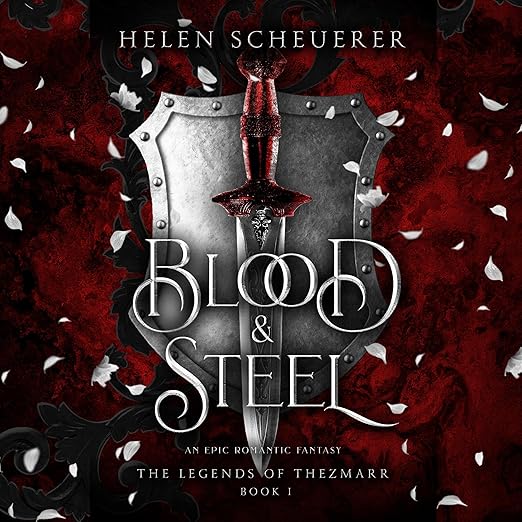
- Narration: Mollie Stark brings Althea Zoltaire's fierce determination to life with genuine fire, navigating the training sequences and intimate Wilder scenes with equal confidence.
- Themes: Women defying prohibition, death foretold and self-determination, found guild family under threat
- Mood: Epic and muscular with enough romantic tension to keep the personal stakes visible
- Verdict: One of the stronger romantasy series openers available in audio; the world-building is rich without being impenetrable and the central relationship earns its tension.
Blood and Steel had been on my list for months before I finally gave it a proper listen. I kept hearing from readers who described it as a gateway book: the title that pulled them into romantic fantasy when nothing else had managed it. That is a specific kind of recommendation, and I approached it with both interest and the mild wariness that very enthusiastic praise always generates. Having finished all fourteen and a half hours, I understand both the enthusiasm and the occasional qualification. This is a carefully constructed series opener from Helen Scheuerer, and it does what first books need to do: it builds a world worth returning to and a central relationship with enough unresolved tension to sustain multiple volumes.
Althea Zoltaire has three years to live, at least according to prophecy. Rather than spend that time in safety, she is determined to use it to become what she has always wanted to be: a warrior legend. The problem is that women are forbidden to wield blades in the five kingdoms, so she has trained in secret her entire life. The Thezmarr guild is the elite institution she needs to enter, and the hazing and sparring that awaits new trainees borders on deadly. Into this training environment comes Wilder Hawthorne, her unwilling warrior chaperone, which is the kind of setup that anyone who has spent time with romantasy will recognize immediately as eventual combustion.
How Blood & Steel Holds Up
One reviewer described the book as a masterclass in world-building and tension, noting that the romantic stakes are undeniably high while acknowledging it left them pondering the elusive nature of true emotional connection. That tension in the assessment is interesting. Scheuerer's world is rich: the history of the veil, the monster threat, the political structure of the five kingdoms, the guild hierarchy at Thezmarr, all of it is established with specificity and internal consistency. What some readers find is that the world-building is slightly better realized than the emotional register of the central romance in this first volume, which is a common trait in series openers that are doing heavy foundational work.
Another reviewer from Australia noted the world-building was hard to understand, particularly the history and the veil mechanics, but found the fantasy elements and the castle of Thezmarr intriguing despite that initial density. This is worth flagging for audio listeners specifically: the history of this world is dense enough that divided attention will create confusion. This is a title that benefits from focused listening, particularly in the first third.
Why Blood & Steel Works as an Audiobook
Mollie Stark is an excellent match for Althea. She captures the character's particular combination of recklessness and purpose, Althea has been called reckless her whole life, all the while wanting something, as one quoted passage puts it, without flattening her into simple defiance. The training sequences at Thezmarr benefit enormously from Stark's performance. Physical action in prose is difficult to make visceral, and audio narration that understands the pacing of a fight scene elevates those passages considerably. The romantic tension between Althea and Wilder, which operates primarily through charged proximity in the first volume, is handled with appropriate restraint.
Weak Spots in Blood & Steel
The prophecy about Althea's death is not a device the narrative forgets. It operates as a constant pressure on every decision she makes, particularly her decision to pursue something as ambitious and time-consuming as warrior legend status with three years on her clock. Pay attention to how that clock interacts with the romance: the forced timeline creates a specific kind of urgency that distinguishes this from romantasy where the stakes are more abstract. The darkness looming at Thezmarr, which several reviewers mention as escalating in later books, is established here with enough specificity to feel like a genuine threat rather than genre furniture.
The Right Listener for Blood & Steel
This is an excellent starting point for readers new to romantic fantasy who want world-building with genuine substance alongside the central relationship. If you read Throne of Glass and wanted more training-sequence detail and less court intrigue, or if you enjoy warrior heroines navigating institutions built to exclude them, Scheuerer's series is constructed with you in mind. Listeners who prefer lighter fantasy with faster romantic payoff may find the first volume heavy on setup. For everyone willing to invest in a layered world with a clear series vision, Blood and Steel earns its runtime completely.
Frequently Asked Questions
Does Blood and Steel work as a standalone, or is the ending a cliffhanger?
The book functions as a series opener and does not provide full resolution. The central romance remains unresolved, and the threat escalating at Thezmarr carries into subsequent volumes. Listeners who prefer standalone experiences should be aware this is the beginning of a longer arc.
How does Mollie Stark handle the training and fight sequences compared to the quieter romantic scenes?
Stark is skilled at both registers. The training sequences have genuine physicality in her delivery, and the tense, charged scenes between Althea and Wilder benefit from her ability to maintain tension through restraint rather than heightening.
Is the prophecy about Althea's death treated as a real narrative constraint or as a device that the story works around?
The prophecy is taken seriously as a structural element. Althea's three-year timeline shapes her urgency and her choices throughout the first book. How the series handles the prophecy in later volumes is a significant part of what keeps readers returning.
How dense is the world-building, and will it overwhelm listeners unfamiliar with epic fantasy?
The first third is the most demanding in terms of world-building. The history of the veil and the monster threat require attention, and one reviewer specifically noted initial difficulty parsing the history. The payoff for that investment is a world that feels genuinely three-dimensional by the midpoint. Listeners should plan for attentive engagement rather than passive listening in the early chapters.







