The Short Version
- Narrator: Wayne Farrell handles the tonal complexity of Berne's space opera well, managing the shift from detective story to mythology-heavy lore revelation without losing the listener.
- Subjects: Reluctant heroism and the cost of past power, the moral weight of ancient history, the station as a character with her own grief and desire
- Tone: Dense and emotionally layered, with the energy of superhero fiction and the gravity of something older trying to surface
- Bottom line: The strongest volume of the opening arc, paying off world-building investment from the first two books in ways that justify the full series commitment.
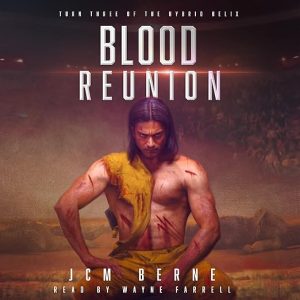
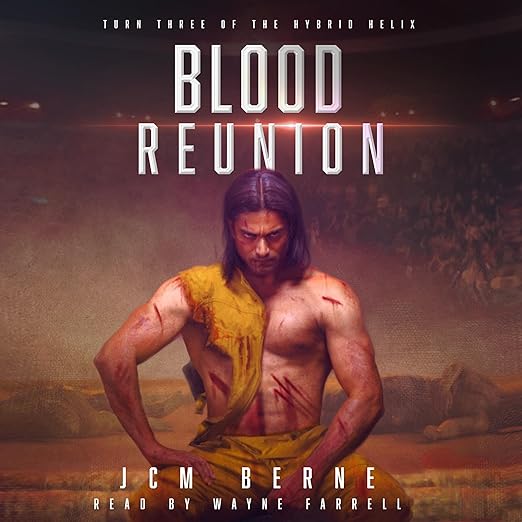
I finished Blood Reunion on a Saturday afternoon that I had originally planned to spend doing something else, which is the cleanest possible endorsement I can give a book that runs nearly fifteen hours. JCM Berne's Hybrid Helix series has built a dedicated following since the first volume appeared, and Blood Reunion, the closing chapter of the Enter the Griffin arc, has generated more enthusiastic reader response than its predecessors. Having now spent time with the full arc, I understand why this one lands differently.
The Hybrid Helix exists in an interesting space between superhero fiction, space opera, and secondary-world fantasy with a science-fictional frame. Rohan, the protagonist, is a half-human, half-il'Drach warrior whose power levels are enormous but whose relationship to that power is complicated by his history and his fundamental reluctance to become what his capabilities would allow. Wistful, the space station where much of the series takes place, is a character in her own right, an ancient entity with her own yearnings and traumas. That combination of genre registers is Berne's signature, and Blood Reunion is where it pays off most fully.
What We Made of It
Blood Reunion begins as a murder mystery: people are dying on Wistful, their bodies drained of blood, and the obvious suspects are vampires, though vampires operating inside Wistful's body should be impossible by the rules the series has established. One reviewer, Jesse, notes with some frustration that the early detective elements are hindered by characters failing to see clues that readers will find obvious. That criticism is accurate, and Berne seems aware of it, the revelation lands with a self-aware acknowledgment of how long it took the characters to arrive there.
What that reviewer's frustration misses, though, is where Berne is actually directing your attention during those chapters. The vampire plot is the scaffolding. The actual architecture being built beneath it is the deep history of Wistful and the il'Drach people, the ancient connections between the Ursans and the wormhole network, and the dark history of a space station that has been waiting for death long enough that her yearning for it has become a kind of personality. These lore revelations are what reviewers who loved this volume are responding to, and they are substantially richer than anything delivered in the first two books.
Why Blood Reunion Works as an Audiobook
The most emotionally effective material in Blood Reunion involves Rohan's relationship with his estranged father, who arrives on Wistful at precisely the wrong moment. Berne has been parceling out information about Rohan's family history and his il'Drach heritage across the series, and Blood Reunion forces a confrontation that the narrative has been building toward without announcing itself. Reviewer Boe's enthusiasm about being the number one Rohan fan contains a real observation: Rohan's reluctance to return to being the warrior he once was, and the personal history that explains that reluctance, reaches its most complex expression here.
Wayne Farrell handles these sections with appropriate weight. He is better at emotional complexity than he is at straightforward action sequences, which is actually the right distribution for this book. Blood Reunion has action, but it is not primarily an action text. It is a text about what happens when you force someone to confront who they used to be, what they gave up to become someone else, and whether that someone else is sustainable when the old world keeps finding them.
What Might Not Land
Ian Blumenfeld's review captures the dynamic precisely: the previous books sometimes felt like table setting, and Blood Reunion is the meal. That is an accurate description of a series structure where the opening volumes are building a world rather than delivering a complete experience. Berne has always built vivid characters and interesting worlds; in Blood Reunion, he builds a plot that is worthy of them. Every twist and reveal serves a purpose, every character is meaningful, and the final resolution feels earned rather than constructed.
Should You Listen to Blood Reunion?
Blood Reunion is not a starting point. The lore payoff that makes it the most satisfying entry in the arc requires the foundation of the first two books, and listeners who begin here will find the emotional stakes unintelligible. At fourteen hours and thirty-six minutes, this is a serious commitment. The payoff is genuine. For listeners already invested in the series, this free audiobook closes the opening arc in the most satisfying way possible, and for anyone still deciding whether to begin the Hybrid Helix, the existence of a third volume this strong is the best possible argument for starting at book one.
Common Questions
Do I need to read the first two Hybrid Helix books before Blood Reunion?
Yes, emphatically. Blood Reunion is the closing volume of the Enter the Griffin arc and pays off character development and lore established across the previous two books. Beginning here would deprive you of most of the emotional impact that reviewers are responding to.
How central is the space station Wistful as a character, and does that element require adjustment from new readers?
Wistful is one of the series' most distinctive elements, a station with genuine interiority, history, and desires of her own. Blood Reunion puts her history and her yearning for death at the center of the plot. Readers who found this premise difficult to engage with in earlier volumes will need to make peace with it here, as it is not peripheral.
Does Blood Reunion function as a complete story or does it end on a cliffhanger?
It closes the Enter the Griffin arc, which means the major questions introduced in book one reach genuine resolution. The broader Hybrid Helix mythology continues beyond this arc, so there are threads that extend forward, but the emotional and narrative arc of the first three books resolves satisfactorily here.
How does Wayne Farrell's narration handle the tonal shift between superhero action and introspective character work?
Competently rather than brilliantly. Farrell is more comfortable with the emotional and reflective passages than with the high-energy action sequences, which is actually a decent distribution for a book where the internal material is more important than the physical spectacle. Listeners who prioritize narration as performance may find him adequate rather than exceptional.