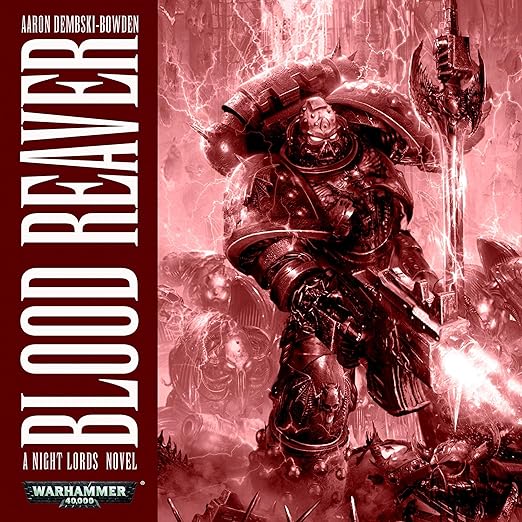
I came to Blood Reaver having recently finished Soul Hunter, and I want to be direct about that context: this is not the book to start with if you are new to Aaron Dembski-Bowden's Night Lords trilogy. The second installment of a trilogy is rarely where a reader should enter a world, and Blood Reaver specifically builds on character relationships and faction dynamics established in the first book. One reviewer recommends the Night Lords Omnibus over the individual volume, and for new listeners that is genuinely good advice. For those who have already met Talos Valcoran and his crew, however, this is where Dembski-Bowden expands the stakes considerably. I listened to most of it during a red-eye flight, which seemed appropriate for fiction about nocturnal predators who hunt in the dark between stars.
What Aaron Dembski-Bowden Delivers
Blood Reaver is built around an event mentioned in a Warhammer 40,000 rulebook, the Fall of Vilamus, and Dembski-Bowden's approach to this kind of canonical reference is instructive. He does not treat the rulebook mention as a constraint. He treats it as a frame, an outcome he must reach, and then fills the space between the present and that outcome with questions about how people with genuinely incompatible interests cooperate when they need each other.
The Night Lords alliance with Huron Blackheart's Red Corsairs is the book's central dramatic engine. These are two groups of traitors and renegades who have every reason to distrust each other and no particular loyalty to anything beyond their own survival and the satisfaction of old grievances. Dembski-Bowden understands that a fractious alliance is more interesting than a united one, and he builds the internal tension of this partnership into every interaction between the two forces. The question is not whether they will succeed at raiding the Marines Errant's fortress-monastery. The question is who will betray whom first, and why, and what it will cost the survivor.
What Aaron Dembski-Bowden Gets Right
The Chaos Space Marines of 40K fiction are often rendered as one-dimensional engines of carnage, distinguished from each other primarily by which Chaos god they serve and how they prefer to commit violence. Dembski-Bowden does something significantly harder. He gives his Night Lords distinct interiorities, private codes, the remnants of institutional culture that survived their fall from the Emperor's light, and the specific grief of having believed in something that ultimately failed them.
Talos and his squad are not sympathetic in any comfortable sense. They are killers operating in a universe without moral redemption. But they have the texture of people who once had reasons for what they became, and that texture makes them dramatically interesting in ways that standard Chaos characters rarely achieve. One reviewer noted that Dembski-Bowden's ability to give distinct voices and viewpoints to each character rivals the best science fiction outside the Warhammer setting, and that is not an overstatement. The characterization here is doing real work, not genre decoration.
Where Aaron Dembski-Bowden Loses Some Ground
A Night Lords novel presents a particular narration challenge: most of the primary characters are ancient, powerful, and deeply strange, and differentiating them without tipping into caricature requires considerable skill. Wincott manages it. His Night Lords carry weight without the operatic excess that would make them feel performative. The quieter moments, private conversations between the squad, arguments about strategy, the specific tension of being around people who would kill you if the calculus changed, are where the narration earns its place.
The action sequences are handled with appropriate momentum, but Dembski-Bowden's writing is at its best in the talky sections, and Wincott knows it. He does not rush the dialogue. The thirteen-plus hour runtime is used well, and the pacing feels deliberate rather than padded. This is one of the better cases for experiencing Black Library fiction in audio rather than print, where Wincott's voice adds a dimension of menace that the page alone cannot fully replicate.
It is also worth addressing what Dembski-Bowden is doing thematically with the concept of honor in a universe of irredeemable traitors. The Night Lords abandoned any claim to virtue centuries before the story begins, and yet they operate by codes that function like honor even when they would not use that word. They keep certain promises. They have standards for acceptable behavior within their own squad that they enforce with real consequences. They are disgusted by the Red Corsairs' lack of discipline in ways that reveal something about what they have retained from their original nature. This tension between fallen warriors who are genuinely monstrous and fallen warriors who still carry the ghost of the people they once were is the engine of everything that makes the series worth reading.
The assault on the fortress-monastery of the Marines Errant is the novel's narrative climax, and Dembski-Bowden executes it with the kind of precision that suggests genuine structural thinking rather than the genre convention of escalating set pieces. The outcome is satisfying without being tidy, which is the Night Lords' signature mode: they survive and they pay a cost, and the question of whether the cost was worth it is left deliberately open.
Who Should Pick Up Blood Reaver: Warhammer 40,000
The reviewer who suggested getting the Night Lords Omnibus instead of this individual volume was making a practical point worth repeating. The Omnibus contains all three novels plus associated short fiction and represents significantly better value for new listeners. Blood Reaver as a standalone audiobook is priced as a full-length title and covers only the middle third of the trilogy's arc.
For established fans who have already heard Soul Hunter, the individual volume offers the most direct path to continuing the story. The Fall of Vilamus is everything the Warhammer fiction that preceded this trilogy suggested it might be: brutal, morally complicated, and handled with considerably more literary seriousness than the setting's reputation might suggest. Dembski-Bowden remains the writer who proved 40K fiction could be literature, and Blood Reaver is among his strongest arguments for that claim.