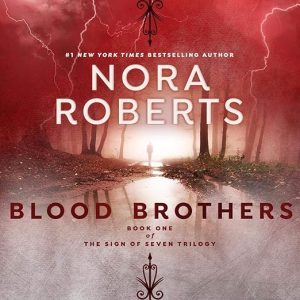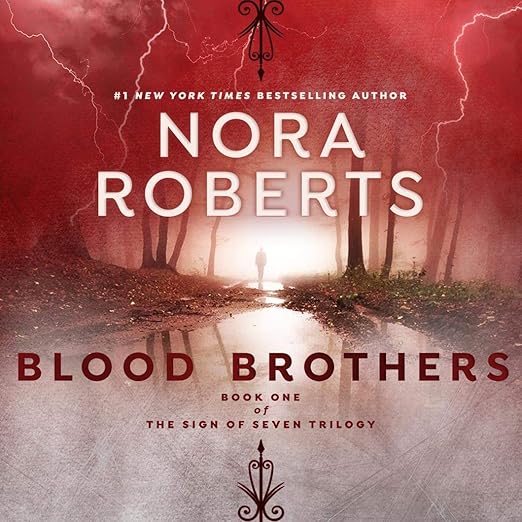
Every seven years, on the seventh day of the seventh month, something happens in Hawkins Hollow, and Nora Roberts spends the first book of her Sign of Seven trilogy explaining exactly what. It began when three boys, Caleb, Fox, and Gage, camped at the Pagan Stone as children; twenty-one years later, the showdown between whatever they unleashed and the men they have become is finally due. I listened to this audiobook knowing Roberts primarily as a romance writer, and the horror-adjacent machinery here, a genuine curse with a genuine body count, is more fully developed than her contemporary work led me to expect.
Reporter and author Quinn Black arrives in Hawkins Hollow chasing the town's strange seven-year legend for a book of her own, only to discover she can see the same evil the locals cannot, a connection that pulls her directly into Caleb's orbit and into the center of the danger itself.
Roberts builds the mythology carefully: the three boys made an actual blood pact at the Pagan Stone on their tenth birthday, and the consequences of that pact have apparently been quietly warping the town ever since, resurfacing worse each cycle. Caleb Hawkins, descendant of the town's founders, has already sensed the coming disturbance months early, which forces him to lean on Fox and Gage, his oldest friends, and, more reluctantly, on Quinn, a total stranger with an inconvenient gift for seeing exactly what he can.
What separates this from a straightforward small-town horror novel is how deliberately Roberts weaves romance into the survival plot rather than treating the two as separate tracks. As winter turns to spring, Cal and Quinn's growing attraction develops in direct parallel with the town's mounting danger, so the romantic tension and the horror tension escalate together rather than one pausing for the other.
The Sign of Seven trilogy completes across two further books, The Hollow and The Pagan Stone, which follow Fox and Gage respectively toward their own romantic pairings while building the town's cyclical crisis toward its final confrontation. Knowing the full shape of the trilogy going in helps calibrate expectations for this opener: Roberts is clearly setting up a slow-building three-book arc rather than trying to resolve everything in one volume, and book one plays fair by that structure rather than padding for length.
Quinn's own project, a book investigating Hawkins Hollow's seven-year legend, creates a neat structural mirror with the audiobook itself: a writer researching and gradually uncovering the same mythology the listener is absorbing in real time, which gives her introduction to the town a natural, curiosity-driven momentum rather than the more common arriving-stranger setup. Her professional skepticism about the supernatural, worn down case by case as the evidence mounts, mirrors the listener's own gradual buy-in to the premise.
Highlights
Phil Gigante narrates, and the material asks him to sustain a fairly large ensemble, three childhood friends now grown into distinct adult men, plus Quinn and the eventual partners the trilogy's later books focus on, while also carrying genuine dread during the town's darker set pieces. Balancing a slow-building horror atmosphere against Roberts' trademark romantic warmth within the same scenes is the specific tightrope this narration has to walk.
This is the first book in a trilogy, and Roberts plants seeds here, Fox's and Gage's own eventual love interests among them, that pay off across the next two entries rather than resolving within this one alone. Readers who want the full seven-year-cycle mythology paid off completely should plan on continuing through all three books rather than treating this as a self-contained standalone.
Roberts has written across nearly every romance subgenre over a long career, but horror-adjacent romantic suspense with a genuine curse mythology is a more specific register than her contemporary-set standalones, and this trilogy shows a writer confident enough in her romance instincts to layer real supernatural dread underneath them without either element undercutting the other. For readers who know her mainly from lighter contemporary work, this is a chance to hear a different, slightly darker gear.
The specific numerology anchoring the whole trilogy, every seventh year, the seventh day, the seventh month, gives Roberts a clean, almost ritualistic structure to build dread around, and returning to that number throughout the book reinforces the sense of an old, patient curse rather than a random modern threat. It is a small structural choice that does real work sustaining atmosphere across a fairly long audiobook.
Roberts has published well over two hundred novels across a career spanning decades, prolific enough that sustaining several distinct series simultaneously, contemporary romance, romantic suspense, and horror-tinged trilogies like this one, is simply part of her established working pattern rather than a departure worth treating as a surprise.
What to Watch For in Blood Brothers
This leans more heavily into horror elements, a genuine curse, physical danger, and a body count tied to the town's cyclical disturbance, than most of Roberts' catalog, and listeners coming from her contemporary romances specifically should recalibrate expectations toward something closer to romantic suspense with real supernatural teeth. One reviewer specifically recommended it as a solid entry point for horror fans curious about trying Roberts for the first time.
This book also introduces a fairly large ensemble early, Cal, Fox, Gage, and Quinn, plus early glimpses of the women who become central to the next two books, and listeners should expect some of those side characters to register mainly as setup rather than fully developed presences within this specific volume. That is a natural function of trilogy world-building rather than a structural flaw, but it does mean Fox and Gage read more as strong supporting characters here than as co-leads.
Structurally, Roberts paces the book across the buildup to the actual seventh-year anniversary, giving roughly the first half to reestablishing the three men's adult lives and introducing Quinn, then tightening into direct confrontation as the date itself approaches, a fairly classic slow-fuse structure that rewards patience in the early chapters.
Who It's For
This suits readers who want romance and horror genuinely blended rather than romance with light supernatural set dressing, fans of small-town-with-a-dark-secret settings, and anyone drawn to a childhood-bond-tested-by-adulthood premise with real stakes attached. The specific pairing of a curse mythology with a slow-building central romance is the book's clearest selling point.
Skip it if you want your Nora Roberts strictly contemporary and light on horror, or if an open trilogy structure without full resolution in book one is a dealbreaker. For everyone else, especially horror-curious romance readers, this is a strong, atmospheric series opener.
Key Details
- Performance: Phil Gigante balances a growing ensemble cast with real horror-tinged atmosphere alongside Roberts' trademark romantic warmth.
- What it covers: small-town curse mythology, childhood bonds tested by adulthood, romance under supernatural threat
- Feel: Atmospheric and tense, with genuine warmth underneath
- Our call: A strong horror-romance hybrid opener that rewards continuing through the full Sign of Seven trilogy.
A Few Questions About Blood Brothers
Does this audiobook resolve the seven-year curse by the end?
No, this is the first book in the Sign of Seven trilogy, and the larger mythology continues across two more books rather than fully resolving here.
Do I need to have read other Nora Roberts books before this audiobook?
No prior Roberts books are required, though listeners expecting her purely contemporary romance style should know this leans more heavily into horror and supernatural danger than her typical catalog.