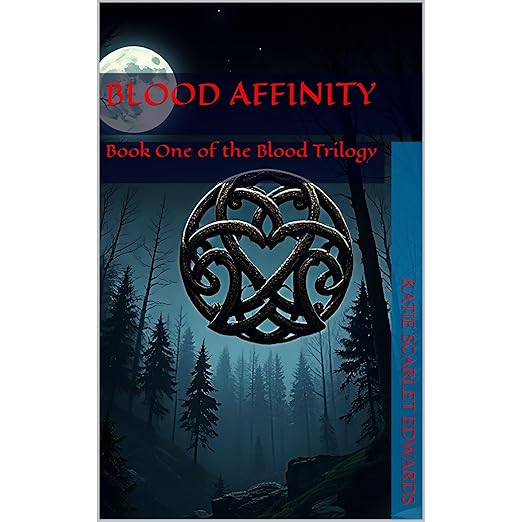
In Brief
- Voice: Virtual Voice handles the plot mechanics cleanly but struggles with the vocal warmth and tension this paranormal romance genuinely needs.
- Big ideas: forbidden attraction, hidden supernatural identity, choosing danger over a safe predictable life
- Atmosphere: Slow-building and atmospheric, small-town grounded before turning genuinely dangerous
- Worth it?: A trope-forward start to a new trilogy, best for listeners willing to try AI narration for the story itself.
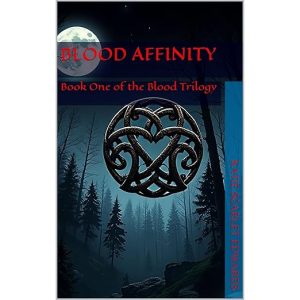
Would Catriona Sullivan have poured Jace McFadden a single drink if she had known what one wedding-night encounter would cost her? That question sits at the center of Blood Affinity, Katie Scarlet Edwards' opening volume in the Blood Trilogy, and this audiobook spends its first act letting a rural Pennsylvania bartender's ordinary life collide with something she has no framework for understanding. Catriona is in her mid-thirties, a perpetual college student content with a quiet life alongside her gay best friend, and Edwards uses that groundedness deliberately: the further Catriona gets from ordinary, the more the listener feels the pull.
Jace arrives at that wedding gig charismatic and clearly hiding something, and what unfolds afterward, described in the synopsis as forbidden truths, ancient powers, and dangerous consequences, follows a shape paranormal romance listeners will recognize while still finding room for its own specific texture: a heroine who has to choose between a familiar, predictable life and a claim on her that reshapes what she thought she knew about herself.
Where This One Lands
An Amazon Customer review calls this 'a new author amazing read,' adding they finished the book in two days and 'could not put it down.' That kind of momentum is exactly what Edwards seems to be chasing in the opening chapters, where the mystery around Jace unfolds in small, deliberate reveals rather than one large exposition dump. A second reviewer, nicola morley, praised the 'great main characters' and confirmed the book ends without a cliffhanger, useful reassurance for listeners who want a complete emotional arc even inside a trilogy's opening volume.
Not every reaction was uniformly glowing on pacing. Reviewer robin feeback noted the story 'started slow' before finding its footing, a fair characterization of a book that spends real time establishing Catriona's ordinary life before the supernatural elements take hold. Patience in the first act pays off for listeners willing to give the setup room to breathe, but anyone hoping for immediate paranormal action from minute one should recalibrate.
Edwards writing as a debut novelist is worth flagging directly, since first-time authors in paranormal romance often lean harder on trope fidelity to orient readers before taking creative risks, and Blood Affinity mostly follows that pattern. The wedding-gig meet-cute, the secretive love interest, the reluctant heroine, these are all familiar entry points, and the book's real ambition shows more in execution and voice than in structural surprise. That is a reasonable trade-off for a series opener whose primary job is convincing readers to commit to two more books.
Catriona's own description as a perpetual college student in her mid-thirties is a small but telling character detail, suggesting someone who has resisted settling into a fixed identity long before Jace ever arrives, which retroactively makes her openness to a life-altering change feel more earned than a more conventionally settled heroine's would.
What Makes Blood Affinity Worth Hearing
The trope work here is confident: a mysterious stranger with a dangerous secret, a heroine anchored by real friendship rather than isolation, and a slow escalation from attraction to full supernatural entanglement. Setting the story in rural Pennsylvania rather than a more familiar urban-fantasy backdrop gives Blood Affinity a grounded, small-town texture that contrasts nicely against the ancient-powers plot machinery once it kicks in.
Catriona's friendship with her best friend gives the book an emotional anchor outside the romance itself, and reviewers responded to the character work specifically rather than just the premise. For listeners newly starting a trilogy, that kind of early character investment matters, since it is what carries them through two more volumes once the central romantic mystery around Jace resolves in this one.
The choice to open the supernatural reveal at a wedding carries its own genre logic worth noting: weddings are already emotionally heightened, public, ritual-bound events, and using one as the entry point into a hidden supernatural world lets Edwards escalate stakes without needing an elaborate new setting. It is a smart structural shortcut for a debut trying to get readers invested quickly.
What Gives Us Pause
Blood Affinity is narrated by Virtual Voice, Amazon's AI narration system, and that is the single biggest consideration for anyone deciding how to experience this book. Paranormal romance depends heavily on vocal warmth and intimacy: the listener needs to feel Catriona's growing desire, her fear, and the danger radiating off Jace, and synthetic narration struggles precisely with that kind of emotional modulation. The plot mechanics survive the format. The genre's core pleasure, the slow-burn tension between attraction and threat, is harder to fully land without a human voice shaping it.
Worth flagging too: only six ratings currently sit on this title, and Virtual Voice titles tend to accumulate reviews more slowly than traditionally narrated ones, in part because the format itself gives some romance listeners pause before committing. If vocal performance matters more to your enjoyment than plot alone, consider sampling the audio before committing to the full trilogy, or reading the ebook instead.
Dialogue-heavy scenes are where Virtual Voice narration shows its limits most clearly. Paranormal romance leans on charged exchanges, verbal sparring between Catriona and Jace that is supposed to carry both tension and chemistry, and synthetic narration tends to deliver those lines with flat, even pacing regardless of subtext. Listeners especially invested in banter-driven romantic tension should weigh that limitation carefully before choosing audio over text.
Who Should Listen to Blood Affinity
Listen if you enjoy small-town-meets-supernatural romance with a slow-building mystery man premise, and if you are comfortable trying AI narration for the sake of getting into a new trilogy early. Listen if a resolved first volume, no cliffhanger, matters to you before committing to books two and three.
Skip the audio, at least for now, if synthetic narration is a dealbreaker for romance specifically, a genre where vocal performance often carries as much emotional weight as the writing itself. Listeners in that camp may prefer the print or ebook edition until, or if, Blood Affinity gets a human-narrated release.
The Blood Trilogy format itself is a commitment worth acknowledging upfront: listeners satisfied by this opening volume are implicitly signing up for a three-book arc before the central mystery around Jace's true nature and the ancient powers referenced in the synopsis fully resolves. That is standard for the genre, but worth stating plainly for anyone assuming paranormal romance trilogies wrap up faster than epic fantasy ones typically do, since the underlying worldbuilding here is clearly built for the long haul.
Does Virtual Voice narration work for a paranormal romance audiobook like Blood Affinity?
It handles the plot competently but struggles with the vocal intimacy and tension paranormal romance depends on. Listeners who prioritize narration performance may prefer the ebook until a human-narrated edition exists.
Does the Blood Affinity audiobook end on a cliffhanger?
No. A reviewer specifically confirmed the first book resolves without a cliffhanger, even though it sets up the rest of the Blood Trilogy.