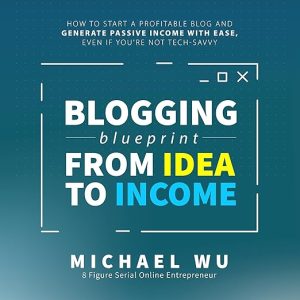
Blogging Blueprint from Idea to Income arrives as an audiobook at a moment when the conversation around blogging as income has split sharply between cynicism and overclaiming. Michael Wu's approach lands closer to the pragmatic middle: this is a structured, step-by-step guide for people who want to start or revive a blog with real monetization intent but who haven't found a clear entry point into the process. At 3 hours and 49 minutes, it doesn't have the luxury of extended philosophical detours, and it doesn't take them. What it does is cover the arc from niche selection to scaled income with the clarity of someone who has worked through this process and is now describing it in sequence.
Robin C Used This to Revive a Dormant Blog
Wu's organizational logic is to take the aspiring blogger from niche selection through to scaled monetization, and the chapters move through that arc with reasonable linearity. The four-step niche identification formula, the 30-minute blog setup process for the technically inexperienced, the six tactics for improving content visibility, the four-step monetization approach, and the advanced income strategies are all present and explained with enough specificity to be actionable. Reviewer Robin C, who returned to a dormant blog using this guide, noted that it works for both new and returning bloggers - and the returning-blogger angle is actually underserved in most blogging resources, which tend to assume a completely blank starting point and offer little for people who started, stalled, and want to begin again with better strategy.
Reviewer Coleen, who works in content development and found the book somewhat basic for her level of experience, made an observation worth using as a frame: for someone with existing knowledge of content creation fundamentals, this reads as a well-organized introduction rather than a source of novel insights. That's accurate. Blogging Blueprint is an entry-level guide, and it serves that function with clarity. The question for any prospective listener is whether the book's entry level matches their own. If it does, the 3-hour-49-minute runtime delivers a complete foundational curriculum. If it doesn't, the book will feel like revision rather than learning.
The niche selection methodology is one of the sections that distinguishes this guide from purely technical blogging tutorials. Wu's argument that most new bloggers fail not because of technical inadequacy but because they choose niches that are either too broad or lack viable monetization paths is well-made and practically framed. The four-step niche-identification formula is presented as a diagnostic rather than a prescription, which makes it more transferable across different people's interests and circumstances than a more directive approach would be.
Gallagher Sounds Like Explaining Rather Than Reading Copy
Nick Gallagher's narration matches Wu's conversational writing register cleanly. The audiobook sounds like someone explaining a process they understand well rather than reading marketing copy, which is a meaningful distinction for instructional content where the listener's trust in the clarity of what they're hearing matters for whether they actually apply it. At under four hours, it's a natural fit for a long drive or a focused afternoon where you want to get grounded on the blogging fundamentals before moving into implementation.
The case for audio over print for this kind of content is partly one of accessibility and activation. Listener Robin C described finding the book at the right moment of wanting to restart something dormant - someone in that state is often better served by hearing an encouraging, structured voice than by parsing pages of the same information. The audiobook version respects that and moves with enough pace to feel generative rather than dry. The spoken delivery of the step-by-step processes makes the sequence feel like something you can actually do rather than a list of things you should theoretically do.
Promotional Language Runs a Little Hot Here
The book covers a wide surface area: niche selection, technical setup, content strategy, audience building, monetization, and scaling. Each of these subjects has entire libraries devoted to it, and at under four hours, Wu necessarily treats them at the level of orientation and framework rather than exhaustive instruction. Advanced bloggers or content professionals looking for deep competitive analysis, sophisticated SEO strategy, or detailed treatment of specific monetization channels like affiliate networks or display advertising will find the coverage introductory. The book is honest about being a blueprint rather than a complete manual, and that title should be taken literally.
Some of the promotional language in Wu's framing - the 30-minute miracle, the insiders' monetization secrets - runs a little hot for what the actual content delivers. The strategies themselves are sound and based in standard blogging practice; the marketing presentation around them overclaims slightly. Listeners who arrive expecting proprietary secrets may need to recalibrate their expectations, but those who arrive expecting a clear, organized overview of blogging fundamentals with practical sequencing will not be disappointed by what the audiobook delivers.
Experienced Marketers Recommend This to Someone Else
First-time bloggers and people returning to a dormant blog with renewed commercial intent will find this audiobook a well-organized starting point that reduces the overwhelm of facing a completely open field of options. The accessible technical framing is genuinely useful for listeners who find the technical side of blog setup intimidating, and the monetization sequencing gives an early-stage blogger a reasonable roadmap through what can otherwise feel like an unnavigable space of contradictory advice.
Experienced content creators and digital marketers who already operate in this space are likely to find the material familiar ground. For them, the audiobook might serve better as a recommendation for someone in their orbit who is just getting started, or as a quick refresher on how to explain blogging fundamentals to a less experienced colleague, rather than as new professional development for themselves. The book knows its audience and serves that audience well; the question is whether you're in it.
- Voice: Nick Gallagher delivers a clean, approachable read that matches the book's conversational tone without overselling the material's enthusiasm.
- Big ideas: Blog monetization, niche selection, passive income strategy
- Atmosphere: Energetic and instructional, best consumed with a notepad nearby
- Worth it?: A practical entry-level blueprint for aspiring bloggers that delivers solid foundational guidance without claiming to reinvent what is now a well-traveled subject.
Before You Listen
Is this audiobook aimed at complete beginners, or does it assume some existing blogging experience?
The book is explicitly designed for people with no existing blog or with a blog that never gained traction. Wu assumes no technical background and explains setup processes in step-by-step terms. Listeners with existing content creation experience will find the fundamentals familiar, but the book is most directly useful as a starting framework for people in the early stages of figuring out what kind of blog they want to build and how to make it financially viable.
Does this audiobook cover technical blog setup in enough detail to follow without a companion print resource?
Wu's approach to the technical setup is deliberately simplified, describing the 30-minute blog launch process at a conceptual level that makes sense in audio. The core principles of platform selection, theme setup, and plugin basics are covered accessibly. That said, step-by-step platform instructions benefit from visual reference, and some listeners will want to have a screen in front of them when applying what they've heard rather than relying on audio recall alone.
At under four hours, does this audiobook cover enough depth to actually help get a blog profitable?
It provides a framework and a starting roadmap rather than a complete operational guide. The audiobook is designed to get you moving in the right direction and thinking correctly about the sequence of steps, not to be the only resource you ever consult. Most listeners who have used it successfully treat it as an orientation and then go deeper on specific topics - SEO, specific monetization channels, content planning - through more targeted resources.