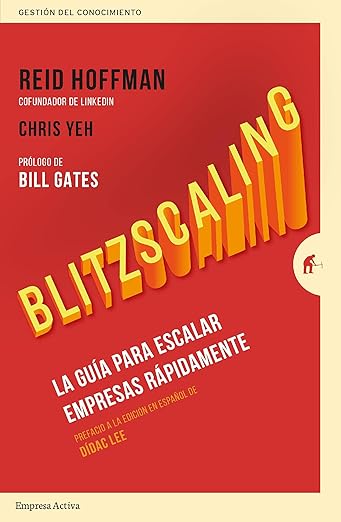
A note before the review proper: this edition of Blitzscaling is the Spanish-language version, published as a translation and narrated in Spanish. All reviews present are in Spanish. AudiobookDaily reviews in English for our international audience, so what follows draws on the English-language content of the book, which is widely available, and frames the material for listeners considering this specific Spanish edition. If you are looking for the English audiobook, verify the language setting on the product page before purchasing.
Blitzscaling, in any language, is one of the genuinely consequential business books of the past decade. Reid Hoffman, co-founder of PayPal and LinkedIn, partner at Greylock, wrote it with Chris Yeh to codify something that had been practiced by Silicon Valley's most successful companies but never fully articulated as a teachable strategy. The central argument is counterintuitive enough to be worth taking seriously: sometimes the correct move for a company is to grow faster than it can efficiently manage, accepting operational chaos and financial risk in exchange for market dominance that competitors cannot later undo.
What We Made of It
The framework is built around a specific set of conditions: large addressable market, the ability to achieve distribution at scale, a business model that improves as it grows, and a competitive environment where being second means being irrelevant. Hoffman illustrates each condition with case studies drawn from companies he knows from the inside, Airbnb, LinkedIn, Dropbox, PayPal, which gives the analysis a specificity that theoretical business writing cannot achieve. One Spanish reviewer described it as the book where they took the most notes by far, which is the response of someone engaging with material that consistently generates applicable insight rather than generic advice.
The book's most important contribution is its honesty about what blitzscaling actually requires. Hoffman does not present hypergrowth as universally correct or risk-free. He is explicit that this strategy destroys companies when applied in the wrong conditions, when the market is not large enough, when the model does not generate network effects, when the organization is not built to absorb the strain of scaling faster than its systems can handle. That intellectual honesty is what separates Blitzscaling from motivational startup rhetoric.
Why Listen to Blitzscaling
Chris Yeh narrates the Spanish edition with the authority of someone who co-wrote the book and has lived its principles through direct involvement with multiple scaling ventures. There is no interpretive gap between the narrator and the material, Yeh is not performing expertise, he is transmitting it. For dense strategic content that rewards close attention, that narrator-material alignment matters. The nine-hour runtime covers a substantial amount of ground, and the density is real, one reviewer noted it as long but intensely informative and worth multiple readings.
For Spanish-speaking entrepreneurs and business leaders, this edition eliminates the cognitive overhead of engaging with complex strategic frameworks in a second language, which is not a trivial advantage. The translation has been described by reviewers as natural and well-executed, maintaining the accessibility that makes the English edition readable by non-specialist audiences.
What Might Not Land
The second half of the book, which organizes eighteen different strategic approaches to scaling, is the section that generates the most reader notes and the most direct applicability. That section requires more active engagement than passive listening, listeners who commute with this book may want to return to the strategic playbook sections in a context where they can take notes or pause for reflection.
The case studies are heavily weighted toward US-based technology companies, and the regulatory, market structure, and cultural assumptions embedded in those examples do not always transfer cleanly to other markets. Entrepreneurs operating in highly regulated industries, non-networked businesses, or markets with different competitive dynamics will need to apply the principles with significant adaptation rather than direct translation. Hoffman acknowledges some of these limitations, but they are worth holding in mind throughout.
Who Should Listen to Blitzscaling
Founders and executives who are in or approaching a hypergrowth phase, investors who want to evaluate whether a company is positioned to blitzscale, and anyone trying to understand how the dominant technology companies of the past two decades built their market positions will find this essential. Those running traditional businesses in stable, competitive markets will find much that is interesting but less that is directly applicable. The Spanish edition specifically serves listeners who process complex business strategy most effectively in their primary language.