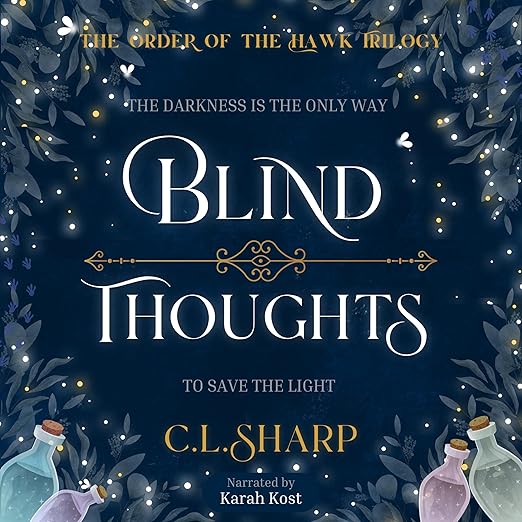
I started Blind Thoughts on a gray February afternoon, the kind of day that suits urban fantasy, rain on the window, a city existing just outside the frame of the story. C.L. Sharp sets this debut trilogy in the Massachusetts Community, where the Order of the Hawk has been waging a war against the Brethren of the Flaming Sword since a time when the witch trials did not end the way history records them. That is a good premise. The idea that the witch trials were real, that something survived them, and that it left an ongoing wound in a community of people trying to live under the nose of modern society, this is the kind of foundation that rewards careful development.
Talliana Hoffman is the protagonist: a young healer whose ordered life, boyfriend on track to become an Elder, mother as her professional model, adopted sister as her anchor, begins to collapse when that boyfriend disappears and she goes looking. What she finds is the true shape of the war her community is fighting, and ultimately the true shape of herself: not the healer she was trained to be, but something much darker. The chosen-one-discovers-her-true-nature arc is familiar territory, but Sharp's magic system gives it enough specificity that the revelation earns its weight.
What C.L. Sharp Delivers
The magic system is genuinely inventive. The Order of the Hawk's abilities center on reading and shielding emotions, members are trained to always shield and control their emotional output, and what Talliana discovers is that embracing her emotions, rather than suppressing them, is the key to unlocking her actual power. This is both a good story mechanic and a coherent thematic throughline. The conflict between suppression and expression maps onto Talliana's personal arc in ways that feel intentional rather than accidental, and Sharp is clearly building toward a trilogy where each book asks more of the protagonist's willingness to feel rather than contain. It is a magic system that rewards readers who pay attention to emotional subtext, which is a rarer design choice than it might sound.
Karah Kost is well-cast for this material. The story is told from a single perspective at a steady pace, which suits audio in particular, there are no jarring POV shifts, no mid-chapter structural experiments. Kost handles Talliana's transformation with consistency, marking the character's shifts without overstating them. The battle sequences get appropriate energy, and the found-family dynamics, Talliana's relationships with her mother, her sister Greer, and eventually the broader Order community, are warm and specific in Kost's reading. The book runs just over nine hours, which feels right for a trilogy opener that is building a world and not just telling a story.
Where C.L. Sharp Loses Some Ground
The content warnings Sharp has included in her author's note are worth taking seriously: explicit language, descriptive sex scenes, violence and mention of torture, death of parents and loved ones in a tragic situation, brief mention of infertility, and characters dealing with anxiety and PTSD. This is a new adult book operating at the upper end of that category's intensity spectrum, and the traumas it engages with are not decorative. Listeners who need lighter fantasy should look elsewhere. The witch trials framing also means the history of persecution and its ongoing consequences runs as a current beneath every community dynamic, this is not a book that treats its dark premise as backdrop.
Should You Listen to Blind Thoughts?
Ideal for new adult urban fantasy readers who want a genuine magic system grounded in emotional intelligence, who enjoy secret society mythology, and who are prepared for content warnings around trauma and violence. Particularly recommended for listeners who responded to the chosen-one-discovers-their-darkness arc in authors like V.E. Schwab or Leigh Bardugo, where the protagonist's greatest power is also their greatest danger. Less suited to listeners who want comfort fantasy, who prefer lighter content warnings, or who need their trilogy openers to be more self-contained.