
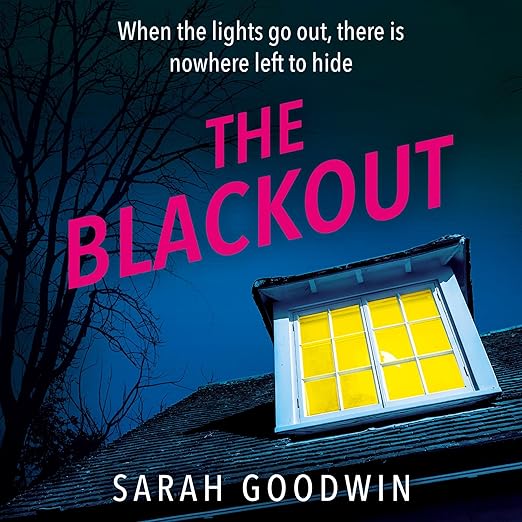
- Voice: Katy Sobey narrates Sarah Goodwin's locked-room psychological thriller with controlled, building tension. Her delivery of the storm sequences and the claustrophobic safehouse scenes is particularly well-suited to the material.
- Big ideas: Trauma and its afterlife, the menace of isolation, locked-room survival under siege
- Atmosphere: Taut and claustrophobic, with accelerating menace
- Worth it?: Sarah Goodwin's storm-and-safehouse thriller delivers a propulsive, high-tension audiobook experience, with Katy Sobey's narration keeping the pressure consistent across the full 7-hour runtime.
Note for buyers: the author field in some editions of this audiobook is listed as Sarah Hepola, but the synopsis and content are Sarah Goodwin's psychological thriller, the fourth book in her Thriller Collection series, and not Hepola's addiction memoir. Verify the edition before purchasing if you are looking for one author or the other. Goodwin's Blackout, narrated by Katy Sobey across 7 hours and 24 minutes, opens on a premise that is both simple and ruthlessly efficient: two women, Meg and Cat, take a dangerous shortcut home one night in summer 2022 and realize they are being followed by two men. They hide in an abandoned building. Fast-forward one year: Meg is attempting to escape the trauma of that night by isolating herself in a safehouse at the edge of a crumbling sea cliff. A storm cuts the power. She is not alone.
The locked-room structure and the dual-timeline framing, the night of the incident in 2022 and the storm night in 2023, is one of Goodwin's signature structural tools. Sobey handles both timelines with enough tonal distinction that transitions between them are clear without being jarring. The 3.8 average rating and the spread of reviewer responses tell a specific story about what this book does and does not do. Reviewer Jackie described it as fast-paced and exciting but found the final chapter disappointing. Reviewer Deborah Baugher described the ending as fascinating and praised Goodwin's signature heroine type: someone who is her own worst enemy but grows on you anyway. These divergent responses are not contradictory. They reflect a real characterization choice Goodwin makes consistently across her Thriller Collection, and Blackout is perhaps the most uncompromising expression of it.
What Sarah Hepola Delivers
Sobey's narration is well-suited to Goodwin's kind of protagonist. She reads Meg with a particular quality, not quite sympathy and not quite judgment, that keeps the ambivalence functional rather than alienating. The sections describing the original 2022 incident have a specific texture of retrospective dread: the kind of narration that knows what is coming and is measuring every detail against that knowledge. The 2023 storm sections are tighter and more kinetic, and Sobey shifts accordingly, shortening her phrasing and pulling the pacing slightly forward in a way that signals the claustrophobic escalation of the present-timeline threat.
The sea cliff safehouse setting is one of Goodwin's better environmental choices. The physical precariousness of the location, a building at risk of collapse during a severe storm at the edge of an eroding cliff, mirrors the psychological precariousness of its protagonist in a way that is economical rather than heavy-handed. The one-star reviewer notes, attributed to a different version or edition entirely, should not be taken as reflective of this production. The reviews from Jackie, Baugher, and the third commenter all engage with Goodwin's Blackout specifically and reflect the genuine range of reader responses to a thriller that makes unusual formal choices.
What Sarah Hepola Gets Right
For listeners who have read earlier books in Goodwin's Thriller Collection, the familiar protagonist archetype, a woman who has survived something that has made her both hyper-vigilant and somehow less equipped to handle the next threat, is developed here with more claustrophobic intensity than previous entries. Sobey's storm sequences are worth noting specifically: she manages the weather as an active narrative element, varying her pacing to let the wind and rain work on the listener's sense of isolation. That is harder to achieve in audio than in text and is done well here.
The three-timeline structure requires active listening in the early chapters to establish which layer the narration has shifted to. Goodwin provides enough anchoring detail at each transition that it is manageable, but the audiobook rewards attention rather than half-listening, because the way events in one timeline reframe what you understood about another is where the book's structural intelligence operates. Sobey's tonal range across the three timelines gives listeners a reliable cue system without making the transitions mechanical.
Where Sarah Hepola Loses Some Ground
Meg's relationship to Cat, the friend from the 2022 incident, is the emotional counterweight to the thriller mechanics. Goodwin uses it to anchor the human stakes of what is otherwise an increasingly formal locked-room problem. Sobey gives their scenes a different register than the threat sequences: warmer, less compressed, and with enough texture to make Meg's isolation in the safehouse feel specifically like loss of connection rather than generically like loneliness. That distinction matters for the book's final quarter, where the resolution depends on the listener caring about what Meg has lost and not merely whether she survives.
The ending divides readers, and it is worth going in knowing that Goodwin chooses an ambiguous close over a conventional thriller resolution. Reviewer Jackie found it disappointing after a strong build; Reviewer Baugher found it fascinating and consistent with the author's style. Sobey reads the final chapter with a restrained delivery that serves the ambiguity rather than trying to resolve it emotionally. Whether that reads as satisfying or unsatisfying will depend almost entirely on what kind of closure the listener needs from a thriller.
Who Should Pick Up Blackout
This works best for listeners who enjoy psychological thrillers with structurally complex timelines and protagonists who are deliberately difficult to read clearly. Readers who found Goodwin's earlier books in the Thriller Collection satisfying will find this a natural continuation with heightened claustrophobic intensity. New listeners can start here without prior knowledge. Those who need sympathetic, straightforward protagonists will find Meg a genuine challenge. Those who actively enjoy unreliable, self-sabotaging narrative voices delivered with real craft will get exactly what they want from Sobey's performance across 7 hours and 24 minutes.
Questions Listeners Ask
Is the Blackout audiobook part of a series, and do you need to listen to the other books first?
Blackout is book 4 in Sarah Goodwin's Thriller Collection, but Goodwin's series books are connected by tone and protagonist archetype rather than continuing characters or plot threads. Listeners can start here without any prior context from the other books in the collection.
Is there a metadata mismatch with this audiobook, and should the author be Sarah Goodwin rather than Sarah Hepola?
Yes. The synopsis and reviewer responses confirm this is Sarah Goodwin's locked-room thriller, not Sarah Hepola's addiction memoir that shares the title. Verify the edition and author carefully before purchasing to ensure you are getting the book you intend.
How does Katy Sobey's narration handle the three-timeline structure in the audiobook?
Sobey uses tonal and pacing shifts to distinguish the 2022 incident timeline, the intervening year, and the 2023 storm night. The transitions are clear enough to follow without extensive re-listening, though the book rewards active attention in the early chapters when the three layers are being established.
Reviewers are split on the ending. What should listeners expect from how Blackout concludes?
The ending is deliberately ambiguous rather than conventionally resolved. Some reviewers found it fascinating and consistent with Goodwin's style; others found it disappointing after a propulsive build. Listeners who prefer clean closure and full explanation should factor this in before starting the audiobook.







