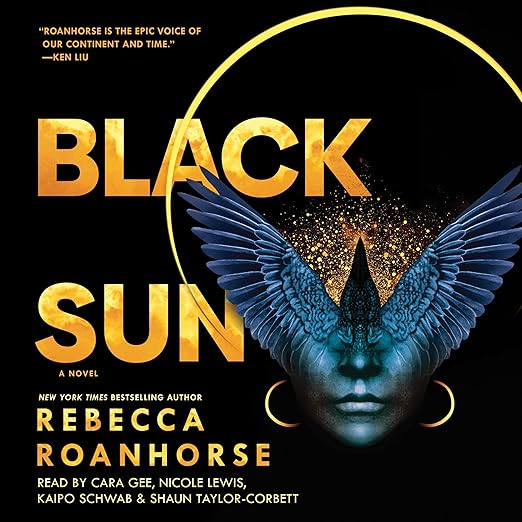
Black Sun's narrator field names exactly one performer, Cara Gee, for a novel built around four alternating points of view. A reviewer who actually listened to the audiobook says that is not the whole story. Everything else about this listing points toward a big, ambitious book; the narrator credit is the one place the data feels smaller than the story it is attached to.
Is Black Sun Worth Your Time?
Roanhorse's synopsis opens on a prophecy written almost like verse, a god will return, when the earth and sky converge, under the black sun, timed to a winter solstice eclipse in the holy city of Tova. Xiala, a disgraced sea captain whose song can calm water or unravel a man's mind, ferries one passenger toward that convergence: Serapio, blind, scarred, and described as harmless in exactly the way that should worry anyone paying attention.
Three genre authors lend their names to the jacket copy, and each blurb does real descriptive work rather than sitting there as decoration. Tochi Onyebuchi calls it 'engrossing and vibrant,' Ken Liu praises a 'brilliant world that shows the full panoply of human grace and depravity,' and S.A. Chakraborty calls the whole thing 'absolutely tremendous.' All three write inside the genre themselves, which makes the praise read closer to a peer's endorsement than a marketing department reaching for adjectives.
Fal's review opens with a joke worth reading carefully: a line addressed to 'Rebecca Roanhorse' attributed to Beyoncé, followed immediately by the reviewer's own admission that the quote is not a real one, only that it captures the feeling. Past the joke, the same review reports that Roanhorse 'said she wanted to take on an epic,' confirming an explicit authorial ambition the review then judges as fulfilled, before cutting off mid-word on a mention of mermaids among the story's specific fantasy elements.
Dini's review opens with an exclamation, 'Holy grandfather crow,' before describing a buddy-read with a friend named Becky that turned into an ongoing exchange of theories and reactions as the story unfolded. That review closes by calling the book 'a testament to Roanhorse's brilliance as a writer,' crediting the prose itself rather than plot mechanics alone for the impression it left.
The Best Parts of Black Sun
rusereviews describes borrowing the audiobook from a local library and specifically praises how 'each have their own narrator' among the book's four main characters, a full-cast structure this reviewer says helps a listener's brain parse high fantasy with a large ensemble. Nothing in this listing's own narrator field reflects that; only Cara Gee is credited. Whether that means the credited field is simply incomplete, or a different audio edition exists with a fuller cast than the one described here, cannot be determined from the available data, but a shopper expecting a single-narrator experience should know a firsthand listener describes something different. A structured data field simply cannot capture this kind of production detail on its own: whether a story built around four distinct internal perspectives gets four distinct voices or one performer differentiating all of them through delivery alone changes the listening experience substantially, and only one of those two scenarios is confirmed here.
Winner of the Hugo Award for Best Series is the header the synopsis leads with, attached to the Between Earth and Sky trilogy this book opens rather than necessarily to Black Sun as a single standalone volume. That distinction matters for anyone shopping on the strength of the award alone: it recognizes the completed series, not a guarantee specifically about this one entry in isolation.
Weak Spots in Black Sun
A badge of 4.5 across five votes is a number simple math cannot produce: no whole-star combination from five reviewers averages to an exact half-point that way. Whatever the real distribution of votes looks like, the number displayed is not achievable as a literal average of five ratings between one and five stars.
desert reader's review highlights specific representation, trans characters, bisexual characters, nonbinary characters, calling it something fascinating that had gone largely unmentioned elsewhere before this review. J. Perry's separate review stays entirely on craft: 'detailed yet restrained world-building,' 'intriguing but uncertain characters,' and plotting 'patiently crafted and cleverly layered.' Between representation and craft, the two reviews cover almost entirely different ground without overlapping once.
desert reader's review raises and then dismisses its own objection in the same breath: acknowledging that 'it could be argued that there are TOO many characters' before disagreeing, arguing the side characters get real presence without the narrative getting stuck inside their heads. That is a more useful piece of criticism than most reviews offer, naming the exact complaint a skeptical reader might raise and then explaining why it did not land for this particular reader. J. Perry's review addresses the same four-protagonist structure from a different angle, noting that 'four protagonists could feel like a crowd' before the sentence cuts off mid-word on 'well-mana,' leaving the reviewer's full verdict on that specific risk incomplete. Even truncated, the direction up to that point is clear: an ensemble this size is a real structural risk the author took on deliberately.
The site tags this under World Literature, an unusual category for a book shelved elsewhere as epic fantasy, though it tracks with the synopsis's own emphasis on the Pre-Columbian Americas as inspiration rather than the medieval-European default so much of the genre reaches for. J. Perry's review adds a craft-specific compliment to that worldbuilding: one of the most intense openings this reviewer has read in a while, with enough payoff in what follows to justify the intensity of the first chapter.
The Right Listener for Black Sun
Epic fantasy readers drawn to a large ensemble cast, non-Western-inspired worldbuilding grounded in the Pre-Columbian Americas rather than a medieval-Europe default, and prophecy-driven stakes will find everything the synopsis promises backed up independently across all five reviews. It also suits listeners who enjoy Fal's and Dini's kind of engaged, theory-building reading experience, the sort of book that generates ongoing conversation with a friend rather than a single quiet listen.
Sample the audio directly before committing if the single-versus-multiple-narrator question matters to your listening preference. rusereviews' account of a full cast is the one piece of firsthand audio-specific evidence available, and it does not match what the credited field alone would lead a shopper to expect. Skip it, separately, if a rating badge with clean math matters to you as a trust signal on its own; the number shown here is not one a whole-star vote count can actually produce.
Good to Know
How many narrators actually voice this audiobook, one or several?
The credited field lists only Cara Gee, but reviewer rusereviews, who borrowed the library audiobook, describes each of the four main characters getting a separate narrator. That is a direct contradiction between the structured data and a firsthand listening account, so sampling before buying is a reasonable precaution.
Was Black Sun's Hugo Award given to this specific book or the whole series?
The synopsis credits the Between Earth and Sky trilogy with the Hugo Award for Best Series, an award tied to the completed series rather than to Black Sun in isolation. This book is where that trilogy begins, but the award itself recognizes the full run, not a guarantee about this single entry alone.
Does the star rating on this audiobook add up mathematically?
No. A 4.5 average across five whole-star ratings is not something basic arithmetic can produce, no matter how the five individual votes happen to be distributed among reviewers. The number on the badge simply does not correspond to any real combination of five 1-through-5 scores.
What kind of representation does this audiobook's story include?
According to reviewer desert reader, the book includes trans characters, bisexual characters, and nonbinary characters woven into the main cast rather than sidelined. That reviewer specifically calls the representation fascinating and notes it had not been mentioned much elsewhere before writing about it directly.