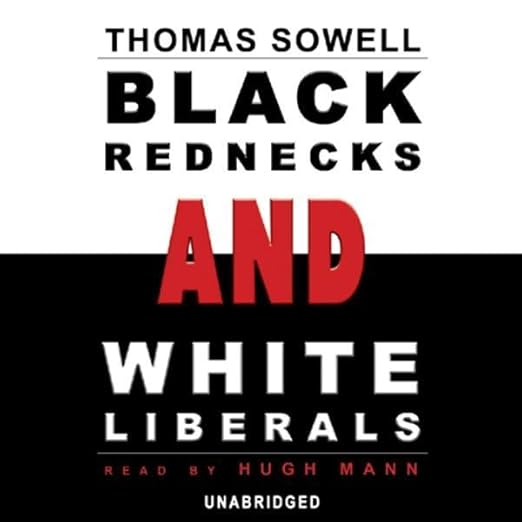
Ghetto culture, Sowell argues across this audiobook, didn't emerge in a vacuum, and he builds the case essay by essay with comparative history spanning blacks, Jews, Germans, and the Nazis who persecuted them. Black Rednecks and White Liberals sets out to challenge long-held assumptions about slavery and education, taking on, in the book's own words, “the trendy intellectuals of our times” alongside historic interpreters of American life. Can a single collection of essays really dismantle decades of received wisdom? Narrator Hugh Mann doesn't editorialize either way, delivering Sowell's dense argument at the unhurried pace of someone who trusts his own footnotes.
A Confrontational Title Built on Documented Facts
The book doesn't undersell itself either, its own description opening with the word “explosive” before diving straight in. Sowell examines the development of what he calls ghetto culture, describing it as a pattern “cheered on toward self-destruction by white liberals” who consider themselves “friends” of blacks, and he backs each claim with, in the book's own phrase, “a startling array of documented facts” rather than leaving the argument to rest on rhetoric alone.
Reviewers consistently point to the comparative scope as the book's biggest strength. One called Sowell's work “magnificently written in a logical and fact-based format.” That same review praised how his survey of German, Jewish, Chinese, and other minority cultures across global history reads as genuinely enlightening rather than narrowly focused on any single group's story.
This didn't arrive as a standalone argument built for one news cycle, and that matters for how it reads decades later. Sowell's method, stacking documented historical fact after documented historical fact rather than leaning on rhetoric, is built to outlast whatever debate happens to be current when a given reader picks it up.
Sowell builds his case through documented history rather than abstraction, which is part of why the book keeps surfacing in contemporary debates well outside academic circles. Essays built on specific, checkable historical claims tend to age differently than purely theoretical arguments, for better or worse depending on how those claims hold up to continued scrutiny.
The book's title alone signals its confrontational approach before the first essay even begins, deliberately pairing two loaded terms to force a specific comparison most readers won't have considered before. That kind of provocation-by-design is a legitimate rhetorical strategy for essays built to overturn assumptions, even for listeners who ultimately disagree with where the argument lands.
Hugh Mann's Measured Delivery Matches Sowell's Evidence
Another reviewer went further, calling it flatly, “This is among the most interesting and enlightening books ever written.” That's a big claim, but it points to something real about the book's ambition: rather than a narrow polemic about one policy dispute, it stands as the capstone of decades of Sowell's research into racial and cultural history, and it reads with that accumulated weight behind it.
Hugh Mann's narration fits the material's own tone well. This is argumentative nonfiction that wants to be judged on its evidence rather than a performance, and a measured, non-editorializing delivery is exactly what lets Sowell's case build essay by essay without a narrator's inflection tipping the scales one way or another.
The comparative structure is really the engine of the whole book: rather than treating any single group's history in isolation, Sowell keeps setting cultures side by side, the same range spanning European persecution, Jewish communities, Chinese immigrants, and freed American slaves, to argue that certain patterns repeat across very different contexts. Whether or not you buy every comparison, the method itself is rigorous and clearly deliberate rather than casually associative.
That same reviewer's account extends the comparative reach further still, into colonialism and warfare's lasting cultural effects on both colonizers and the colonized, suggesting the book's ambitions stretch beyond America's specific racial history into a broader theory about how cultural attitudes get transmitted and absorbed across very different conflicts.
Dense Nonfiction That Rewards Focused Listening
Go in expecting a polemic, not a neutral survey. Sowell has a clear point of view and argues it forcefully across every essay, directly confronting assumptions that plenty of listeners will have taken for granted, and that confrontational stance is very much the point rather than a flaw to be smoothed over.
This particular edition currently shows a comparatively small number of ratings, which is worth noting honestly for a backlist title from an author this well known, though it more likely reflects how recently this specific audio release built its listener base than anything about the content itself.
This is dense, argument-heavy nonfiction, and it rewards focused listening rather than background or half-attention listening during a commute. Sowell builds each case carefully across a long essay, and missing a step in the reasoning partway through means losing the thread of the specific argument being made.
The ideal listening posture for a book like this is open skepticism rather than either uncritical agreement or reflexive dismissal. Sowell isn't asking to be taken on faith, the method here is built on inviting listeners to check his evidence against their own assumptions, and the essays land hardest when a claim is allowed to sit and be tested rather than accepted or rejected purely on how it feels in the moment.
Readers Who Want Their Assumptions Tested
Readers who enjoy rigorous, evidence-heavy argumentative nonfiction, and who want their assumptions tested rather than simply confirmed, are the clear audience here. So are listeners drawn to comparative cultural and economic history that ranges across multiple ethnic groups instead of a single-nation narrative.
One closing thought worth carrying in: this book pairs well with, or invites real debate against, other treatments of the same history, so it rewards listeners who want to engage critically and form their own conclusions rather than take any single author's synthesis as the final word on a subject this contested.
One reviewer's title captures the book's contemporary resonance nicely, describing it as “Enlightening, Intelligent, and Refreshing in a Culture of Political Correctness”. Whatever your own politics, that framing points to why the book keeps finding new readers well past its original publication, entering ongoing debates rather than staying frozen as a historical artifact.
Listeners newer to Sowell's work specifically might reasonably start here rather than with his more narrowly economic titles, since this collection's comparative-history approach offers a wider on-ramp into his general method of argument before narrowing into subjects that assume more background.
Whatever conclusions you draw from any single essay, the sheer range of historical ground covered here means most listeners will come away having learned something genuinely new about at least one of the cultures discussed, even if the book's broader argument doesn't fully convince you by the end.
The Short Version
- Read by: Hugh Mann doesn't editorialize Sowell's argument either way, delivering dense, evidence-heavy essays at an unhurried pace that lets the material speak for itself.
- At its heart: Comparative cultural history, racial and economic policy, challenged assumptions
- Vibe: Rigorous, provocative, and unapologetically argumentative
- Short version: A dense, evidence-driven listen for anyone willing to have long-held assumptions tested rather than confirmed.
Questions Listeners Ask
Is the Black Rednecks and White Liberals audiobook narrated in a neutral tone, or does it feel like a lecture?
Hugh Mann's delivery stays measured and unhurried rather than lecture-like, letting Sowell's essays build their case through evidence rather than vocal emphasis.
Does this audiobook cover more than just American racial history?
Yes. It ranges comparatively across German, Jewish, Chinese, and other cultural histories, using that breadth to build its central argument about ghetto culture's origins.
How does Thomas Sowell support his arguments in this audiobook?
Through a large body of documented historical facts and comparative case studies across cultures, rather than relying primarily on rhetoric or anecdote.
Should I expect Black Rednecks and White Liberals to be a controversial listen?
Likely yes. The book directly challenges widely held assumptions about race, slavery, and education, and its own description calls it explosive, so go in ready for a forceful argument rather than a neutral survey.