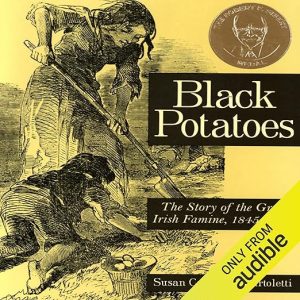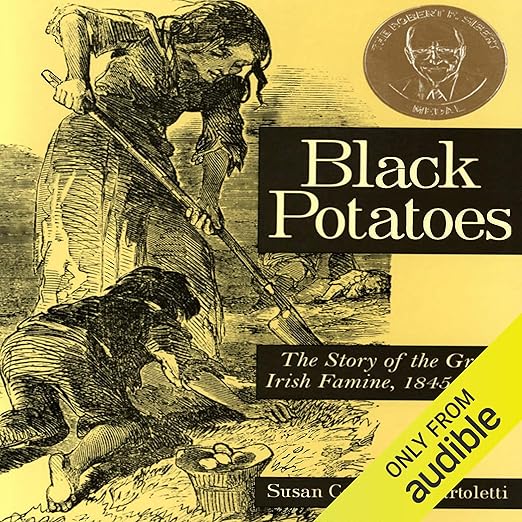
Bartoletti's craft in Black Potatoes is visible from the first chapter: she refuses to let the Great Irish Famine remain statistical. Narrated by Graeme Malcolm and running three hours and thirty-three minutes, this audiobook covers the 1845 blight and its five-year aftermath through the experiences of specific men, women, and children who walked miles each day to reach soup kitchens, searched empty fields for scraps after landlords had cleared the harvest, and committed minor crimes specifically to be imprisoned because prison guaranteed a meal. Susan Campbell Bartoletti's research turns aggregate catastrophe into individual decision-making, and Malcolm's narration holds the appropriate weight throughout without tipping into melodrama or pedagogical remove.
The Great Irish Famine is catastrophic enough by the numbers alone: one million dead from starvation and disease, two million more fled or forced to emigrate over five years. Bartoletti covers both the immediate physical reality of starvation and the political and economic decisions that shaped who survived and who did not. For a book with a middle-grade primary audience, this is notably honest about the systemic dimensions of the famine rather than treating it purely as a natural disaster. Landlord structures, food export policies, and governmental responses are addressed with enough specificity that the audiobook functions as genuine history rather than simplified narrative for younger listeners.
The book's organizing principle is human rather than chronological. Bartoletti follows specific individuals and families through the famine years, tracing how people in different circumstances made the decisions available to them. The families who committed minor crimes to be jailed, the landowners who provided relief and those who did not, the children who survived and the many who did not: these are not illustrative examples but the audiobook's actual subject matter. Reviewer Isabel Gnippitto noted that Bartoletti made an inherently difficult and potentially dry subject impossible to put down, and that quality comes directly from this structural decision. The audiobook does not lecture about the famine; it inhabits it at the level of daily survival and daily choice.
Malcolm Avoids Both Didacticism and Exploitation
Malcolm's narration holds the right tone throughout. The Great Famine is material that, handled wrong, can tip into either didacticism or exploitation, and Malcolm avoids both. His delivery has the weight of historical gravity without the distance of academic remove, and the individual stories land as real human accounts rather than pedagogical illustrations. At three and a half hours, the audiobook is well-sized for a young listener's attention span without sacrificing the complexity of the story it tells.
Reviewer Rosa Bailey described the audiobook as captivating and suitable for preteens and adults alike. Reviewer Elizabeth du Fresne, writing from a family background of Irish descent with inherited knowledge of the famine period, noted that Bartoletti's account added new specificity and context even against that personal history. That cross-audience range is the mark of a well-constructed middle-grade history: precise enough to teach, human enough to feel, and honest enough that adult listeners come away having learned something rather than simply revisited familiar ground. The compact runtime makes it accessible for classroom and homeschool use without the pacing problems that can affect longer juvenile nonfiction in audio format.
People Reduced to Victims of Circumstance
The chapters covering the heroes of the famine, the individuals and communities who found ways to provide relief, resist exploitation, or simply endure with dignity, are where Bartoletti's humanist project is most explicit. She is equally interested in suffering and resilience, and the accounts of specific acts of organizing, maintaining cultural practices under the pressure of survival, and searching fields after official clearance, are among the audiobook's most memorable sections precisely because they restore agency to people who could easily be reduced to victims of circumstance.
The soup kitchen sequences capture something about the dignity and indignity of institutional relief that historical overview tends to flatten. The physical reality of walking miles each day in a state of starvation to receive a single meal is described with the kind of detail that reminds a listener that statistics about famine mortality represent individual human decisions made under conditions of extreme physical deterioration. Bartoletti does not spare the listener from the worst of what happened, but she frames it consistently in terms of what people chose, endured, and lost rather than as spectacle. Malcolm's narration respects that framing throughout and delivers the harder sections without leaning into them.
Heroes Alongside Victims Avoid Pure Helplessness
Middle-grade and high school students studying Irish history, American immigration patterns, or nineteenth-century European history will find this audiobook both accessible and substantive. Teachers and homeschooling parents looking for narrative history that maintains rigorous factual standards while remaining humane and engaging have used it in exactly that context across multiple reviews. Adults with Irish heritage or a general interest in famine history will find the three-and-a-half-hour runtime a focused and rewarding listen. Listeners who want rigorous academic history should supplement with longer scholarly accounts, but for a clear, person-centered introduction to the Great Famine and its human dimensions, this audiobook is as good an entry point as the genre offers and works across a wider age range than its middle-grade classification suggests.
One final quality worth noting for parents considering this audiobook for children: Bartoletti includes the heroes of the famine alongside the victims, which means the audiobook does not leave young listeners in a posture of pure helplessness in the face of historical catastrophe. The people who organized relief, maintained communities, and found ways to protect those around them are named and described with the same specificity as the suffering. That balance is a pedagogical choice with real value.
Before You Listen
Does the Black Potatoes audiobook address the political and economic causes of the famine, or just the human experience?
Bartoletti covers both. The audiobook addresses landlord structures, British governmental responses, and food export policies that shaped the famine's duration and severity alongside the individual human stories. The political dimensions are present throughout rather than confined to background context.
Is Black Potatoes suitable as a classroom audiobook resource for studying Irish history?
Yes, and several reviewers have used it in exactly that context. The book maintains factual rigor while centering individual human experience, making it both pedagogically sound and engaging for students. The three-and-a-half-hour runtime fits comfortably within standard instructional planning, and the coverage of survival, emigration, and systemic failure maps onto standard history curriculum topics.