The Short Version
- Voice: Lewis-Giggetts reads her own essays, which is the only arrangement that preserves their spoken cadence
- Big ideas: Black joy as resilience, inherited trauma, family and ancestry, self-care as practice
- Atmosphere: Warm, testimonial, generous with the reader
- Worth it?: A short, deeply felt essay collection best heard in its author's voice, and badly misfiled as fiction.
Joy as a resource rather than a reward is the argument this audiobook makes, and it makes it in the author's own voice across seven hours and sixteen minutes. Tracey Michae'l Lewis-Giggetts wrote an essay about Black joy for The Washington Post, watched the response confirm something she already knew from her own life, and built a collection out of it. The thesis sits in the description without hedging: Black joy is not only a weapon of resistance, it is a tool for resilience.
Lewis-Giggetts Reads Essays Built to Be Spoken
Form is doing something specific here, and it deserves naming. These are lyrical essays rather than a memoir with chapters, tracing how joy has evolved in one life lived in the midst of trauma. C.W. Reads, at five stars, described the effect in terms that map almost too neatly onto the audio edition: the pieces read like a private journal, like a favorite spoken word artist at a slam competition, like a transcript of a conversation. Two of those three comparisons are about a speaking voice, and the person reading here is the person who wrote the sentences.
That pairing is the strongest reason to prefer this edition. Personal essays written with this much cadence in them lose their timing under a hired performer, and no such distance exists on this recording. The description also positions the collection alongside Black Girls Rock!, You Are Your Best Thing and I Really Needed This Today, and carries an endorsement from Kerry Washington calling it a necessary testimony on the magic and beauty of our capacity to live and love fully and out loud. Those coordinates set the register accurately: affirmational, communal, and entirely unembarrassed about being both.
Proof That Joy Survived Alongside the Grief
The essay-sized structure is well suited to listening. Alisha Smith, at five stars, described the digging as mutual, chapter by chapter: the listener going inward while the author does the same on the page, sharing what she finds. Each piece resolves on its own, so you can leave and come back without losing a thread, and the collection accumulates rather than builds toward a single revelation. That makes it one of the more forgiving long listens available and the kind of book that survives being spread across two weeks of short sessions.
Structure aside, the essays are doing something harder than they advertise. The argument is not that joy cancels grief or that Black life should be narrated only through its pleasures. It is that joy has been present the whole time, alongside everything else, and that recording it is a corrective to a body of writing which treats trauma as the only serious subject. Holding both without letting either one dominate is genuinely difficult, and the essay form is the reason it works here: each piece can sit in one register without the collection committing to it.
What audio adds beyond convenience is proof. A collection arguing that joy is a practice rather than a mood is more persuasive when you can hear it practiced. Kirkus, quoted at length in the description, praised the way the essays chart a path through her ancestors' history and their capacity to seize hold of situational heartbreak and build something better out of it, calling the result gorgeous and heartbreaking at once. That double register is difficult to hold on the page and considerably easier to hold in a voice, which is where this edition has the advantage over the printed one.
Filed as Fiction, Awarded as Instructional
Genre filing is wrong here, and not trivially so. This sits under literature and fiction. What it is, on the same page that files it there, is a collection of personal essays tagged as essays, by an author writing about her own family, which won a nonfiction award. Anyone filtering for fiction will be handed something that is not fiction, and anyone browsing memoir or essay collections will never see it surface. The byline compounds the confusion by printing the author's first name one way while the description writes it another, so the same person appears twice on one page under two spellings.
Worth a second look is the award line itself. The description opens by announcing the NAACP Image Award for Outstanding Literary Work in the Instructional category. That is a strange home for lyrical personal essays, and it suggests the book has been read in more than one register by more than one set of judges. That takes nothing away from it. It does tell you that the practical, use-this-in-your-own-life dimension is pronounced enough that an awards panel filed the collection as something close to a how-to, which is useful calibration before you press play.
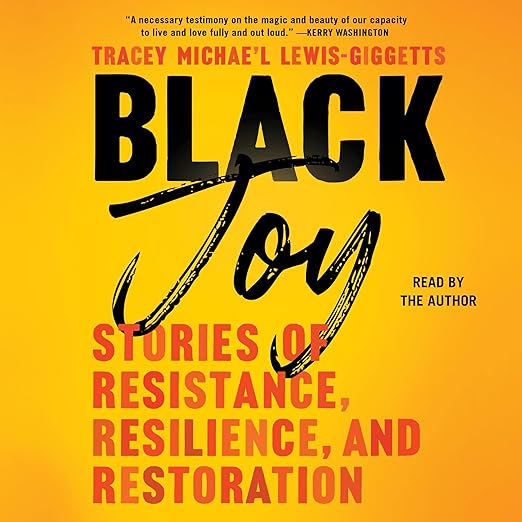
One caution belongs specifically to this format. Tynisha Davis, at five stars, opens by calling the cover gorgeous before moving on to how the first few lines pulled her in. Physical presence is a real part of how this book has been received, and none of it arrives with a recording. Worth noting alongside that: every written response on this page is five stars, sitting above a 4.8 aggregate across 149 ratings, so whatever reservations exist are held entirely by people who did not write a sentence about them.
Testimony for Community, Useful for Caregivers Too
The primary audience is named in the description without euphemism: the author's own community, offered a collection about how joy has survived inside it. NEENEE, at five stars, framed the reading as a process, weighing life's disappointments and struggles against the need to be happy, and finishing with a plan for seeing the world through more joyful eyes. That is a genuine use case and it sits closer to devotional reading than to literary criticism. Anyone approaching the book that way will find it does exactly what it sets out to do.
Beyond that first audience, the collection reaches readers who work with people rather than ideas. Teachers, therapists, ministers and anyone running a room where other lives get discussed will find a vocabulary here for something usually left implicit, and the award panel that filed it as instructional evidently saw the same thing. It is also a natural gift, which the pool bears out: several of the responses read as passed along rather than merely purchased, written by people who had somebody in mind before they reached the end.
The rest of us are welcome without being the target, and the book is honest about the difference. Listeners wanting argument, historical analysis or reportage on the subject should look elsewhere, because the method here is testimony and the evidence is a life. Anyone impatient with affirmation as a mode will find this a long stretch of it, and no amount of craft in the sentences will change what the sentences are for.
Common Questions
Does Tracey Michae'l Lewis-Giggetts narrate the Black Joy audiobook herself?
Yes, and it is the right call for the material. These are personal essays about her own family and her own life, written with a pronounced spoken rhythm that survives far better in a voice than on a page. Hearing them from the author keeps them as testimony rather than turning them into recitation.
Is Black Joy a memoir or an essay collection?
A collection of lyrical personal essays, tagged as essays on its own listing and awarded in a nonfiction category. The pieces draw on one life and one family, so it reads memoir-adjacent, but each essay stands alone rather than building a continuous chronological narrative.
Why is the Black Joy audiobook filed under fiction?
Almost certainly a cataloguing error. The listing simultaneously tags it as essays, the description quotes a starred nonfiction review, and the award announced at the top is for a literary work in an instructional category. Nothing in the material itself is fiction.