Key Details
- Read by: Frank Muller narrates, but several of the five reviews describe the print novel rather than this specific recording.
- At its heart: Parallel worlds, serial murder, a decades-later reckoning with childhood heroism
- Vibe: Dark, sprawling, deeply tied to King's wider universe
- Short version: Rewarding for King completionists who already know The Talisman, disorienting as a cold start.
Two decades after the Territories, this audiobook picks up on Jack Sawyer as a retired Los Angeles homicide detective who has buried every memory of the parallel world he once saved as a boy, right up until a serial killer starts leaving robins' eggs and red feathers at murder scenes in his adopted Wisconsin hometown. The story spends real time in Jack's reluctance before the plot forces his hand, so patience with a slow-building first act pays off once the Territories fully reassert themselves in the back half.
Frank Muller Narrates the Territories' Return
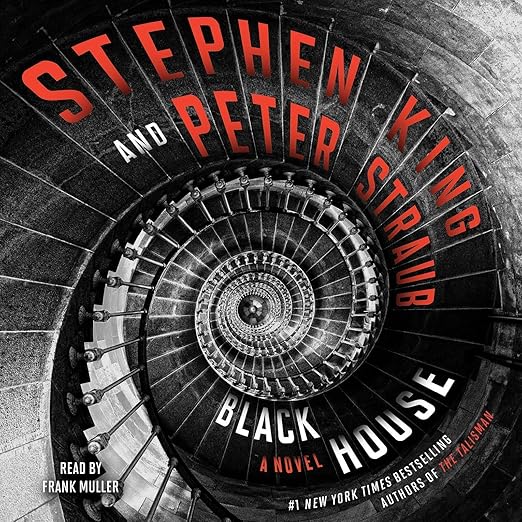
Frank Muller narrates the sequel to The Talisman, and the synopsis opens with an odd flourish: a note that this title won 'the 2020 Audio Publishers Association Lifetime Achievement Award,' without specifying whether that recognition belongs to the narrator, the authors, or the production as a whole. Whatever the award actually covers, the story picks up two decades after Jack Sawyer's childhood trip to the Territories, a parallel world he saved as a boy and has since buried every memory of, now working as a retired Los Angeles homicide detective in the small Wisconsin town of Tamarack. When a string of murders echoing the real historical killer Albert Fish starts turning up robins' eggs and red feathers at each scene, the local police chief pulls Jack back into detective work, and the case pulls him back toward the Territories whether he wants that or not. The Territories themselves carry their own mythology worth knowing before you start: the synopsis describes Jack's original childhood mission as saving his mother and her 'Twinner,' a parallel-world counterpart whose fate was tied to hers, from a death that would have brought 'cataclysm to the other world.' That concept of paired lives across two realities keeps driving events forward once Jack starts having inexplicable waking dreams that pull him back toward the Territories against his will.
An Uncredited Co-Author and Deep Dark Tower Ties
The synopsis credits 'the #1 New York Times bestselling authors of The Talisman' in the plural, though this listing names only Stephen King, leaving the identity of any co-author on the original novel unaddressed here. What the five reviews make clear is how tightly this book connects to King's wider catalog: Jenny's review calls it 'beautiful and horrifying and amazing,' loves getting to see Jack Sawyer 'again as an adult,' and notes the story ties in so heavily with the Dark Tower series that a third book in the loose trilogy feels overdue. Steven D Peters goes further, crediting having read the Dark Tower novels beforehand with making so much of this book click into place that would not otherwise make sense. Tripower53's review names supporting characters the synopsis leaves out entirely, a police chief called Dale and a blind friend called Henry who both pressure Jack into taking the case seriously, small details suggesting the investigation is as much about Jack's return to a community that needs him as it is about catching a killer.
The five ratings behind the 4.6 average must total exactly 23 of a possible 25, two points short of a perfect sweep across five five-star votes, which lines up with the one four-star review in the mix pulling the number down slightly from a clean run of praise.
When Reviewers Describe the Page, Not the Narration
An unusual pattern runs through this particular set of reviews: several of them read like reactions to the print novel rather than to Muller's recording. Tripower53 opens a review by noting '834 pages' and describes re-reading a personal Stephen King novel collection, language that describes a physical book rather than a listening session, and irene tortorelli's five-star review praises a story that 'kept me alert as I browsed each page,' page-browsing being another detail that fits a paperback more naturally than an audio file. Neither review is dishonest about the book's quality, but neither is really evaluating this specific audiobook either, so weigh the star rating with that in mind. ann0314's review adds a useful data point about how the book plays for readers without deep Talisman history fresh in mind: initially hesitant after reading mixed opinions from other readers, the review describes 'having bit the bullet' and ultimately enjoying it despite that hesitation, evidence that the sequel can work even for listeners approaching it cautiously rather than as devoted completionists.
More than one reviewer also frames this as the wrong place to start: ann0314 admits picking up Black House only after being told it was a sequel to The Talisman, read years earlier, and Steven D Peters is explicit that skipping the Dark Tower novels first would have left large parts of the plot confusing. If you want the full effect King and this catalog's connected universe are going for, treat this as a middle chapter in a longer reading project rather than a stand-alone entry point. Worth knowing too if you plan to continue past this book: Jenny's review hopes out loud for a third installment to this 'loose trilogy,' though nothing on this specific listing confirms whether such a continuation exists.
Existing King Readers Get the Real Payoff
This is a strong pick for existing Stephen King readers working through King's connected catalog, especially anyone who already has The Talisman and ideally some of the Dark Tower novels behind them; Steven D Peters describes being down to one SK novel left before finishing King's entire output, which gives you a sense of the completionist energy this book rewards. Horror listeners drawn more to atmosphere and dread than to gore will likely find the Fishman plot line effective on its own, even setting the deeper mythology aside; the historical echo of a real serial killer, Albert Fish, grounds the horror in something uncomfortably close to reality.
Skip it if you are looking for a stand-alone horror or mystery novel with no homework required first; this is very much a sequel that assumes emotional and plot investment built up elsewhere. At least two of the five reviews are describing the print novel rather than Muller's narration, so let those specific opinions carry less weight than the rest of the column.