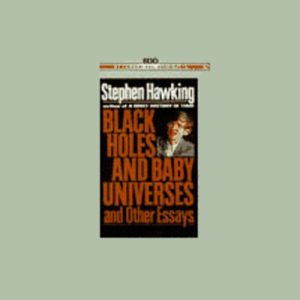
A Brief History of Time made Stephen Hawking a household name well beyond physics departments, and this audiobook collects the essays and one extended interview he produced in the years immediately after that unexpected fame. Despite how this title gets filed in some listings, Black Holes and Baby Universes and Other Essays is not children's content; it's Hawking working at full adult register, mixing genuinely difficult cosmology with personal reflection on his own childhood, his taste in music, and living with ALS. Thirteen essays and change, four and a half hours total, cover a lot of intellectual ground for a fairly compact runtime.
Hawking's 1993 Essays Mislabeled as Kids Content
What distinguishes this collection from Hawking's more famous single-subject books is its range. Reviewer pebbles calls it 'a definite must read' specifically for how it mixes personal and professional material, essays on imaginary time and baby universes budding off black holes sit right alongside reflections on childhood. A second reviewer, Justin Thompson, makes a similar point: the collection lets listeners understand who Hawking was 'outside Cosmology and Theoretical Physics,' touching his taste in music and his experience living with ALS alongside the science most readers already expected from him.
That genre mislabeling is worth addressing directly, since it could genuinely mislead a parent browsing by category. This is a 1993 essay collection written for an adult audience already curious about serious theoretical physics; it assumes a baseline sophistication no picture book or middle-grade science title would. A curious, advanced teenager could absolutely engage with it, but treat that as the exception rather than the intended audience. Whatever tag placed this under children's content got it wrong, and it's worth knowing before queuing it up for a young kid expecting something lighter.
The Closing Interview Shifts Hawking's Register
The collection's closing piece, an extended interview rather than a written essay, changes the register again. It sounds more spontaneous than the polished essays preceding it, closer to hearing Hawking think in real time about a unified theory that would, in his own words, predict everything in the universe. That interview format gives the narration a chance to shift pacing slightly, leaning into a more conversational rhythm than the essay sections call for, which keeps the back half of a fairly short runtime from feeling repetitive.
It's worth situating this collection within Hawking's wider bibliography too. Coming after the phenomenon of A Brief History of Time and before his later, more collaborative work, this sits at a specific transitional moment, a scientist adjusting to unexpected global fame while still producing serious original material. That transitional quality gives the essays a slightly different energy than either his earlier or later work, more self-aware about being read by a mass audience.
Simon Prebble's Unhurried Delivery Suits Hawking's Wit
Simon Prebble narrates, and this is close to ideal casting for Hawking's particular prose style. Prebble brings an intellectual warmth that suits theoretical physics and essay collections specifically, the kind of unhurried, articulate delivery that lets Hawking's own wit land without over-emphasizing the punchlines. Crucially, he handles Hawking's prose on its own terms rather than attempting to mimic the synthesized speech patterns most listeners associate with Hawking's actual voice, a choice that keeps the listening experience from feeling like an impression rather than a reading.
Reviewer brian's take is worth repeating almost verbatim: Hawking's books are written at a level 'that can be understood by those of us without a physics degree,' and the material is 'obtainable and fun.' That accessibility is real, though Hawking achieves it through analogy and plain language rather than by simplifying the underlying concepts; listeners still have to sit with genuinely strange ideas like imaginary time and universe-birthing black holes. Prebble's pacing gives those ideas room to breathe rather than rushing past them toward the next chapter.
The numbers back up the enthusiasm: a 4.6 average across 809 ratings is a genuinely strong showing for a nearly thirty-year-old essay collection, and the pattern among the three attached written reviews, all five stars, all specifically praising the personal-professional blend, suggests the book's appeal has held up better than its most dated scientific claims have.
Prebble's restraint matters even more in the closing interview, where a listener might expect a shift toward a more casual, chatty register; instead he maintains the same careful clarity throughout, treating even Hawking's more off-the-cuff answers with the same respect for precision as the polished essays.
It's also worth noting how well the essay format suits a fragmented listening schedule; unlike a continuous argument that loses coherence if interrupted, each piece here can be picked up cold during a commute without needing to remember where the previous chapter left off, a genuine practical advantage for anyone squeezing physics into a busy day.
Physics That Dates to the Early 1990s
One honest caveat, flagged directly by reviewer pebbles: the newest material here dates to the early 1990s, and physics has moved considerably since then. Listeners expecting Hawking's most current thinking, or expecting this to function as an up-to-date primer on black hole research, should recalibrate; treat this as a snapshot of where the field, and where Hawking's own thinking, stood at a specific moment.
Structurally, this is an essay collection rather than a single sustained argument, which actually suits audio well; each piece runs short enough to work as a standalone listen during a commute or a workout, without requiring the sustained concentration a full-length physics book might demand. Unlike some of Hawking's more diagram-dependent work, these essays lean conversational and reflective rather than equation-heavy, so the audio format doesn't lose much by skipping visual aids the way a more technical text might.
The book also rewards a second listen more than most physics titles might, precisely because of its essay structure; individual pieces on subjects like the arrow of time or the anthropic principle hold up as standalone re-listens once the surrounding collection's context is already familiar, in a way a single continuous argument typically doesn't.
Adult Listeners Who Want Hawking the Person
This suits curious adult listeners who enjoyed A Brief History of Time but want more of Hawking the person alongside Hawking the physicist, plus anyone who prefers essay collections they can dip in and out of over a single continuous argument. At under four and a half hours, it's also a reasonable entry point for someone who wants a taste of serious popular physics without committing to a much longer, denser title.
Skip it if you're specifically looking for children's science content; despite the category listing, nothing here is written or paced for a young audience, and parents browsing by that tag should look elsewhere for read-aloud science material. Listeners wanting Hawking's most current scientific thinking, rather than an early-1990s snapshot, should look toward his later collaborative work instead.
Good to Know
Is this audiobook really appropriate for children despite the childrens category listing?
No. Despite how it's categorized in some listings, this 1993 essay collection is adult popular science and memoir, assuming a level of sophistication no children's title would. A curious, advanced teenager might engage with parts of it, but it wasn't written or paced for a young audience.
Do I need to have read A Brief History of Time before this audiobook?
It helps but isn't required. Hawking builds on ideas from that earlier bestseller, but the essays here are written to stand on their own, and reviewer brian specifically notes the material is understandable 'without a physics degree.'
How technical does this audiobook get, and can a non-physicist follow it?
It stays accessible throughout. Hawking relies on analogy and plain language rather than equations, and narrator Simon Prebble's unhurried pacing gives genuinely strange concepts, like imaginary time, room to land before moving on.
Does the audiobook cover Hawking's personal life, not just physics?
Yes, extensively. Alongside essays on black holes and cosmology, the collection touches his childhood, his taste in music, and his experience living with ALS, which is exactly what reviewers Justin Thompson and pebbles single out as the book's distinguishing strength.