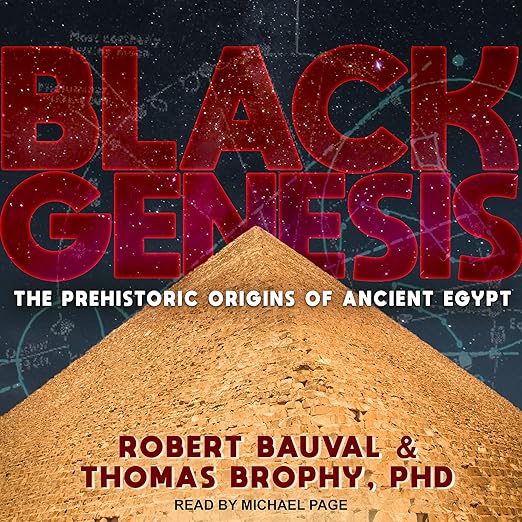
Nabta Playa's megaliths and stone calendar circle give narrator Michael Page a real workload in this audiobook adaptation of Robert Bauval and Thomas Brophy's case for a Black African origin of Egyptian civilization. Page has built a career on long, dense narrations, including the Gentleman Bastard Sequence and the Titanic Trilogy, and Black Genesis tests a different muscle: ten hours and thirteen minutes of archaeoastronomy, hieroglyphic analysis, and climatological data delivered with enough clarity that a listener without a background in Egyptology can still track the argument. Bauval, an Egyptologist, and Brophy, an astrophysicist, build on four decades of research into what they call the Cattle People, an early culture at Gilf Kebir and Gebel Uwainat whose astronomical sophistication predates the pyramids by millennia.
Reframing Egypt's Origin Story as Black African
Bauval's name carries weight in this genre already. He co-wrote The Orion Mystery, the book that put the Giza pyramids' alignment with Orion's belt into mainstream conversation, and Black Genesis extends that same instinct: treat ancient monuments as star charts first, religious symbols second. Here the argument moves south and back in time, from Giza to Nabta Playa, and from the Fourth Dynasty to a culture Bauval and Brophy date thousands of years earlier. The throughline is discipline. Nearly every claim gets tied to a specific piece of archaeoastronomical or genetic evidence rather than left as speculation, and Page's narration matches that discipline by keeping his pace level even through the driest stretches of methodology.
What makes Black Genesis distinct from a typical alternative-history audiobook is its target. The authors are not chasing lost continents; they are arguing for a specific, historically marginalized Black African civilization's role in Egypt's origin story, a claim they present as suppressed by conventional Egyptology rather than simply overlooked. Reviewer Vince frames the book as overdue: indigenous African contributions to Kemet's early culture given the same rigor usually reserved for pharaonic-era scholarship. That framing matters for how a listener should approach the audiobook. This is advocacy built on evidence, and Page never editorializes past what the text gives him, which keeps the delivery credible even when the underlying thesis remains contested among mainstream Egyptologists.
Nabta Playa itself is real and well documented, a genuine archaeological site in Egypt's Nubian Desert that predates Stonehenge and has drawn serious academic study beyond Bauval and Brophy's own work, including published research into its stone alignments' possible astronomical function. That existing scholarly interest in the site gives Black Genesis a foundation that is not purely the authors' own invention, even if the specific conclusions they draw about who built it and why remain their own contested interpretation. Page's narration treats this distinction carefully, never blurring the line between the site's documented physical features and the authors' interpretive argument about their meaning.
Page's Enunciation Keeps the Evidence Distinct
The case for the audio format here is mostly about pacing control. Black Genesis is not a book built for skimming, and a physical copy invites exactly that: flipping ahead to the Nabta Playa chapter, skipping the climatological appendix, treating the argument as a series of standalone claims. Page's narration removes that option and forces the sequential build the authors actually intended, evidence stacked on evidence across ten hours rather than sampled out of order. Reviewer Darrell Davisson describes reading straight through despite noticing typographical errors along the way, a small but telling detail: the material apparently pulls hard enough that proofreading slips did not break the momentum, a reasonable proxy for how absorbing the audio version plays as well.
A genuine craft case for Page exists here too, separate from the argument's own merits. His fantasy work rewards listeners who track a large cast across a long runtime without losing individual voices, and while Black Genesis has no characters to differentiate, it has a comparable problem: dozens of place names, technical terms, and named prior researchers that a lesser narrator could blur together. Page keeps them distinct through consistent, careful enunciation rather than vocal tricks, the right choice for a text that wants to be evaluated on its evidence rather than performed as entertainment.
Where Black Genesis Breaks From Mainstream Egyptology
Reviewer S.T. calls the book's central claim, that Egyptian civilization evolved gradually from an advanced Black culture rather than appearing suddenly, a rewriting of the standard timeline, and that is a fair description of the stakes involved. Listeners should know going in that Black Genesis argues against the mainstream Egyptological consensus, not alongside it, and the audiobook does not soften that positioning. A firm mainstream-versus-fringe binary will color all ten hours here, not just one chapter.
The density is real. This sits closer to a peer-reviewed argument delivered aloud than a breezy popular-history audiobook, and listeners who want story, character, or narrative color will not find much of it here. The genetic, geological, and archaeoastronomical evidence sections in particular ask for sustained attention; this is not driving-with-half-your-brain-elsewhere material, at least not through the middle third.
One structural note worth flagging: the synopsis text supplied with this listing contains a visible typo, rendering 'Black' as 'B;ack' in one sentence, evidently a scanning artifact rather than anything in the audiobook itself. It does not affect the narration or content, but it signals the source metadata for this title has a rough edge, worth knowing in case similar imprecision shows up elsewhere in the listing.
Ten hours and thirteen minutes sits on the longer end for a single-argument archaeology audiobook, more comparable to a multi-part academic course than a typical popular-history single title. Listeners budgeting their queue should expect this to occupy multiple sessions rather than one or two sittings.
Black Genesis also sits inside a longer, larger academic argument about African contributions to ancient Mediterranean civilization, a debate that goes back at least to Martin Bernal's Black Athena in the 1980s and has never fully settled either in mainstream classics departments or in public conversation. Listeners familiar with that wider debate will recognize Black Genesis as one specific, more recent entry into it, focused on Egypt rather than Bernal's broader Greek-influence claims, and framed through archaeoastronomy rather than linguistics or mythology.
Skip It If You Want Settled Consensus
Black Genesis rewards listeners already curious about alternative Egyptology, or at minimum willing to sit with a contested thesis for ten hours without needing the narrator to adjudicate it for them. Fans of Graham Hancock's audiobooks, or of Bauval's own earlier Orion Mystery, will recognize the argumentative shape immediately and will likely find Page's steady delivery a good match for material that wants to be judged on evidence rather than charisma.
Skip this one if you want your ancient-history audio filed as settled consensus, or if ten hours of methodology, geology, and archaeoastronomy sounds like homework rather than entertainment. Black Genesis is a rigorous argument, not a survey course, and listeners hoping for a broad, uncontroversial introduction to ancient Egypt should look elsewhere first.
Frequently Asked Questions
Does this audiobook require a background in Egyptology to follow?
No, though it helps. Bauval and Brophy build their argument methodically, and Michael Page's clear narration tracks each piece of evidence step by step, but listeners with zero prior context should expect unfamiliar terminology in the archaeoastronomy sections.
How does this audiobook compare to Bauval's earlier book The Orion Mystery?
Black Genesis extends the same archaeoastronomical method Bauval used at Giza to an earlier, different site and culture at Nabta Playa, so listeners who enjoyed the earlier book's approach will recognize the throughline immediately.