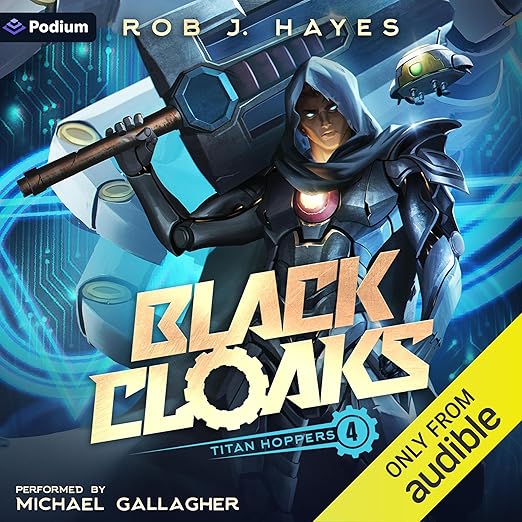
Key Details
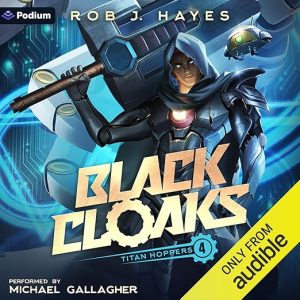
- Narrator: Michael Gallagher has been with the Titan Hoppers series from the beginning, and his familiarity with the characters pays compound interest by book four, the voices are fully inhabited.
- Subjects: Identity and allegiance, the cost of revelation, war as institutional betrayal
- Tone: Escalating and relentless, with the particular weight of a series that has earned its revelations
- Bottom line: Black Cloaks is the entry in the Titan Hoppers series that flips the board, existing loyalties fracture, dead enemies return, and Rob J. Hayes delivers the kind of fourth-book momentum that long fantasy series rarely sustain this cleanly.
I came to Black Cloaks with a specific curiosity: I had heard the Titan Hoppers series described as doing something genuinely interesting with the science-fantasy hybrid, combining the progression fantasy instincts of cultivation fiction with a space-fleet military structure that has more in common with Star Wars than with Cradle. I started with the first book on a Wednesday evening, moved through the second and third across a busy weekend, and arrived at Black Cloaks at the point where a series either justifies all the preceding investment or reveals it as setup without payoff. Book four justifies it, decisively.
Titan Hoppers is Rob J. Hayes's six-book series about two protagonists, Iro, who begins the series as a Corsair recruit, and Emil, who serves in the Home Fleet's Squad Four, navigating a universe built around the TITAN core, a mysterious structure that generates the power systems that everything in this world depends on. By book four, both characters have been fundamentally altered by what they have encountered, and the revelations that Black Cloaks delivers are earned in the specific sense that they recontextualize choices made in earlier books rather than simply announcing new stakes from nowhere.
A Closer Look at Black Cloaks
Hayes has maintained dual narrative threads throughout the series, Iro's story and Emil's story run in parallel, intersecting at specific points but mostly operating in different parts of the world with different sets of immediate stakes. By book four, the structural logic of that split becomes clearer: what Iro discovers in the TITAN core and what Emil encounters on the war's front lines are converging toward a common revelation about the nature of the conflict itself. The question of whether Fleet Command is actually trying to win the war, raised explicitly in the synopsis, is not a narrative trick. It is the kind of institutional betrayal that gives the military elements of the series genuine moral weight rather than just spectacular action.
Michael Gallagher's narration is one of the series' consistent strengths. By book four, he has been living with these characters long enough that the voices are fully differentiated without effort. Iro's growing uncertainty sounds different from Emil's pragmatic determination, and the newly introduced Black Cloaks, including the monsters gathering under golden crowns in the TITAN core's depths, get distinct enough vocal textures to be trackable across fifteen hours of dense world-building and overlapping storylines.
What Makes Black Cloaks Worth Hearing
One reviewer praises the series for balancing mystery with revelation in a realistic manner, keeping enough hidden to create forward momentum while delivering enough payoff to reward investment. Black Cloaks is where that balance tips most decisively toward payoff. Multiple old enemies return in forms that require reassessment of earlier encounters. The identity question at Iro's core, what if he were never a Corsair?, gets movement that changes the interpretive frame of everything he has done across the preceding three books.
That kind of retroactive recontextualization is the highest reward a long series can offer, and Hayes earns it here. The world-building has been accumulating the pieces that Black Cloaks assembles, and the assembly does not feel forced or convenient. It feels like the shape the series was always moving toward, which is exactly what book four of six should feel like if the author has been working from a coherent plan.
Things to Know Before Starting Black Cloaks
At fifteen hours and sixteen minutes, this is the longest book in the series so far, and it uses the runtime purposefully. Hayes is not padding. The Iro sections in the TITAN core are dense with lore and consequence. The Emil sections on the front lines carry the ground-level weight of a war that the people fighting it are not fully informed about. The action sequences, which reviewers describe as dynamic and creative, with character power sets that feel intentional rather than arbitrary, are well-spaced against the revelation-heavy quieter sections that do the structural work the series requires at this stage.
One reviewer describes finishing the book far too quickly, which is a specific kind of reading experience: not that it felt short, but that the pace was compulsive enough that the fifteen hours passed without the usual resistance that long books can produce. That pace is a technical achievement in serialized science-fantasy, a genre where the fourth book is statistically likely to be where a series loses readers who were willing to follow through book three. Black Cloaks bucks that tendency.
The TITAN core sections, which are unique to Iro's narrative, are doing the most complex world-building work in this installment. Hayes is revealing the underlying structure of the universe's power systems while simultaneously raising questions about who built them and why, and those revelations carry implications that will clearly reshape the final two books in ways that cannot be fully anticipated from within the fourth installment. That sense of genuine mystery, that the author knows more than he is currently showing and that the remaining information will matter, is the quality that distinguishes ambitious series fantasy from episodic world-building that never quite resolves.
Who Rob J. Hayes Is Writing For
Listen if you are already in the Titan Hoppers series and have finished the first three books, Black Cloaks will not function as an entry point and is clearly designed for an audience with accumulated investment in both protagonists and their distinct storylines. Also listen if you are a progression fantasy reader who has not yet encountered this series, with the understanding that you will need to start at book one and give the early volumes time to build. Skip if you are series-averse or if fifteen hours of dense world-building with multiple active storylines is more than your current listening bandwidth can support. This is a committed reader's book, and it rewards that commitment with proportional satisfaction.
Questions Listeners Ask
Can Black Cloaks be read as a standalone entry, or is prior series knowledge essential?
Prior series knowledge is essential. This is book four of six in a continuous narrative with no meaningful recap of earlier events. Starting here would mean encountering revelations about characters and world elements whose significance depends entirely on knowing the preceding books.
Is Michael Gallagher the narrator for all six Titan Hoppers books?
Based on the series consistency through book four, yes, Gallagher has remained with the series throughout. Narrator continuity matters significantly in long fantasy series where character voice differentiation accumulates across dozens of hours of listening.
Does Black Cloaks end on a cliffhanger, or does it resolve its major arcs before the next book?
Reviewers describe it as delivering significant payoff on the revelations it promises while clearly setting up the final two books. One reader describes it as a preview of what is to come rather than a hard stop, which suggests it functions as a turning-point volume rather than a conventional cliffhanger.