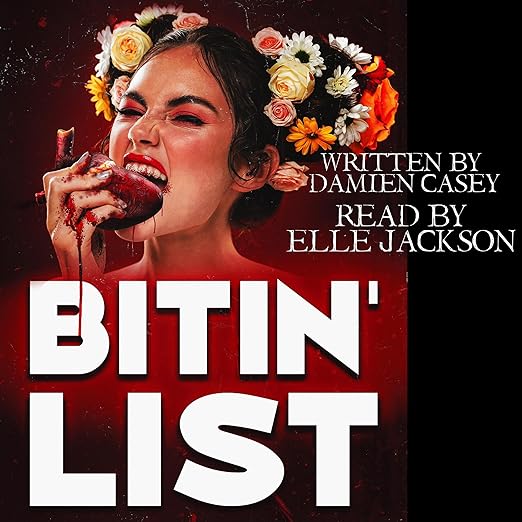
At a Glance
- Read by: Elle Jackson brings an assured, dry energy to this short experimental work, her timing with the comedy is sharp, and she navigates the tonal shifts between satire and genuine menace without losing the thread.
- At its heart: Class and survival, zombie-genre deconstruction, female partnership under pressure
- Vibe: Sharp and sardonic, with a strange undertow of real unease
- Short version: A brief, deliberately rough-edged piece of experimental fiction that knows exactly what it is doing and does it with more skill than its first-draft framing suggests.
Damien Casey's Bitin' List arrives with a disarming, self-aware declaration: this is an experimental novella released as a first draft. That framing does a lot of work. It signals that the roughness is intentional, that the seams are meant to show, and that the conventional polish of a finished commercial audiobook is not what Casey is selling. At one hour and fifty-five minutes, this audiobook does not outstay its welcome, and Elle Jackson's narration makes the unconventional premise feel considerably more grounded than its description might suggest.
The synopsis describes it as one of those post-apocalyptic-man-is-the-real-monster type things - but also not like that at all. That self-contradiction is intentional and accurate. Casey is working in a tradition of genre deconstruction that takes the zombie apocalypse as a lens for contemporary social critique while also genuinely caring about its two protagonists. Two women trying to survive in a world of mindless zombies, crummy people, and classism. Kind of like the year 2025 but a little weirder. The joke lands harder the longer you sit with it.
Jackson Shifts Register Without an Abrupt Turn
The classism angle is where Casey does his most interesting work. Zombie fiction has always been a vehicle for social allegory - from Romero's shopping mall satire through to more recent iterations that use the genre to examine race, gender, or institutional collapse - and Casey uses the survival setting to strip away the social lubricants that normally obscure class dynamics. When civilization falls, who has resources and who does not becomes brutally clear very quickly. Casey's two protagonists navigate that reality with a combination of practical resourcefulness and genuine fury that gives the story more edge than its comedic framing might suggest.
The comedy works because Casey does not mistake grimness for sophistication. The humor is specific and pointed rather than broad genre parody - it emerges from character and situation rather than from winking at the audience about zombie conventions. The two women at the center of the story have a relationship dynamic that feels lived-in rather than constructed for the narrative, which is one of the things the first-draft framing paradoxically gets right. Some of the best character work happens in what feel like improvised moments rather than carefully architected set pieces.
Elle Jackson's narration is a significant asset here. She has a dry, precise comic timing that suits Casey's authorial voice without overplaying the satirical elements. When the story shifts into more genuinely menacing territory - because underneath the sardonic surface, the threat is real and the danger to the protagonists is not played for laughs - Jackson adjusts her register without making the transition feel abrupt. That tonal flexibility is harder to achieve than it sounds, particularly in material that is deliberately straddling comedy and horror.
Two Women Could Sustain a Longer Book
The experimental novella format means that the usual rules of audiobook evaluation apply only partially here. This is not a title to reach for if you want complete narrative closure, a polished prose surface, or a conventionally satisfying structure. It is a title to reach for if you want to hear what a writer sounds like when they are thinking out loud in fiction - following an idea through without the usual safety nets of revision, workshop feedback, and production smoothing.
The female partnership at the center of the story is the real anchor. Casey writes two women who are neither defined by the zombie threat nor reduced to genre stereotypes of the capable survivor. Their dynamic - their arguments, their complementary and occasionally clashing survival instincts, their particular way of reading the social landscape of the post-apocalypse - is what sustains the story's two hours. It would sustain a longer work, which is perhaps the most compelling thing about this as an experimental piece: the characters could carry more.
At under two hours, the audiobook is a low-commitment experiment in unconventional fiction. The first-draft label sets expectations that the content generally meets and occasionally exceeds. Some passages that feel like they belong to an earlier, rougher version of the story and passages that feel like they could survive into any final draft unchanged. The mix is interesting rather than frustrating if you come to it with the right frame.
Structural Looseness Is Part of the Design
The self-described first-draft status is the most important thing to hold in mind while listening. Structural looseness is part of the design, and listeners who expect tight three-act architecture or careful foreshadowing and payoff will find the experience disorienting. The story moves in ways that feel intuitive rather than planned, which is sometimes a strength and occasionally a limitation.
The comedy-horror blend is not always perfectly calibrated. Casey is more consistently strong in the satirical social commentary than in the pure horror elements, and some sequences that probably intend to generate genuine unease land slightly closer to absurdism. That may be a function of the first-draft status, or it may be a deliberate aesthetic choice - it is genuinely difficult to tell, which is its own kind of interesting.
The runtime at one hour and fifty-five minutes means the world-building is necessarily compressed. Casey establishes the social landscape of the post-apocalypse through inference and specific detail rather than through explicit explanation, which works well for the experimental fiction context but may leave listeners who prefer more thorough world-building feeling slightly underserved.
Best Suited to an Experimental Appetite
This audiobook is best suited to listeners with an appetite for experimental and unconventional fiction - people who find value in work that is deliberately unfinished and interested in that state as a creative condition rather than as a failure of polish. Readers who enjoy genre deconstruction, feminist survival narratives, and social satire in the zombie tradition will find the most to engage with here. Elle Jackson's narration makes it worth the brief time investment regardless of where you end up on the content. Those who need conventional narrative structure and a polished prose surface should look elsewhere.