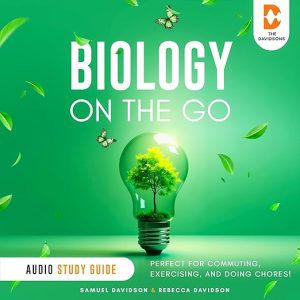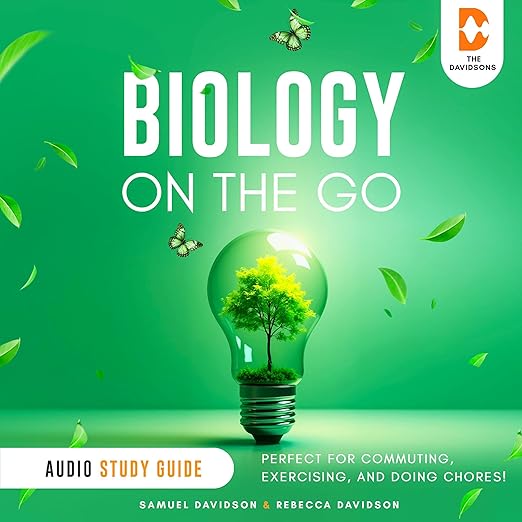
I have a standing theory that the hardest genre to write well is the educational audiobook. Get it wrong and you have a textbook read aloud, which manages to be simultaneously boring and hard to follow. Get it right and you have something that uses the specific affordances of audio to make information genuinely stick in a way that passive reading sometimes does not. Biology On the Go is, for the most part, a successful example of the second category. I spent a week listening to it during morning runs and was consistently surprised by how much material the format managed to convey without making me feel like I was being lectured.
The Davidson Publishing series positions itself explicitly as a companion for movement, and the production reflects that. The narration by Brennan Koenigsreuter is calm and clearly paced, with enough variation in rhythm to prevent the extended runtime from flattening into a drone. At twenty-six hours and seventeen minutes, this is a substantial commitment, covering the full scope of modern biology from chemical foundations through cell biology, genetics, evolution, physiology, ecology, and current biotechnology. The chapter structure is logical, with each section building on what preceded it in a way that makes the sequence feel genuinely considered rather than merely comprehensive.
How Biology On the Go - Audio Study Guide Holds Up
Biology presents specific challenges as an audio subject. The discipline is famously visual: cell diagrams, Punnett squares, food webs, phylogenetic trees. A text that simply describes these structures in words risks creating confusion rather than clarity. The Davidson approach sidesteps this partly through scale and partly through deliberate narrative construction. Rather than attempting to replace the visual with description, the guide builds from first principles in language, using the progression from molecules to cells to tissues to bodies to ecosystems as an organizing framework that can be followed aurally without reference to diagrams.
The synopsis describes this as using the subtle power of energy, frequency, and vibration to make biological concepts resonate and stick, which is marketing language, but it points at something real. The guide uses repetition, verbal analogy, and varied sentence rhythm to reinforce concepts in ways that standard lecture delivery does not. The review questions and audio-explained answers at the end of each section are the most practically valuable feature of the format, providing the kind of active recall that learning research consistently identifies as more effective for long-term retention than passive re-reading or re-listening.
Why Biology On the Go - Audio Study Guide Works as an Audiobook
A companion PDF is available alongside the audio, which matters for a biology guide because some concepts genuinely benefit from visual representation. The audio content is designed to function independently, and for most of the material it does. But for listeners preparing for exams or trying to understand concepts like phospholipid bilayer structure or Mendelian inheritance ratios in detail, having the visual support of the PDF significantly increases comprehension. The guide works best when treated as a true companion format rather than a replacement for all visual study.
The publisher's note that listeners can master biology without opening a textbook is aspirational rather than strictly accurate for anyone in a formal academic context with exams that test diagram interpretation and visual problem-solving. For self-directed learners, curious adults who want a solid understanding of modern biology without a classroom, or students who want to supplement their course reading with audio reinforcement during time that would otherwise go unused, the claim is much more defensible. The series positions itself correctly as an on-the-go companion, and within that framing it delivers what it promises.
Weak Spots in Biology On the Go - Audio Study Guide
Sustaining listener engagement across a twenty-six-hour educational audio is primarily a narration problem, and Koenigsreuter handles it better than most. His voice has a quality of patient attention rather than performative enthusiasm, which is exactly right for a study guide where the listener needs to trust that each piece of information is going to be handled clearly rather than dramatized. The pacing quickens appropriately for descriptive passages and slows for conceptual explanations that require time to process. The review question sections have a slightly different register that signals the shift in mode, which helps orient the listener who has been half-attending while on a run or commute.
The guide is also notably current in its treatment of biotechnology, covering CRISPR, gene expression, and contemporary applications of molecular biology in a way that reflects the December 2025 release date. This matters for a science subject where the textbook you studied from five years ago may already be significantly outdated in its cutting-edge chapters. The audio-first format turns out to be a reasonable solution to the textbook revision problem: a production that can be updated more easily than a printed volume and that positions itself explicitly as a companion to current study rather than a permanent reference. For listeners who want to understand how biology is being practiced and applied right now rather than how it was taught a decade ago, the recency of the content is a genuine advantage.
The Right Listener for Biology On the Go - Audio Study Guide
This free audiobook serves students preparing for AP Biology, pre-med coursework, or standardized science exams who want to maximize otherwise unproductive time. It also serves curious adults who last studied biology decades ago and want a comprehensive refresher that does not require sitting at a desk. The format is genuinely strong for the commute, workout, or household chores context it is designed for. Listeners who need to pass an exam with a significant visual component should treat this as one tool among several rather than their only resource. Those without a specific academic goal will find it a genuinely engaging survey of one of the richest fields in contemporary science.
Key Details
- Performance: Brennan Koenigsreuter's calm, structured delivery suits the study guide format well, keeping twenty-six hours of biological content accessible without becoming soporific.
- What it covers: Life sciences from molecules to ecosystems, audio-native learning, concept retention through sound
- Feel: Methodical and immersive, designed for ambient and active listening alike
- Our call: A well-constructed audio companion for biology students and lifelong learners who want to use commute or exercise time productively, though it works best alongside rather than instead of visual study materials.
Can Biology On the Go fully replace a textbook for someone studying for a biology exam?
Not entirely. The audio handles conceptual understanding and verbal retention very well, but biology exams often test diagram interpretation and visual problem-solving that the audio format cannot replicate. Use it alongside visual study materials for best results.
Is this part of a series, and do the other Davidson On the Go guides cover other sciences at the same depth?
Yes, this is part of the Davidson's Audiobooks: On the Go series. The biology volume is comprehensive at twenty-six hours, suggesting the series approach prioritizes breadth and depth over brevity.