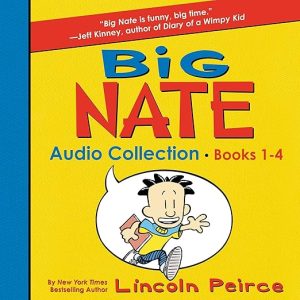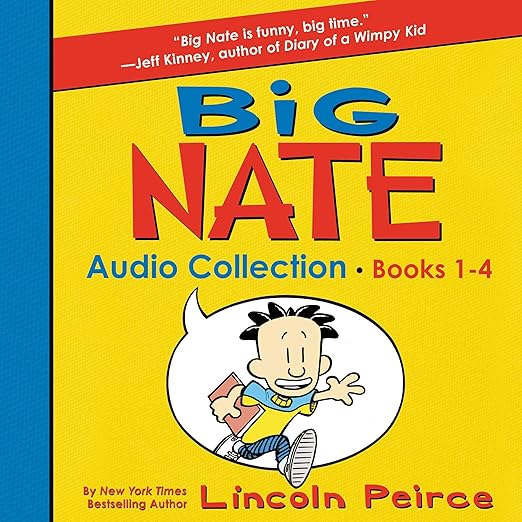
Middle school throws one disaster after another at Big Nate across all four books gathered in this audiobook, starting before he is even out the door for school. Lincoln Peirce's comic-strip energy translates surprisingly well to audio here, bundling In a Class by Himself, Strikes Again, On a Roll, and Goes for Broke into one continuous dose of middle-school chaos. Nate insults his least favorite teacher, the fearsome Mrs. Godfrey, body-slams the principal by accident, and clings to a fortune cookie's promise of future greatness while everything around him falls apart, and somehow the whole thing stays genuinely funny rather than exhausting across all four adventures.
Four Books, Each With Its Own Rivalry
Each of the four books gets its own clear conflict rather than repeating the same joke structure over and over, which is the real achievement of packaging them together. Book two pits Nate against his rival Gina in both a class project and a fleeceball championship at the same time; book three introduces scout-troop rival Artur, dubbed Mr. Perfect, as a new kind of threat to Nate's self-image; book four escalates into the Ultimate Snowdown, a full snow-sculpture rivalry against Jefferson Middle School. Listening to all four back to back reveals a real escalation in stakes, even within a fundamentally episodic, gag-driven structure.
Jeff Kinney, whose own Diary of a Wimpy Kid comparisons are inevitable and openly invited by the synopsis itself, calls Big Nate 'funny, big time!' in his cover blurb. That's an accurate read on the register: broader and more slapstick than Kinney's own series, with Nate's confidence in his own destiny for greatness surviving every single humiliation completely intact.
Setup, Escalation, Punchline, Even in Audio
The physical comedy set pieces work especially well precisely because Peirce, a longtime syndicated cartoonist, structures gags with a strip artist's sense of timing: setup, escalation, punchline, even when translated from visual panels into pure audio narration. That comic-strip DNA is easy to hear in how quickly each disaster resolves into the next one, never lingering long enough on any single humiliation to slow the momentum down.
Jeff Kinney's own endorsement carries particular weight given how frequently the two series get compared; Kinney had every commercial incentive to stay quiet about a direct competitor to Diary of a Wimpy Kid, and his enthusiastic blurb instead suggests genuine respect between two authors working similar territory with meaningfully different comic sensibilities, Kinney's more restrained and diary-format, Peirce's louder and more chaotic.
The series' central joke, Nate's unshakeable confidence despite constant evidence that he should probably dial it back, works because Peirce never lets other characters simply validate him; Mrs. Godfrey, his father, and his friends all push back on his self-mythology regularly, which keeps Nate's confidence funny rather than grating across four consecutive books.
Berman Keeps a Crowded Cafeteria Legible
Fred Berman narrates, and this is well-trodden ground for him; his Big Nate work consistently plays Nate's self-belief as genuine enthusiasm rather than arrogance, which is the single most important choice for keeping a character this boastful likable across four full books. His comic timing is calibrated specifically for Peirce's rapid-fire gag structure, and quieter beats, like Nate's dead-serious faith in a fortune cookie's prophecy, land with the same precision as the bigger physical set pieces.
Across seven hours and seventeen minutes for four full books, Berman sustains distinct, quick supporting-character sketches, Mrs. Godfrey's exasperation, Gina's rivalry, Artur's insufferable perfection, without needing elaborate voice work to keep each one legible. For a collection aimed at kids working through a laugh-heavy, dialogue-dense series, that clarity under a brisk pace matters more than vocal range.
Bundling four books into one continuous audiobook also changes how the series' recurring cast lands; listeners meet Gina, Artur, and Mrs. Godfrey enough times across the collection that their specific quirks start to feel familiar rather than freshly introduced each time, which is a genuine advantage of the bundled format over picking up the books individually and spaced apart.
Berman's pacing through dialogue-heavy classroom and cafeteria scenes specifically keeps the ensemble comedy legible even when several kids are talking over each other on the page; that clarity under a crowded scene is a genuine narration skill easy to take for granted until a lesser performance loses track of who's speaking.
A Starting Point With Plenty Still Ahead
That compact overall runtime moves quickly, which suits the comic-strip pacing but means each individual book gets a fairly compact treatment; listeners expecting the deeper emotional beats of a longer middle-grade novel should recalibrate toward this series' actual register: fast, funny, and episodic rather than slow-building.
Because these are the first four books in an ongoing series with many more entries beyond it, kids who finish this collection and want more should know it's a starting point, not the whole run; parents buying this expecting a complete Big Nate experience should treat it as a strong first taste of a much longer series instead.
One Consistent Nate Across Four Separate Books
Because the original books rely partly on comic-panel-style visual jokes and Nate's own doodles scattered through the print editions, a small amount of visual humor doesn't translate directly to audio; Berman's narration compensates well through vocal timing, but families who loved the books' visual gags specifically may want to keep a print copy nearby as a companion.
Nate's voice stays remarkably consistent across all four books despite them originally being written and published as separate volumes, which speaks well of both Peirce's own writing discipline and Berman's narration holding the character steady across one long recording rather than four disconnected ones.
Because the collection moves fast between all four books' distinct storylines, kids listening over several sittings rather than in one long stretch may occasionally need a quick reminder of which specific rivalry or competition is currently in play; the character names stay consistent enough that this is a minor issue rather than a real barrier.
Mischief-Forward Rather Than Moralizing
This collection is an easy match for the age range parents are already reporting success with, roughly seven through eleven based on the attached reviews, and especially for fans of Diary of a Wimpy Kid looking for a similarly voiced but distinct series. Reluctant readers who respond better to fast pacing and physical comedy than to quieter narrative middle-grade fiction are a particularly strong fit.
Families doing shared car-ride or bedtime listening will find this format especially convenient, since each book breaks naturally into a satisfying chunk without requiring an entire long collection to be finished in one sitting.
Parents hoping for gentle life lessons wrapped in tidy morals should know Big Nate's charm is mischief-forward rather than moralizing; Nate rarely learns a clean lesson by each story's end, he mostly just survives to cause more chaos in the next one, which is either exactly what a reluctant reader needs or a minor mismatch for households wanting more explicit takeaways.
Frequently Asked Questions
How many Big Nate books are included in this audiobook collection?
Four: In a Class by Himself, Strikes Again, On a Roll, and Goes for Broke.
Does Fred Berman voice different characters distinctly in this audiobook, or is it a single flat narration?
He differentiates supporting characters like Mrs. Godfrey, Gina, and Artur with quick, functional vocal choices while keeping Nate's own voice consistent across all four books.