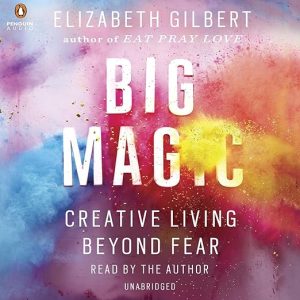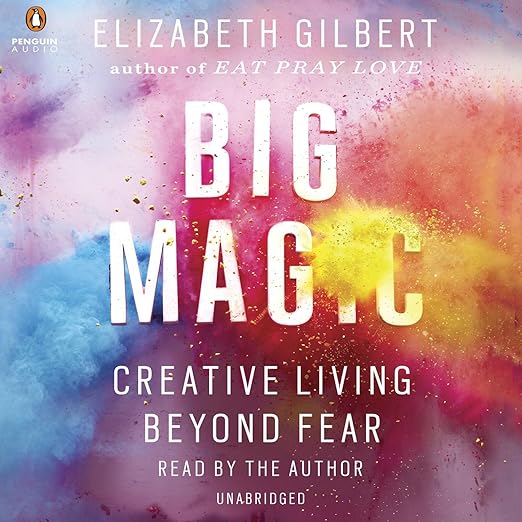
I came to Big Magic a little skeptically. I had read enough creativity self-help to know the genre's pitfalls: vague inspirational slogans, anecdotes dressed up as method, the implicit assumption that everyone secretly wants to be an artist. Elizabeth Gilbert sidesteps most of those traps, though not always gracefully, and the result is something I found genuinely more useful than I expected.
The audiobook is narrated by Gilbert herself, and this matters more than it usually does for author-narrated nonfiction. Her voice carries a quality of someone working through the ideas in real time rather than reading polished copy. At five hours and six minutes, it is a compact listen that functions best absorbed in pieces rather than consumed in one sitting.
Our Take on Big Magic
Gilbert's central argument is that a creative life is not about genius or suffering or the myth of the tortured artist. It is about living with curiosity over fear. She breaks creativity down into five elements, courage, enchantment, permission, persistence, and trust, and moves through each with a blend of personal story and philosophical reflection. The section on ideas as living entities that travel between minds until they find a host willing to act on them will either enchant or irritate you depending on how you feel about mystical metaphor. I found it charming and pointedly not verifiable, which is probably the honest way to describe it. One reviewer framed the book's premise as the relationship between a human being and the mysteries of the universe, and Gilbert leans into that framing deliberately. It grounds the book in a spiritual register that is distinct from the more mechanistic productivity literature crowding the same shelf space. Another reviewer who had been in debt and struggling described Gilbert's ideas as genuinely giving them a new perspective on their own creativity and how they interact with it, which is exactly the effect the book is designed to produce.
Why Listen to Big Magic
The case for the audiobook over the print edition comes down to performance. Gilbert's reading is relaxed and conversational, entirely free of the strained uplift that plagues so many author-read self-help titles. She sounds like she is talking to you directly, not performing for an audience. Reviewers who followed her on YouTube noted they could hear her actual speaking voice and personality coming through the reading. That quality, the sense of a real person rather than a brand voice, is what makes the audio version the preferred format. If you are going to spend time with Gilbert's argument about curiosity and courage, hear it in her own voice. The difference is substantial and worth choosing the audio for specifically.
What to Watch For in Big Magic
The book is not a practical guide in the way that a writing craft manual is practical. Gilbert explicitly resists that framing. There are no worksheets, no schedules, no step-by-step frameworks. What she offers is closer to a permission structure: a sustained argument that you are allowed to make things without a commercial justification, without a guaranteed audience, without suffering first. For some listeners that is exactly what they need to hear. For others who want actionable tools, the book can feel like it dances around the edge of usefulness without quite landing. The mystical framing of ideas as independent beings with their own desires may also grate on listeners who prefer their self-help grounded in cognitive science rather than metaphysics. Know what you are walking into, and you will not be disappointed by it.
Who Should Listen to Big Magic
This is for anyone who has a creative project they keep putting off because they do not feel qualified, talented enough, or sufficiently certain of success. It is also for people who used to make things and stopped. Gilbert's assertion that you are already a creative person, whether you claim the identity or not, is the kind of thing that sounds obvious until you realize you stopped believing it. Skip it if you want concrete technique or a structured approach to creative output. This is philosophy dressed in memoir, not a productivity system.