In Brief
- Voice: Lyle Blaker delivers Bernard Marr's case-study format cleanly, his measured pace well-suited to the analytical nature of the material.
- Big ideas: Real-world data strategy, corporate innovation, predictive analytics
- Atmosphere: Informative and energizing, with a strong practical undercurrent
- Worth it?: A genuinely useful audiobook for anyone who wants to understand how companies translate data ambition into operational results.
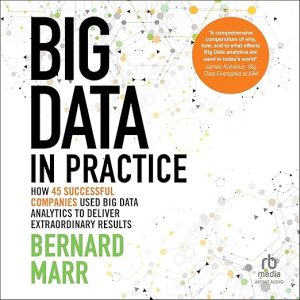
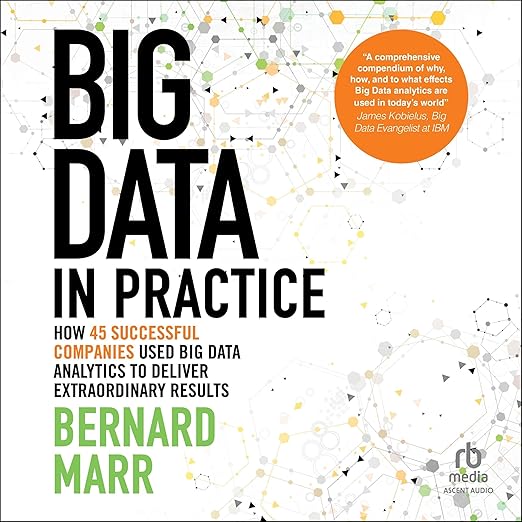
Bernard Marr's Big Data in Practice landed on my radar during a stretch when I was trying to make sense of what "big data" actually means for organizations beyond the buzzword cycle. I had heard the phrase so many times in conference rooms and podcast segments that it had started to feel hollow. This audiobook punctured that hollowness fast. Within the first chapter, Marr moves away from definitional hand-wringing and straight into case studies, which is exactly the right call for this kind of material. The audiobook format, narrated by Lyle Blaker, suited my commute perfectly, and I found myself returning to it over several lunch breaks because the chapter structure made dipping in and out painless.
The book is organized so that each company profile follows the same architecture: what data was collected, what problem it was solving, how the process was built, and what obstacles emerged along the way. That consistency is a genuine strength in audio. You know what is coming, which means you can engage with the substance rather than trying to figure out where you are in the argument. Blaker reads with an unhurried, professional tone that suits this approach well. He is not performing enthusiasm for the material; he is conveying it, which for an information-dense audiobook is exactly the right register.
Case Studies That Show Rather Than Tell
What sets this audiobook apart from the flood of data-adjacent business titles is its commitment to showing rather than telling. Marr does not theorize about what big data could do for hypothetical companies. He documents what Walmart did with supply chain data to reduce waste at scale, how LinkedIn built its recommendation engine on behavioral signals from hundreds of millions of users, and how Netflix moved from reactive content licensing to proactive production decisions rooted in viewing pattern analysis. These are not vague anecdotes. Each profile walks through the actual mechanism, the data type, the analytical approach, and the measurable outcome. For a listener without a data science background, that specificity is exactly what makes the material land.
The breadth of sectors covered is one of the book's strongest arguments for the audio format. Marr moves from retail to healthcare, from law enforcement to professional sport, from hospitality to fashion. Each chapter is self-contained enough that a manager in logistics can engage with a chapter on predictive analytics in manufacturing and immediately start thinking about analogues in their own context. One reviewer described the structure as keeping "even the shortest attention spans focused," which tracks with my experience. The episodic format rewards the kind of partial listening that a busy work week actually permits.
Blaker's Restraint Suits Dense Predictive Analytics
The section on how predictive analytics helps organizations understand customer behavior is particularly strong. Marr unpacks how John Deere uses sensor data from its equipment to predict maintenance needs before failures happen, and how Apple constructs behavioral models from device usage. These examples are not just impressive in isolation; they are instructive because Marr explains the underlying logic rather than simply celebrating the outcome. The same principle applies to his treatment of Microsoft's data-driven product development cycle and the way financial institutions use behavioral data to model fraud risk in real time.
Blaker's narration is workmanlike in the best sense. He does not try to make dry technical content sound like a thriller, and that restraint serves the material. His pacing is measured, his diction clear, and he handles company names and technical terminology without stumbling. For a densely informational audiobook, those qualities matter more than vocal theatrics. The seven-hour runtime goes by faster than you might expect precisely because Blaker's steady delivery makes sustained listening easy rather than fatiguing.
Dated Cloud Details and Skipped Privacy Questions
A few caveats are worth naming honestly. The audiobook was written at a moment when the companies profiled were at a particular stage of their data maturity, and the landscape has shifted considerably since publication. Some of the technical architecture described, particularly around cloud storage and processing pipelines, will feel dated to practitioners working with current tooling. Listeners looking for cutting-edge implementation guidance will need to supplement this with more recent material.
The book also does not go deep on data governance, ethics, or the privacy dimensions of large-scale data collection. For a project of this scope, that absence is notable. If you are a practitioner working in regulated industries or grappling with GDPR compliance, you will need to look elsewhere for that layer of the conversation. What Marr does exceptionally well is the strategic overview. This is a book about why and what, not how and with what tools. The case studies reward that framing entirely. A PDF companion is included with the Audible purchase and is worth downloading for any charts or diagrams referenced in the narration.
Vocabulary for Business Leaders Advocating a Data Initiative
This audiobook earns a recommendation for business leaders, mid-level managers, and curious professionals who want a concrete, case-driven introduction to how data strategy actually functions in large organizations. If you are preparing to advocate for a data initiative inside your company and need a vocabulary for the conversation, this gives you exactly that. If you are a data scientist or engineer looking for technical implementation depth, this is not the right entry point. The PDF companion mentioned in the listing is worth downloading alongside the audio, as some diagrams referenced in the narration are more useful in print form. For its target audience, this is a well-executed entry point into a subject that most people encounter through jargon and rarely through the kind of operational specificity that Marr provides.
Before You Listen
Does the audiobook version of Big Data in Practice work without the PDF companion?
It works well as a standalone listen because the case studies are narrative-driven rather than chart-dependent, but Marr does reference diagrams in certain chapters. Downloading the PDF companion from your Audible library gives you a more complete picture of the data visualizations discussed.
Does this audiobook cover data privacy and ethics concerns around big data collection?
Not in any substantial depth. The book focuses on the strategic and operational dimensions of big data implementation. Listeners who need coverage of GDPR compliance, data governance frameworks, or ethical AI considerations will need to supplement with other titles focused on those specific areas.