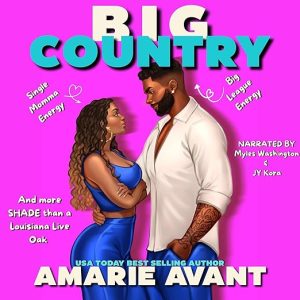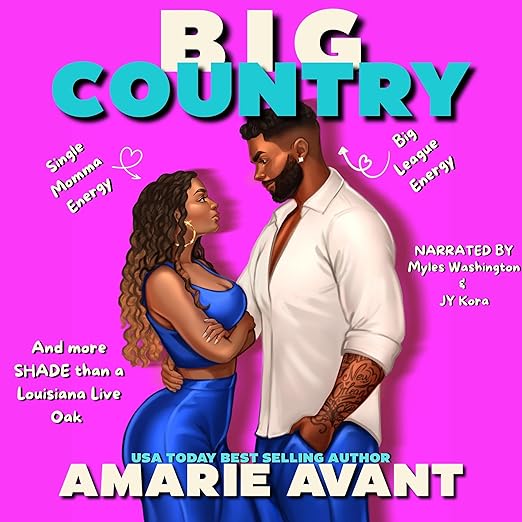
New Orleans does most of the persuading in the responses under this audiobook, and the book seems to know it. Food, carnival, a Creole restaurant, a Diana Ross wig and a leading man billed as the pride of NOLA: the setting is not decoration around the romance, it is half the reason readers keep saying they want to book a flight. Eight hours and eighteen minutes is a generous amount of room to spend in one city.
How Big Country Holds Up
Two first-person voices split the book down the middle. Montana is a World Series winner, six foot four, a national legend facing talk of a suspension, and the only thing that reliably gets him into his own restaurant is a woman he knows as Journey. Zuri is a single mother with locs hidden under a wig, a name she has not given him, and a secret about her son's father she intends to keep. Sports-romance setup, disguise plot, and a comic register that the description flags immediately.
Shauntavia, writing in February 2026, read a pre-release sample and came back to describe the shape of the thing rather than the plot: an awkward first meeting, then the slow dismantling of the protective layers both characters had assembled. That is the actual promise on offer here, and it is worth more to a buyer than a plot summary. Romantic comedies live or die on whether the defenses come down convincingly, and that entry says they do.
The two names deserve a warning, because the description handles them badly. Montana's half calls her Journey and gives no explanation. Her half calls her Zuri and states outright that he does not know her real name. Read in order the device is clear enough; skimmed on a store page it reads like an error, and a buyer scanning a blurb for a heroine's name will come away with the wrong one.
Why Big Country Works as an Audiobook
Place carries the comedy. Mardi Gras, southern hospitality, a restaurant kitchen and a city with a food culture worth arguing about give a romantic comedy somewhere specific to happen, which is rarer in the genre than it should be. The copy promises the book will have you planning a trip, and the column suggests that promise lands: more than one entry spends its space on the city rather than on the couple.
Miss Dragonfly, writing in February 2026, gets specific about the reading itself, and the verdict is a favorable one. The reader is called perfect for the book, and the reason given is specific: a New Orleans twang engaging enough to make that listener want to head south. J. Y. Kora takes the sole credit. For a novel whose comedy runs on regional speech, a reader who can hold that accent through eight hours is not a bonus feature, it is the whole production risk, and one listener at least reports it paying off.
Honesty about the contents is a genuine virtue here. The description closes with a plain list of what the book contains: single mother, protector, opposites attract, found family, meet cute, alpha with a soft spot, healing after trauma, black love, secrets, hidden past. Trade convention or not, that list is a contract. You know before paying whether these are the tropes you want, which is further than most publisher copy goes.
Weak Spots in Big Country
Lauren E graded it three stars in March 2026 and the complaint is craft rather than story: choppy, disjointed writing, passages that required stopping and going back, and things the characters discuss that never get resolved. That last part is a plot objection any reader can weigh. The first part matters more in audio than in print, because going back is exactly what a listener cannot easily do. A confusing paragraph on a page costs ten seconds; the same paragraph in a car costs you the thread.
Attribution on this page wobbles too. Phacez, arriving as a first-time reader of this author, gets the byline slightly wrong and drops a letter from the name. That same entry is among the more useful here, recognizing the carnival material and the language from a Caribbean background rather than a Louisiana one, which is a specific and unexpected endorsement of how the setting is written.
Timing tells you what the column is. All five written responses landed within about five weeks of the February 2026 release, one of them from a reader who had seen the book before it came out, on a record whose publisher field carries the author's own name. That is a launch column on a self-published title, and it should be read as the enthusiasm of an existing readership rather than as five years of accumulated verdicts. The 4.3 across a hundred ratings will move.
Content deserves one flag the comedy pitch does not give it. Healing after trauma, a hidden past and a question the trope list phrases as who hurt you are all advertised alongside the jokes, so the book is carrying real weight underneath the banter. Nothing on the record specifies what that weight consists of, which is worth knowing if you are choosing a light listen rather than a book that goes somewhere darker between the laughs.
The Right Listener for Big Country
Returning readers of this author are the safest bet, and Nicole84, writing in March 2026, is the model: already familiar with the work, delighted by the enemies-to-smooth-sailing arc, and most enthusiastic of all about the food, the culture and the history of a city visited too many times to count. If you have read this author before and liked the register, this is more of it with a ballplayer attached.
Newcomers who want a sports romance with a disguise plot and a strong sense of place will do well, provided a rougher prose finish is acceptable at the price. Anyone who reads primarily for sentences should weigh the three-star craft objection seriously before committing eight hours. Baseball knowledge is not required and barely helps, since the sport is background to a restaurant, a wig and a secret.