
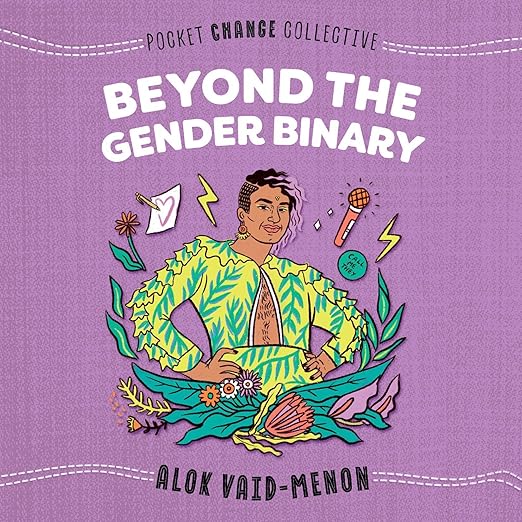
Key Details
- Performance: Alok Vaid-Menon self-narrates in a voice that is at once performative and intimate, exactly the register this short but dense text requires.
- What it covers: gender as creative expression, lived experience of non-conformity, dismantling binary frameworks
- Feel: Compassionate and quietly radical, with a personal urgency that sustains every page
- Our call: A short, dense primer that does more genuine conceptual work in 67 minutes than most full-length cultural theory texts manage in hours.
Sixty-seven minutes. That is how long the Beyond the Gender Binary audiobook runs, and for a text that has prompted Sam Smith to say "when reading this book, all I feel is kindness," and that has generated serious conversations in therapy rooms and classrooms alike, the brevity is both its challenge and its power. Alok Vaid-Menon, poet, artist, and gender non-conforming performance artist, packs a genuinely rigorous conceptual argument into a format that feels simultaneously like a personal essay, a political manifesto, and an act of care.
Published as part of the Pocket Change Collective, a series built around the idea that small books can carry large ideas, this audiobook is best understood as an entry point rather than an endpoint. It is a primer, as the publisher describes it, but primers can be more challenging than the word implies. Vaid-Menon does not condescend. They assume a reader capable of following a sustained argument and responding to lived experience as evidence rather than simply anecdote.
A Closer Look at Beyond the Gender Binary
The self-narration is essential. Vaid-Menon's voice has a quality that reading the text on the page cannot fully replicate: the weight of someone telling you something from inside an experience you may not share. Reviewer Joshua Brainard describes the book as a "tremendous resource for those who consider themselves LGBTQ+ allies or the unsympathetic but curious," and distinguishes usefully between the book's two primary functions. The first half draws on Vaid-Menon's own growing up, the experience of gender expansiveness from early childhood through adulthood, rendered in language that is precise without being clinical. The second addresses the most common objections to non-binary frameworks and responds to them with clarity and without condescension.
That structural move, from testimony to argument, is one of the most effective things the book does. You hear first what it actually feels like to grow up in a body the world keeps misreading, and then you encounter the intellectual framework that explains why that misreading happens and what it costs. The sequence matters. Listeners who encounter the argument before the testimony often find it abstract; listeners who encounter the testimony first find the argument lands in a way that feels both intellectually satisfying and humanly necessary.
What Makes Beyond the Gender Binary Worth Hearing
Reviewer AK Squidsauce describes an initial skepticism, pulling the book out of a box and thinking it was too small to contain anything valuable, followed by surprise at how much was packed into its pages. That arc of expectation and revelation is common among new readers, and the audiobook version heightens it in an interesting way. At just over an hour, it is easy to underestimate before you press play and something close to impossible to dismiss once you do.
For listeners approaching gender theory for the first time, the book's accessibility is genuinely impressive. Vaid-Menon does not assume familiarity with academic frameworks or specialized vocabulary. They build their argument from experience and common sense, and the conclusions they reach feel earned rather than imposed. For listeners who already have fluency in gender studies, the book operates differently: as a model for how to translate difficult ideas into accessible language without losing precision, and as a record of lived experience that theoretical texts often bracket out.
Things to Know Before Starting Beyond the Gender Binary
The book's title suggests a survey of gender beyond male and female, but the text is more specific and more personal than that framing implies. Vaid-Menon is not cataloging all possible gender identities. They are making an argument about what gender actually is, and using their own life as the primary evidence. That focus gives the book a coherence and a depth of feeling that broader surveys often sacrifice for comprehensiveness.
The passages about childhood are the book's most affecting material. Vaid-Menon describes the specific experience of growing up with an inner sense of self that the external world consistently refuses to recognize, and the cost that refusal extracts. These sections are rendered in language that is specific and image-rich rather than abstract, which makes them effective even for listeners who have not shared those experiences. Reviewer Marco notes that the book makes you "understand things in a different way, in a good way," which is a quiet but accurate description of what Vaid-Menon is accomplishing.
The Pocket Change Collective framing, with its emphasis on making ideas accessible to young audiences especially, means the book is also used frequently in high school and college classrooms. The audiobook format is well suited to that educational context. Hearing Vaid-Menon's voice deliver the argument makes the text more immediate and more difficult to hold at an intellectual arm's length, which is pedagogically valuable.
Who Should Pick Up Beyond the Gender Binary
This audiobook is for listeners across a wide spectrum of familiarity with gender theory and LGBTQ+ experience. For those new to non-binary frameworks, it functions as a compassionate and rigorous introduction that respects your intelligence while not assuming prior knowledge. For those already familiar with the landscape, it offers a model of personal argument that has something to teach anyone interested in the relationship between lived experience and conceptual thinking.
It is worth noting that the running time of just over an hour makes this audiobook uniquely accessible. You can return to it multiple times, hearing different elements on each listen as your engagement with the ideas deepens. Listeners expecting a comprehensive survey of gender across cultures and histories will need to supplement with broader texts, but those who want a starting point that is both honest and precise will find this one of the most effective primers available.
Before You Listen
Does Alok Vaid-Menon narrate the Beyond the Gender Binary audiobook themselves?
Yes. Vaid-Menon self-narrates, which is significant for a text this grounded in personal experience. Hearing the argument delivered in their own voice adds an immediacy that recorded reading by another narrator would not replicate.
Is this audiobook appropriate for listeners who are new to gender theory?
Very much so. Vaid-Menon builds the argument from lived experience and accessible language rather than academic jargon. No prior knowledge of gender studies is required. The book is specifically designed as a primer for curious and open-minded listeners at any starting point.







